Researchers at Tohoku University have unraveled the reasons behind the underperformance of a promising field of catalysis known as dual atom catalysts (DACs). Published in the prestigious journal ACS Catalysis on July 10, 2023, their findings shed light on the challenges faced by DACs in converting carbon dioxide (CO2) into valuable multicarbon products.
Credit: Hao Li et al.
Researchers at Tohoku University have unraveled the reasons behind the underperformance of a promising field of catalysis known as dual atom catalysts (DACs). Published in the prestigious journal ACS Catalysis on July 10, 2023, their findings shed light on the challenges faced by DACs in converting carbon dioxide (CO2) into valuable multicarbon products.
Unlike traditional catalysts, metal-nitrogen-carbon (M-N-C) DACs have two isolated atom pairs that work in tandem to produce catalytic mechanisms. DACs could improve the efficiency and sustainability of catalytic processes, something essential for clean energy technologies.
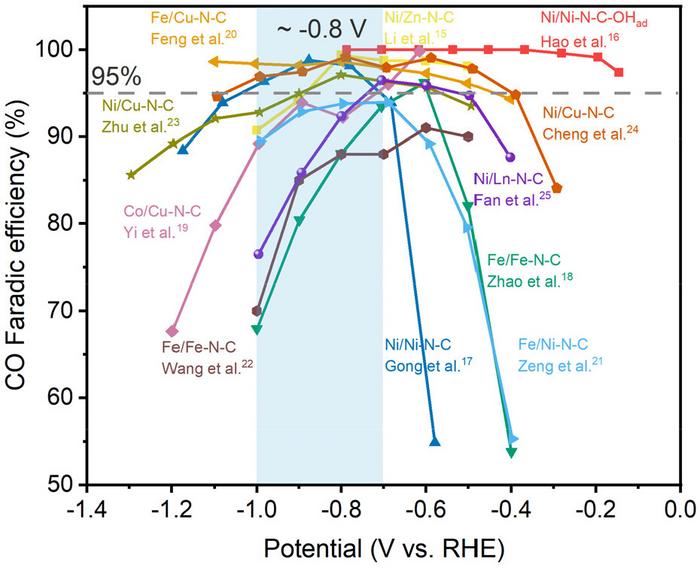
DACs have been touted for their potential to convert CO2 into multicarbon products such as ethanol and ethylene. This is because of the presence of multimetal sites, which should enable carbon atoms to couple together (C-C coupling) easily, thus producing the CO2 reduction reaction (CO2RR). Yet, recent experiments have failed to reach this outcome, showing that almost no DAC could produce a high quantity of multicarbon products.
“Given the large expectations placed on DACs, we wanted to uncover the causes of this failure,” says Hao Li, associate professor at Tohoku University’s Advanced Institute for Materials Research (WPI-AIMR) and corresponding author of the paper. “To do so, we probed the surface states of typical homonuclear and heteronuclear DACs and explored the reaction mechanisms of the CO2RR using advanced theoretical calculations.”
Pourbaix analyses demonstrated that, contrary to the conventional hypothesis that C-C coupling occurs at the surface of the DACs, CO prefers to occupy the bridge site between the two metals, hindering the subsequent C-C coupling. This makes it challenging for the Co2RR reaction to happen both in terms of thermodynamics and kinetics. According to models, DACs preferentially develop CO in the CO2 reaction, which matches what has been observed in experiments.
The researchers also discovered that double-side occupancy, i.e., where two molecules bind or occupy both sides of the carbon layer on the surface of the M-N-C DAC, becomes more favorable if the molecules can pass through a big gap in the carbon layer. This renders the formation of HCOOH more likely in the CO2RR.
Li and his team believe that their study provides essential understanding of the inner catalytic mechanisms of DACs and paves the way for future improvements. “Our analytical framework, which combines surface state analysis, activity modeling, and electronic structure analysis, has revealed why C-C coupling in the CO2RR remains difficult for DACs. Additionally, we have provided key insights into enhancing the catalyst’s performance.”
Further research and development based on these insights could lead to more effective and sustainable solutions for converting CO2 into valuable chemicals and fuels.
Journal
ACS Catalysis
DOI
10.1021/acscatal.3c01768
Article Title
Why Is C-C Coupling in CO2 Reduction Still Difficult on Dual-Atom Electrocatalysts?
Article Publication Date
10-Jul-2023