Researchers investigated the fatigue behavior of 2D hybrid materials, opening doors to their widespread use in real-world applications.
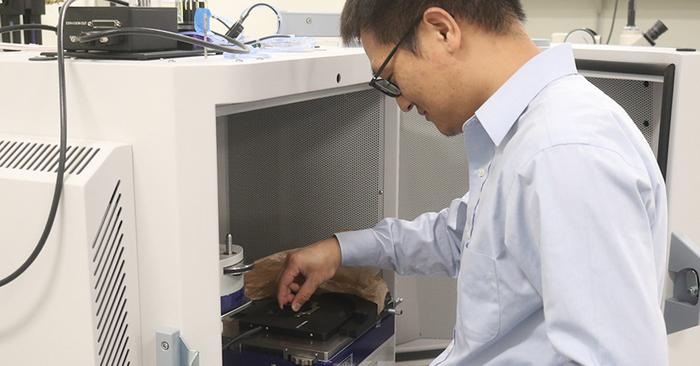
Credit: Texas A&M Engineering
Researchers investigated the fatigue behavior of 2D hybrid materials, opening doors to their widespread use in real-world applications.
New research has unveiled the fatigue resistance of 2D hybrid materials. These materials have long-held promise across semiconductor fields. However, their durability under cyclic loading conditions remained a mystery — until now.
Led by Dr. Qing Tu, professor in the Department of Materials Science and Engineering at Texas A&M University, this is the first study of fatigue behavior on the semiconductor material called 2D hybrid organic-inorganic perovskites (HOIPs) in practical applications.
Researchers recently published their findings in Advanced Sciences.
This new generation of semiconductors holds great potential in nearly the whole spectra of semiconductor applications, including photovoltaics, light-emitting diodes and photosensors, among others. The application of repeated or fluctuating stresses below the material’s strength, known as fatigue loading, often leads to failure in 2D hybrid materials. However, the fatigue properties of these materials have remained elusive despite their widespread use in various applications.
The research group demonstrated how fatigue loading conditions, wearing different components, would affect the lifetime and failure behavior of the new materials. Their results provide indispensable insights into designing and engineering 2D HOIPs and other hybrid organic-inorganic materials for long-term mechanical durability.
“We are focusing on a new generation of low-cost, high-performance semiconductor material with hybrid bonding features. That means within the crystal structure, you have a mixture of organic and inorganic components at molecular level,” Tu said. “The unique bonding nature gives rise to unique properties in these materials, including optoelectronic and mechanical properties.”
Researchers discovered that 2D HOIPs can survive over one billion cycles, much longer than engineering practical application needs (typically on the order of 105 to 106 cycles), which outperforms most polymers under similar loading conditions and suggests that 2D HOIPs are fatigue robust. Tu said further examining the failure morphology of the materials reveals both brittle (similar to other 3D oxide perovskites owing to the ionic bonding in the crystals) and ductile (similar to organic materials like polymer) behaviors depending on the loading conditions.
The recurrent component of the loading conditions can significantly drive the creation and accumulation of defects in these materials, which ultimately leads to mechanical failure. The unexpected plastic deformation, suggested by the ductile behavior, is likely to impede the mechanical failure and be the cause of the long fatigue lifetime. This special failure behavior under cyclic stress is probably due to the hybrid organic-inorganic bonding nature, unlike most conventional materials, which typically exhibit pure inorganic or pure organic bonding.
The team also investigated how each component of the stress and the materials’ thickness affect the fatigue behavior of these materials.
“My group has been continuing working on understanding how the chemistry and environmental stressors, such as temperature, humidity and light illumination, affect the mechanical property for this new family of semiconductor material,” Tu said.
This project was also led by Texas A&M doctoral student Doyun Kim, a student in Tu’s research group. Other collaborators include Dr. Eugenia Vasileiadou and Dr. Mercouri Kanatzidis from Northwestern University; Dr. Ioannis Spanopoulos from the University of South Florida; and Dr. Jinhui Yan and Dr. Xugang Wang from the University of Illinois Urbana-Champaign.
The work at Texas A&M is partially supported by the Haythornthwaite Research Initiation Award that Tu received in 2021 from the American Society of Mechanical Engineers – Applied Mechanics Division and by a recent grant from the National Science Foundation.
By Andrew Tineo, Texas A&M Engineering
Journal
Advanced Science
DOI
10.1002/advs.202303133
Article Title
Unveiling the Fatigue Behavior of 2D Hybrid Organic–Inorganic Perovskites: Insights for Long-Term Durability
Article Publication Date
6-Jul-2023