• HOME
  • NEWS
  • EXPLORE
    • CAREER
      • Companies
      • Jobs
    • EVENTS
    • iGEM
      • News
      • Team
    • PHOTOS
    • VIDEO
    • WIKI
  • BLOG
  • COMMUNITY
    • FACEBOOK
    • INSTAGRAM
    • TWITTER
Tuesday, September 1, 2026
BIOENGINEER.ORG
No Result
View All Result
  • Login
  • HOME
  • NEWS
  • EXPLORE
    • CAREER
      • Companies
      • Jobs
        • Lecturer
        • PhD Studentship
        • Postdoc
        • Research Assistant
    • EVENTS
    • iGEM
      • News
      • Team
    • PHOTOS
    • VIDEO
    • WIKI
  • BLOG
  • COMMUNITY
    • FACEBOOK
    • INSTAGRAM
    • TWITTER
  • HOME
  • NEWS
  • EXPLORE
    • CAREER
      • Companies
      • Jobs
        • Lecturer
        • PhD Studentship
        • Postdoc
        • Research Assistant
    • EVENTS
    • iGEM
      • News
      • Team
    • PHOTOS
    • VIDEO
    • WIKI
  • BLOG
  • COMMUNITY
    • FACEBOOK
    • INSTAGRAM
    • TWITTER
No Result
View All Result
Bioengineer.org
No Result
View All Result
Home NEWS Science News Chemistry

A new type of quantum bit in semiconductor nanostructures

Bioengineer by Bioengineer
July 25, 2023
in Chemistry
Reading Time: 3 mins read
0
Researchers in the lab
Share on FacebookShare on TwitterShare on LinkedinShare on RedditShare on Telegram

A German-Chinese research team has successfully created a quantum bit in a semiconductor nanostructure. Using a special energy transition, the researchers created a superposition state in a quantum dot – a tiny area of the semiconductor – in which an electron hole simultaneously possessed two different energy levels. Such superposition states are fundamental for quantum computing. However, excitation of the state would require a large-scale free-electron laser that can emit light in the terahertz range. Additionally, this wavelength is too long to focus the beam on the tiny quantum dot. The German-Chinese team has now achieved the excitation with two finely tuned short-wavelength optical laser pulses.
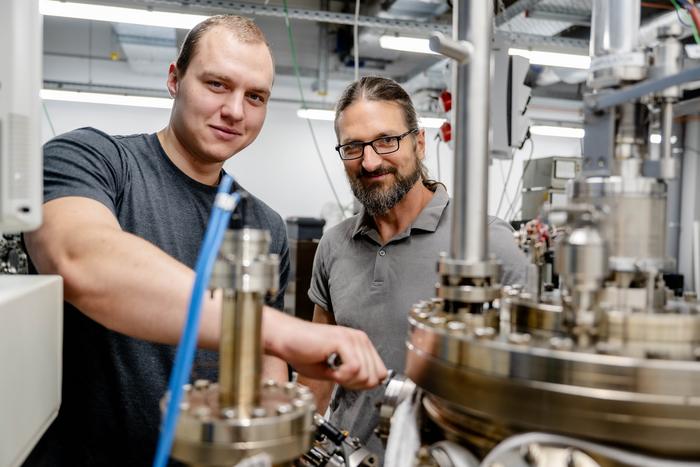
Researchers in the lab

Credit: RUB, Marquard

A German-Chinese research team has successfully created a quantum bit in a semiconductor nanostructure. Using a special energy transition, the researchers created a superposition state in a quantum dot – a tiny area of the semiconductor – in which an electron hole simultaneously possessed two different energy levels. Such superposition states are fundamental for quantum computing. However, excitation of the state would require a large-scale free-electron laser that can emit light in the terahertz range. Additionally, this wavelength is too long to focus the beam on the tiny quantum dot. The German-Chinese team has now achieved the excitation with two finely tuned short-wavelength optical laser pulses.

The team headed by Feng Liu from Zhejiang University in Hangzhou, together with a group led by Dr. Arne Ludwig from Ruhr University Bochum and other researchers from China and the UK, report their findings in the journal “Nature Nanotechnology”, published online on 24 July 2023.

Lasers trigger the radiative Auger process

The team made use of the so-called radiative Auger transition. In this process, an electron recombines with a hole, releasing its energy partly in the form of a single photon and partly by transferring the energy to another electron. The same process can also be observed with electron holes – in other words, missing electrons. In 2021, a research team succeeded for the first time in specifically stimulating the radiative Auger transition in a semiconductor.

In the current project, the researchers showed that the radiative Auger process can be coherently driven: they used two different laser beams with intensities in a specific ratio to each other. With the first laser, they excited an electron-hole pair in the quantum dot to create a quasiparticle consisting of two holes and an electron. With a second laser, they triggered the radiative Auger process to elevate one hole to a series of higher energy states.

Two states simultaneously

The team used finely tuned laser pulses to create a superposition between the hole ground state and the higher energy state. The hole thus existed in both states simultaneously. Such superpositions are the basis for quantum bits, which, unlike conventional bits, exist not only in the states “0” and “1”, but also in superpositions of both.

Hans-Georg Babin produced the high-purity semiconductor samples for the experiment at Ruhr University Bochum under the supervision of Dr. Arne Ludwig at the Chair for Applied Solid State Physics headed by Professor Andreas Wieck. In the process, the researchers increased the ensemble homogeneity of the quantum dots and ensured the high purity of the structures produced. These measures facilitated the performance of the experiments by the Chinese partners working with Jun-Yong Yan and Feng Liu.


Journal

Nature Nanotechnology

DOI

10.1038/s41565-023-01442-y

Article Title

Coherent control of a high-orbital hole in a semiconductor quantum dot

Article Publication Date

24-Jul-2023
Share12Tweet8Share2ShareShareShare2

Related Posts

β-Sitosterol from Ipomoea carnea Jacq. As a promising anti-inflammatory agent: Evidence from in silico modeling and in vitro validation

β-Sitosterol from Ipomoea carnea Jacq. As a promising anti-inflammatory agent: Evidence from in silico modeling and in vitro validation

August 31, 2026
Graded membranes point to a sustainable route for refining complex petroleum

Graded membranes point to a sustainable route for refining complex petroleum

August 31, 2026

Round-robin tests quantify catalyst activity and deactivation in CO2 hydrogenation modelling

August 30, 2026

Researchers reveal guiding principles for electrochemical synthesis of multimetallic nanocrystals

August 30, 2026

POPULAR NEWS

  • β-Sitosterol from Ipomoea carnea Jacq. As a promising anti-inflammatory agent: Evidence from in silico modeling and in vitro validation

    29 shares
    Share 12 Tweet 7
  • Design, fabrication and characterization of a wearable Fiber Bragg grating sensor for cardiorespiratory monitoring using finger plethysmography

    29 shares
    Share 12 Tweet 7
  • KAIST opens the era of industrial-scale microbial foods, proposing growth strategies for the next-generation protein market

    29 shares
    Share 12 Tweet 7
  • Virologist awarded $2 million NIH grant to investigate how virus-infected cells live and die

    29 shares
    Share 12 Tweet 7

About

We bring you the latest biotechnology news from best research centers and universities around the world. Check our website.

Follow us

Recent News

β-Sitosterol from Ipomoea carnea Jacq. As a promising anti-inflammatory agent: Evidence from in silico modeling and in vitro validation

Design, fabrication and characterization of a wearable Fiber Bragg grating sensor for cardiorespiratory monitoring using finger plethysmography

KAIST opens the era of industrial-scale microbial foods, proposing growth strategies for the next-generation protein market

Subscribe to Blog via Email

Success! An email was just sent to confirm your subscription. Please find the email now and click 'Confirm' to start subscribing.

Join 85 other subscribers
  • Contact Us

Bioengineer.org © Copyright 2023 All Rights Reserved.

Welcome Back!

Login to your account below

Forgotten Password?

Retrieve your password

Please enter your username or email address to reset your password.

Log In
No Result
View All Result
  • Homepages
    • Home Page 1
    • Home Page 2
  • News
  • National
  • Business
  • Health
  • Lifestyle
  • Science

Bioengineer.org © Copyright 2023 All Rights Reserved.