New research led by Adam Dixon, a conservation scientist with the World Wildlife Fund, describes the successful pilot of a novel method to study how well grassland birds are faring on croplands. The study, published in Ecological Applications, looked at 44 pockets of non-crop vegetation in the gaps between crop rows and at the edges of fields on lands under intensive agricultural cultivation in Iowa. The study may serve as a model for monitoring wildlife on working lands more generally, which can include crop fields, cattle ranches, and logged forests.
Credit: Courtesy of Adam Dixon
New research led by Adam Dixon, a conservation scientist with the World Wildlife Fund, describes the successful pilot of a novel method to study how well grassland birds are faring on croplands. The study, published in Ecological Applications, looked at 44 pockets of non-crop vegetation in the gaps between crop rows and at the edges of fields on lands under intensive agricultural cultivation in Iowa. The study may serve as a model for monitoring wildlife on working lands more generally, which can include crop fields, cattle ranches, and logged forests.
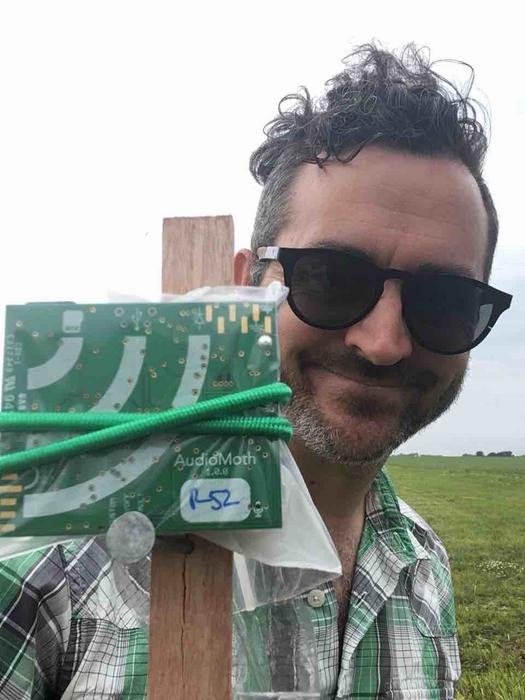
The researchers analyzed satellite imagery data to determine each pocket’s area and “texture,” referring to the variety in plant species, height, and density in the habitat. Simple, inexpensive on-site bioacoustic recorders—essentially circuit boards with a battery and mini cell phone microphone attached, all sealed in a plastic bag—helped the team identify which bird species were using the habitat. Both methods were low-cost and required very few visits to the lands under study, demonstrating the scalability of this approach.
The combination of techniques allowed the researchers to determine that larger habitat area and greater variety in texture were associated with more bird species overall. However, the results also revealed that species reliant on grassland habitat for their entire life cycle (mating, raising young, foraging, etc.) seemed to benefit less than birds who only used the habitat for certain activities, such as hunting.
“Using novel methods, we found that agricultural habitats are good for birds in general, but when you look at grassland birds specifically, either there’s not enough habitat or the habitat characteristics aren’t good,” Dixon says, who studies working lands biodiversity in the northern U.S. plains for the World Wildlife Fund.
The study’s relatively small sample size limited the researchers’ ability to determine whether habitat texture and area each had independent effects on the birds. Still, the study showed that their unique method combining satellite imagery and bioacoustic data can help researchers effectively measure habitat quality and bird biodiversity. The authors hope their work encourages future studies incorporating more study sites to strengthen the statistical power of the results.
Beyond protected areas
Dixon grew up surrounded by large wheat farms in the Midwest and observed their effects on the environment, which informed his career goals. His formative experiences, he says, led to an understanding that protected areas alone are not enough to solve the biodiversity, food, and health challenges the U.S. and the world are facing. “I saw a lot of research emphasis on protected areas,” Dixon says, whereas he wanted to focus on the intersection of intensive agriculture and ecology.
Dixon completed the new research as part of his Ph.D. with Erle Ellis, a landscape ecologist at University of Maryland, Baltimore County whose work has focused for decades on the longstanding relationships between humans and landscapes across the planet. Ellis is senior author on the new paper.
“Agriculture covers more of this planet than protected areas do, and Adam’s research on bird habitats in Iowa farmlands confirms that even some of the most intensively managed agricultural landscapes on Earth can sustain significant biodiversity,” Ellis shares. “More research like Adam’s is needed to conserve, restore, and monitor biodiversity in the working landscapes needed to sustain both people and wildlife across more than three quarters of Earth’s land.”
Community collaboration
The new study is also unusual in that it took place on privately held farmland. Dixon worked with landowners to get permission to conduct research on their property, and in some cases farmers placed the recorders themselves.
“It’s difficult but not impossible to work on private lands,” Dixon says. “You just need to build trust and relationships.” In the future, Dixon would like to deepen his collaboration with farmers. Gathering more information about their management practices would open up additional research questions. Plus, learning about any barriers farmers face to participating in research could make it more likely that other projects requiring farmer buy-in would get off the ground.
“What was impressive about Adam’s investigation was his willingness to employ novel technology and ideas to overcome what has historically been an absolute challenge in surveying working landscapes,” says Matthew Baker, a UMBC ecologist and a co-author on the paper. “His example has really shown the potential and the need for additional study.”
Supporting farmers and the environment
Farmers lead a challenging existence, frequently operating on extremely thin financial margins and relying on fickle weather, Dixon says, which incentivizes them to simplify and control the landscape as much as possible. Unfortunately, that can lead to environmental harm. Through his work, Dixon wants to help find a middle way that supports both farmers and the environment. Many questions remain.
“How do we move from the necessity to simplify the system to something that’s more balanced and takes into account the entire environment? To something that understands the unique ecology of a place and integrates that into management, and allows the farmer to prosper across generations? How can we find a better solution besides just hoping that we’re going to protect these small patches?” Dixon asks.
Those questions are why Dixon has pursued research into biodiversity on working lands, he says. While the new paper may be a small step to better understanding how wildlife is and is not flourishing on working lands, it is a step in the right direction and opens the door for future projects.
“We need to integrate conservation solutions into our most intensive places,” Dixon says. “So this research identifies that as an area of valid research and also shows how that research might be done.”
Journal
Ecological Applications
DOI
10.1002/eap.2860
Method of Research
Observational study
Subject of Research
Animals
Article Title
Passive monitoring of avian habitat on working lands
Article Publication Date
24-Apr-2023