How do bees choose which flowers to visit? Some bees will visit almost any bloom, while others are more discerning. How, and whether, bees choose to specialize in one kind of flower or pollen is a question entomologists and ecologists have puzzled over for years.
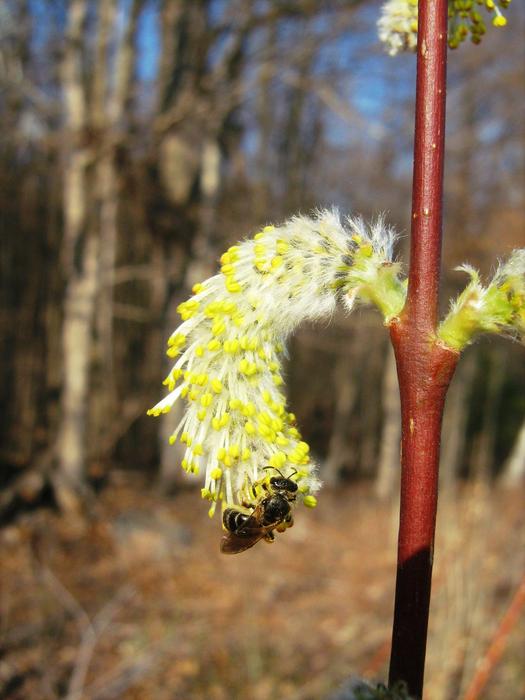
Credit: Photo by Jessica Forrest
How do bees choose which flowers to visit? Some bees will visit almost any bloom, while others are more discerning. How, and whether, bees choose to specialize in one kind of flower or pollen is a question entomologists and ecologists have puzzled over for years.
Now, a team of scientists led by ecologist Colleen Smith – who is currently based at the University of California, Santa Barbara, but conducted the research while working at the University of Ottawa – is deciphering why some species of bees specialize in visiting one type of plant over others. They concluded that bees who specialize tend to focus on the most abundant species in an ecosystem – at least in the eastern United States. The findings were published last month in the Ecological Society of America’s journal Ecology.
“Most environments have a few common species that are really abundant, so most plants that a bee encounters will be from a few common plants,” Smith explained. “Bees are much less likely to encounter rare plants. Plant abundance could be a mechanism that promotes specialization – and thus speciation.”
Of the thousands of bee species in the United States, about one-quarter of them are pollen specialists that only use pollen from plants in one genus, species or family. Only a tiny percentage of plants are hosts to these pollen specialists.
“Some plant taxa, like willows and sunflowers, support tons of bee species, and most don’t support any species of specialist bees,” Smith said. “Why do some plants support specialists? What causes a bee to specialize in one plant type? That’s what we set out to measure.”
Two competing hypotheses held sway in the field: One proposes that bees might specialize when the plants they favor have low pollen quality. The other posits that bees specialize on the most abundant taxa or types of plants in their ecosystem.
To decide between the two, Smith’s team tested each hypothesis. First, they conducted a field study in Ottawa to see if generalist bees also collected pollen from the host plants of specialist bees. If specialist bees target host plants with low quality or actively toxic pollen, generalists would avoid those plants. That’s not what they found, indicating that pollen quality did not affect specialization.
To test the plant-abundance hypothesis, they turned to a large public data source: citizen scientists uploading pictures to the iNaturalist app.
“It’s hard to get standardized measures of plant abundance of all the plant genera in the Eastern United States if you’re going out sampling yourself,” Smith said. “We used data from a phone app, iNaturalist. Because people are recording where they see different plant species, we were opportunistically able to use this data to get regional plant abundance.
“Our research showed that specialist bees are more likely to use abundant plants than rare plants,” Smith said. “This is strong support for what many people had suspected anecdotally. This is the first time, though, that there has been a quantitative test of a broad range of plants. One of the things that is interesting about this study is that it supports some ecological theories suggesting why specialization evolves in the first place.”
Future research might test the same hypotheses in the western United States – a hotspot for specialist bee diversity – to see if the pattern holds true there as well.
For non-researchers the implication for boosting bee species is clear: Plant your garden with those plants that host both specialists and generalist bees.
“By planting these abundant host plants that both the specialists and the generalist species visit, you’re supporting these potentially more vulnerable bee species in addition to the largest number of bees,” Smith said. “By paying attention to what plants specialists need, you’ll be helping more bee species.”
###
Press registration is open for the 2023 annual meeting of the Ecological Society of America, August 6-11, in Portland, Oregon. To register, please contact ESA Public Information Manager Heidi Swanson ([email protected]). Learn more on the meeting website.
The Ecological Society of America, founded in 1915, is the world’s largest community of professional ecologists and a trusted source of ecological knowledge, committed to advancing the understanding of life on Earth. The 9,000 member Society publishes five journals and a membership bulletin and broadly shares ecological information through policy, media outreach, and education initiatives. The Society’s Annual Meeting attracts 4,000 attendees and features the most recent advances in ecological science. Visit the ESA website at http://www.esa.org.
Follow ESA on social media:
Twitter – @esa_org
Instagram – @ecologicalsociety
Facebook – @esa.org
Journal
Ecology
DOI
10.1002/ecy.4122
Article Title
Regional plant abundance explains patterns of host use by pollen-specialist bees in eastern North America
Article Publication Date
11-Jun-2023