Cisplatin is a potent chemotherapeutic agent used to treat various cancers, including cervical cancer. But the continued use of cisplatin can lead to the development of cisplatin resistance and other side effects, like chemotherapy-induced neuropathic pain. Overcoming these issues is a critical concern in cervical cancer treatment.
Credit: Tae Woo Kim from Korea University Medicine
Cisplatin is a potent chemotherapeutic agent used to treat various cancers, including cervical cancer. But the continued use of cisplatin can lead to the development of cisplatin resistance and other side effects, like chemotherapy-induced neuropathic pain. Overcoming these issues is a critical concern in cervical cancer treatment.
Now, in a new study, Prof. Tae Woo Kim from Korea University Medicine and his team have explored the pathways leading to cisplatin resistance. Their study was published online on 10 May 2023 in Nature Communications.
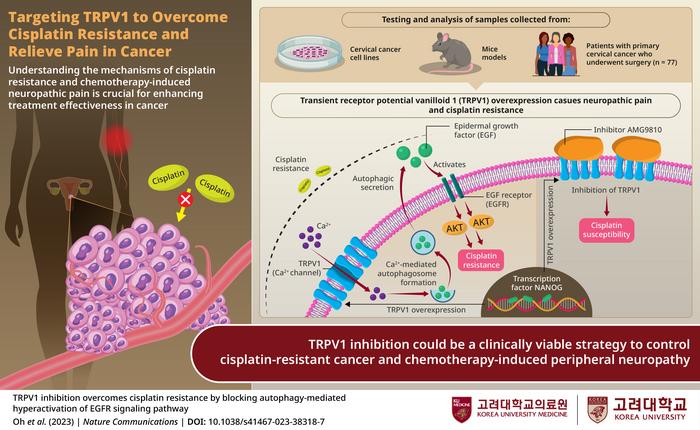
The team analyzed the transcriptome of patients with cervical cancer who had undergone surgery and found that elevated epidermal growth factor receptor (EGFR) activity scores were associated with poor overall survival in cisplatin-treated patients. “EGFR is a protein involved in cell signaling and its dysregulation leads to uncontrolled cell growth and tumor formation. We conducted experiments on EGFR signaling using cervical cancer cell lines and observed that the cisplatin-resistant cell line exhibited hyperactivated EGFR signaling compared to the cisplatin-susceptible cells. This led us to conclude that hyperactive EGFR triggers resistance mechanisms, leading to decreased drug effectiveness in tumor cells,” explains Prof. Kim.
The team further identified NANOG, a transcription factor associated with resistance, metastasis, and stem cell-like properties in cancer cells, to be involved in the regulation of the EGFR pathway. They discovered that NANOG activates the transient receptor potential vanilloid 1 (TRPV1), which is responsible for causing neuropathic pain. TRPV1 further promotes a process called secretory autophagy, which leads epidermal growth factor (EGF) secretion. EGF, in turn, activates the EGFR signaling pathway, contributing to cisplatin resistance. “Most noteworthily, in our study, inhibiting TRPV1 using AMG9810, a potential pain-relieving agent, rendered the resistant tumors vulnerable to cisplatin,” says Prof. Kim.
This study serves as valuable proof-of-concept for TRPV1 as a therapeutic target to combat cisplatin resistance and neuropathic pain, thereby improving the outlook for patients with cervical cancer.
***
Reference
DOI: https://doi.org/10.1038/s41467-023-38318-7
About the Korea University Medicine
Korea University (KU), located in Seoul, South Korea, is a leading university established in 1905, renowned for its academic excellence and contributions to higher education. Within KU, Korea University Medicine (KU Medicine) is a top-ranked medical institution, comprising campuses like Anam Hospital, Guro Hospital, Ansan Hospital, Cheongdam Goyeong Campus, and Jeongneung Mediscience Park. KU Medicine also has educational institutions affiliated to it, including the College of Medicine, Graduate School of Public Health, and Graduate School of Clinical Dentistry, driving remarkable advancements in medical treatment, education, research, and social contributions.
Website: https://www.kumc.or.kr/en/index.do
About the author
Prof. Tae Woo Kim received his Ph.D. from Korea University, Seoul, Republic of Korea, in 2000 and then trained at Johns Hopkins University, School of Medicine, Baltimore, MD, USA during his postdoctoral course. Then he joined Graduate School of Medicine, Korea University, Seoul, Republic of Korea in 2005, where he is currently a professor. His laboratory has focused on the elucidation of the mechanism of tumor immune escape and the understanding of malignant evolution of tumor cells after cancer treatment. Based on those, he has tried to develop a novel modality for the control of immune-refractory tumors.
Journal
Nature Communications
DOI
10.1038/s41467-023-38318-7
Method of Research
Experimental study
Subject of Research
Human tissue samples
Article Title
TRPV1 inhibition overcomes cisplatin resistance by blocking autophagy-mediated hyperactivation of EGFR signaling pathway
Article Publication Date
10-May-2023
COI Statement
The authors declare that they have no competing interests