El Niño is a term derived from Spanish to describe a natural phenomenon marked by higher-than-average sea surface temperatures in the tropical Eastern Pacific. The convective Extreme El Niño denotes events with daily rainfall exceeding five millimeters, triggering unusual global weather patterns. The scientific consensus predicts that increasing greenhouse gas concentrations in the atmosphere will escalate the frequency of extreme El Niño events. However, recent simulations by a research team at Pohang University of Science and Technology (POSTECH) suggest a counterintuitive outcome: a reduction in atmospheric carbon dioxide could still trigger an increase in both the frequency and intensity of extreme El Niño events. This unexpected finding underscores the need for a more nuanced approach to climate change mitigation strategies, a sentiment now echoed within academic circles.
Credit: POSTECH
El Niño is a term derived from Spanish to describe a natural phenomenon marked by higher-than-average sea surface temperatures in the tropical Eastern Pacific. The convective Extreme El Niño denotes events with daily rainfall exceeding five millimeters, triggering unusual global weather patterns. The scientific consensus predicts that increasing greenhouse gas concentrations in the atmosphere will escalate the frequency of extreme El Niño events. However, recent simulations by a research team at Pohang University of Science and Technology (POSTECH) suggest a counterintuitive outcome: a reduction in atmospheric carbon dioxide could still trigger an increase in both the frequency and intensity of extreme El Niño events. This unexpected finding underscores the need for a more nuanced approach to climate change mitigation strategies, a sentiment now echoed within academic circles.
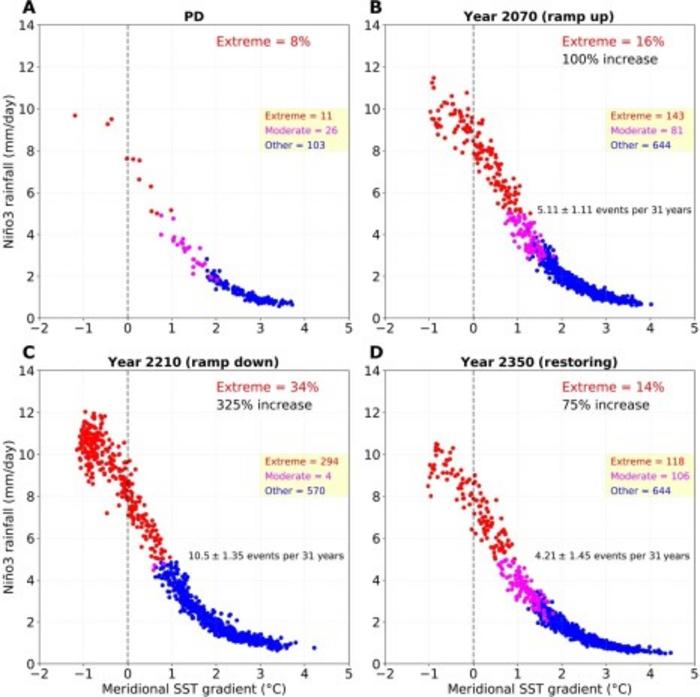
The research team, led by Professor Jong-Seong Kug of the Division of Environmental Science and Engineering and the Department of Mathematics, and Gayan Pathirana of the Division of Environmental Science and Engineering, utilized the Community Earth System Model for their simulations. Their results, published in the international academic journal Science Advances, demonstrated that even in the wake of a CO2 reduction, extreme El Niño events could become more frequent.
The simulation confirmed that a rise in the atmospheric concentration of carbon dioxide results in an escalation in the frequency and severity of extreme El Niño events. Interestingly, contrary to general belief, they also found that even with a subsequent lowering of carbon dioxide levels, extreme El Niño events could still occur frequently. As the intertropical convergence zone, which is sensitive to sea temperature changes, shifts southward, extreme El Niño events can occur due to increased rainfall in the tropical Eastern Pacific region. These predictions indicate that despite carbon reduction policies like carbon neutrality, extreme El Niño events could be inevitable due to the high concentration of carbon dioxide already present in the atmosphere.
Moreover, the simulations revealed potential climate regime shifts, or changes in prevailing weather patterns, in areas affected by extreme El Niño events. Regions like tropical South America, Northwestern Australia, and South Asia could face desertification due to a reduction in average rainfall. Conversely, extratropical Northern and Southern America, East Asia, and tropical Africa could see an increase in rainfall. In fact, tropical Africa, North America, and western South America, where an increase in rainfall has already been observed, could face an increased risk of frequent flooding.
In East Asia, including Korea, if extreme El Niño events become more frequent in winter, the following spring could see an explosive increase in rainfall. This research is pioneering in suggesting that extreme El Niño events could change not only the immediate weather but also long-term climate conditions in various regions.
Leading the study, Professor Kug explained, “When designing policies to prevent abnormal climate conditions, we need to factor in more than just indicators like global average temperature and precipitation. The climate system is intricate, and phenomena like the intensification of extreme El Niño must be adequately considered. Given the persistent impacts of the greenhouse gases already released into the atmosphere, it’s crucial to assess these long-term effects as societal costs of climate change, and predicting them is of utmost importance.”
This was conducted with the support from the Research Leader Program (Center for Abrupt Climate Change) of the National Research Foundation of Korea.
Journal
Science Advances
DOI
10.1126/sciadv.adh2412
Article Title
Increase in convective extreme El Niño events in a CO2 removal scenario
Article Publication Date
21-Jun-2023