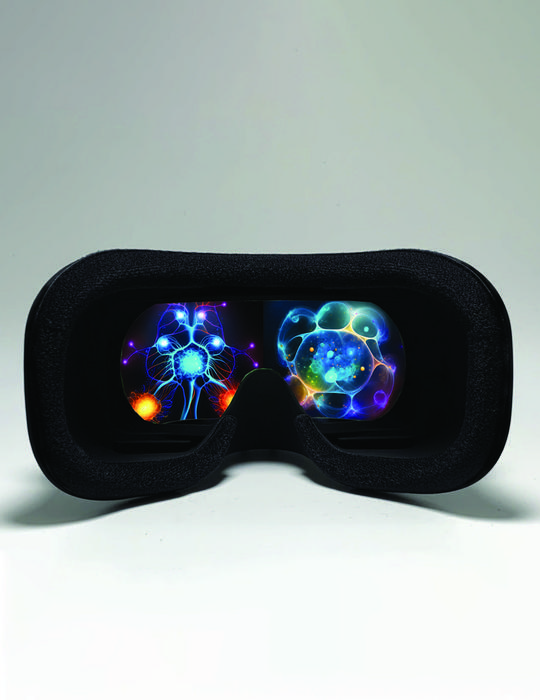
SAN CARLOS, California – Integrated Biosciences, a biotechnology company combining synthetic biology and machine learning to target aging, in collaboration with researchers at the University of California Santa Barbara, today announced a drug discovery platform that enables precise control of the integrated stress response (ISR), a biological pathway that is activated by cells in response to a wide variety of pathological and aging-associated conditions. A new publication, “Optogenetic control of the integrated stress response reveals proportional encoding and the stress memory landscape,” authored by company founders and featured on the cover of Cell Systems describes a technique that triggers the ISR virtually using light and demonstrates how the accumulation of stress over time shifts a cell’s reaction from adaptation to apoptosis (programmed cell death).
Credit: Integrated Biosciences
SAN CARLOS, California – Integrated Biosciences, a biotechnology company combining synthetic biology and machine learning to target aging, in collaboration with researchers at the University of California Santa Barbara, today announced a drug discovery platform that enables precise control of the integrated stress response (ISR), a biological pathway that is activated by cells in response to a wide variety of pathological and aging-associated conditions. A new publication, “Optogenetic control of the integrated stress response reveals proportional encoding and the stress memory landscape,” authored by company founders and featured on the cover of Cell Systems describes a technique that triggers the ISR virtually using light and demonstrates how the accumulation of stress over time shifts a cell’s reaction from adaptation to apoptosis (programmed cell death).
“In a very real way, our platform puts cells into a virtual reality, making them experience stress in the absence of physical stressors,” said Maxwell Wilson, Ph.D., a co-founder of Integrated Biosciences and Assistant Professor of Molecular, Cellular, and Developmental Biology at the University of California Santa Barbara. “This work is an important advance because it relies on a light-activated switch to control the ISR, which is key to aging, rather than using the chemical poisons that are common in this field of research. Our synthetic biology platform enables previously impossible drug discovery because it avoids inducing the collateral damage caused by chemical poisons, enabling us to observe direct effects of drug candidates on the cell’s stress response and perform fast and accurate target deconvolution.”
Integrated Biosciences’ “cellular virtual reality” system adapts optogenetics, a research method pioneered by neuroscientists to activate specific neurons by wiring them to fire in response to flashes of light. In Integrated Biosciences’ platform, neuroglioma and osteosarcoma cancer cells were genetically modified such that their ISR could respond to light. The research found that duration and intensity both dictate a cell’s reaction to the virtual-reality stress, and that the accumulation of stress over time plays an important role in how the cell responds. Transient stress leads to an adaptive response that protects a cell from damage, but prolonged activation of the ISR leads to cell death. As the ISR represents a key hallmark of aging, these findings inform the cell fate decisions that cells make as they age.
The Cell Systems paper represents the second major publication associated with Integrated Biosciences. A Nature Aging paper, “Discovering small-molecule senolytics with deep neural networks,” published in May demonstrated how artificial intelligence (AI) can be used to discover novel senolytics, anti-aging compounds that selectively eliminate senescent “zombie” cells. These compounds have shown promise in their ability to treat age-related diseases such as fibrosis, neurodegeneration, and cancer, but have faced challenges in clinical studies. The Nature Aging paper identified three drug candidates that have comparable efficacy and superior medicinal chemistry properties than those of the most promising senolytics currently under investigation.
By combining cutting-edge technologies described in these two publications – AI-driven small-molecule drug discovery and precise synthetic control of aging-associated pathways – Integrated Biosciences is generating unprecedented types of data regarding the activities and properties of their anti-aging drug candidates, substantially derisking future clinical trials that target age-related diseases.
“This study demonstrates an important pillar of Integrated Biosciences’ platform – that the company can use synthetic biology, and in particular optogenetics, to control age-related cellular signaling pathways. This technology allows for novel drug discovery efforts, allowing us to query specific aspects of cellular biology that produce faster, on-target drug screens with built-in mechanism of action validation,” said James J. Collins, Ph.D., Termeer Professor of Medical Engineering and Science at MIT and founding chair of the Integrated Biosciences Scientific Advisory Board.
###
About Integrated Biosciences
Integrated Biosciences is a seed-stage biotechnology company that has developed proprietary synthetic biology and AI platforms to target age-related cellular stress responses. Integrated Biosciences was founded by MIT-, Harvard- and Princeton-trained scientists Felix Wong, Ph.D., and Max Wilson, Ph.D., in 2022. Its scientific advisors include James J. Collins, Ph.D., one of the founders of the field of synthetic biology and Termeer Professor of Medical Engineering and Science at MIT, and Sir David W. C. MacMillan Ph.D., 2021 winner of the Nobel Prize in Chemistry and James S. McDonnell Distinguished University Professor of Chemistry at Princeton. Its investors include Root Ventures, Mission BioCapital, Conscience VC, Reinforced Ventures and Polymath Capital. Integrated Biosciences is based in San Carlos, California.
Journal
Cell Systems
Method of Research
Experimental study
Subject of Research
Cells
Article Title
Optogenetic control of the integrated stress response reveals proportional encoding and the stress memory landscape
Article Publication Date
19-Jul-2023