In an effort to discover new 2D materials, a team of scientists from Ames National Laboratory determined the structure of boron monoxide. This compound was first discovered in the 1940s and maintained research interest throughout the years. Scientists were, however, unable to determine the structure of the material due to technological limitations of the time. Using new NMR methods and previously unavailable analytical tools, the team from Ames Lab finally solved the structure of this deceptively simple material.
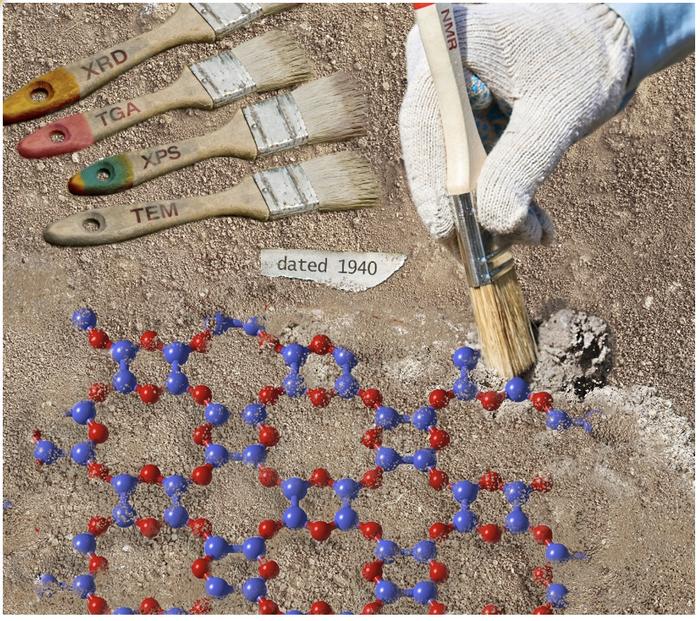
Credit: U.S. Department of Energy Ames National Laboratory
In an effort to discover new 2D materials, a team of scientists from Ames National Laboratory determined the structure of boron monoxide. This compound was first discovered in the 1940s and maintained research interest throughout the years. Scientists were, however, unable to determine the structure of the material due to technological limitations of the time. Using new NMR methods and previously unavailable analytical tools, the team from Ames Lab finally solved the structure of this deceptively simple material.
“We initially weren’t really looking into studying this particular material,” said Frédéric Perras, a scientist from Ames Lab and member of the research team. “We were actually trying to make a carbon-free covalent organic framework.” A covalent organic framework is a low-density and porous material with a periodically ordered crystal structure. It is composed of organic molecules that are linked together through covalent bonds.
“However, after many synthesis trials, we could not get a highly crystalline covalent organic framework material,” said Wenyu Huang, another scientist from Ames Lab and member of the team. Perras’ and Huang’s groups are interested in these materials for alternative energy applications.
The team ended up making a boron-based material that Perras said was difficult to characterize. Through their research, they came upon literature dating back to 1940 that contained descriptions of the exact reaction the team was working on, and the synthesis of a material called boron monoxide. Unfortunately, previous scientists were unable to determine the structure of the material.
Luckily, technology for materials research has advanced since the 1940s. “Because of our expertise in nuclear magnetic resonance spectroscopy, and the development of new methods to which people in the 40s, 50s, and 60s didn’t have access, we thought that we might be able to lay this nearly century old mystery to rest,” said Perras.
Perras explained that boron monoxide is made using a precursor molecule that acts like building blocks. These molecules stick together through dehydration reactions. The key to understating the structure is to figure out how the blocks are physically arranged. “So we developed some NMR methods that allow us to study the orientation of these building blocks relative to each other. Basically, we found that adjacent precursor molecules were getting organized parallel to each other, which matched one of the previously proposed models,” Perras said.
“We also applied a lot of other techniques, including powder X-ray diffraction, which showed that these nanosheets organized themselves into what’s called a turbostratic arrangement,” said Perras. He explained that these stacked nanosheets are like a stack of paper thrown onto a desk. Once they land, they are not perfectly aligned, but they remain in a stack.
According to Perras, there has been a lot of recent interest in synthesizing new boron-based 2D materials. Understanding the structure of this one could lead to the synthesis of other useful boron-based 2D materials. “What really excites me is just the fact that this is an old problem. It’s such a basic material; when you write down the chemical formula, it’s BO. So, it’s interesting from that point of view that we finally solved its structure,” said Perras
This research is further discussed in the paper, “The Structure of Boron Monoxide,” written by Frédéric A. Perras, Henry Thomas, Patrick Heintz, Ranjan Behera, Jiaqi Yu, Gayatri Viswanathan, Dapeng Jing, Scott A. Southern, Kirill Kovnir, Levi Stanley, and Wenyu Huang, and published in Journal of the American Chemical Society.
Ames National Laboratory is a U.S. Department of Energy Office of Science National Laboratory operated by Iowa State University. Ames Laboratory creates innovative materials, technologies, and energy solutions. We use our expertise, unique capabilities, and interdisciplinary collaborations to solve global problems.
Ames Laboratory is supported by the Office of Science of the U.S. Department of Energy. The Office of Science is the single largest supporter of basic research in the physical sciences in the United States and is working to address some of the most pressing challenges of our time. For more information, please visit https://energy.gov/science.
Journal
Journal of the American Chemical Society
DOI
10.1021/jacs.3c02070
Article Title
The Structure of Boron Monoxide
Article Publication Date
28-Jun-2023