• HOME
  • NEWS
  • EXPLORE
    • CAREER
      • Companies
      • Jobs
    • EVENTS
    • iGEM
      • News
      • Team
    • PHOTOS
    • VIDEO
    • WIKI
  • BLOG
  • COMMUNITY
    • FACEBOOK
    • INSTAGRAM
    • TWITTER
Sunday, April 12, 2026
BIOENGINEER.ORG
No Result
View All Result
  • Login
  • HOME
  • NEWS
  • EXPLORE
    • CAREER
      • Companies
      • Jobs
        • Lecturer
        • PhD Studentship
        • Postdoc
        • Research Assistant
    • EVENTS
    • iGEM
      • News
      • Team
    • PHOTOS
    • VIDEO
    • WIKI
  • BLOG
  • COMMUNITY
    • FACEBOOK
    • INSTAGRAM
    • TWITTER
  • HOME
  • NEWS
  • EXPLORE
    • CAREER
      • Companies
      • Jobs
        • Lecturer
        • PhD Studentship
        • Postdoc
        • Research Assistant
    • EVENTS
    • iGEM
      • News
      • Team
    • PHOTOS
    • VIDEO
    • WIKI
  • BLOG
  • COMMUNITY
    • FACEBOOK
    • INSTAGRAM
    • TWITTER
No Result
View All Result
Bioengineer.org
No Result
View All Result
Home NEWS Science News Biology

Cell-to-cell diversity is key to protecting brain from neurological diseases: University of Ottawa research

Bioengineer by Bioengineer
July 18, 2023
in Biology
Reading Time: 3 mins read
0
Cell-to-cell diversity is key to protecting brain from neurological diseases: uOttawa research
Share on FacebookShare on TwitterShare on LinkedinShare on RedditShare on Telegram

A brain’s cell makeup may transform the way we understand and treat neuropsychiatric conditions, potentially opening a new treatment path for diseases like epilepsy, autism, schizophrenia, and depression.
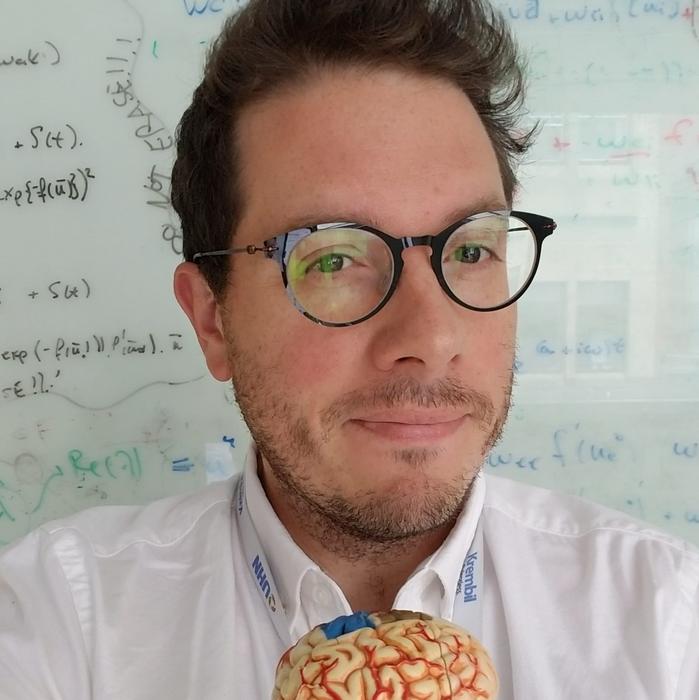
Cell-to-cell diversity is key to protecting brain from neurological diseases: uOttawa research

Credit: Faculty of Science, University of Ottawa

A brain’s cell makeup may transform the way we understand and treat neuropsychiatric conditions, potentially opening a new treatment path for diseases like epilepsy, autism, schizophrenia, and depression.

The study from the University of Ottawa’s Faculty of Science demonstrates how a brain’s ecosystem and its diversity of cells can allow it to maintain normal function while better responding to changes, perturbations, or injury. The response to such “insults” – as the study coins them – is amplified by cells that are too connected or too alike, which makes them less resilient and unable to maintain the activity needed to preserve brain function.

Inspired by Charles Darwin’s Origin of Species and the idea that biodiversity of natural ecosystems is the key to survival, lead author Jérémie Lefebvre and his team used mathematical models of brain circuitry to analyze how neurons respond to “insults” and how cell-to-cell diversity helps prevent failures.

“Our results demonstrate how diversity is a foundational, essential ingredient in the constitution of brain circuits,” says Lefebvre, a member of uOttawa’s Brain and Mind Research Institute. “Just like the biodiversity of ecosystems, the diversity of neurons is as important and represents a new way of interpreting certain illnesses, like epilepsy.”

Epilepsy is characterized by recurrent seizures during which brain circuits go haywire and cells become too synchronous with one another. Lefebvre and the team of researchers, which includes members from the University Health Network’s Krembil Brain Institute, used electrical recordings to explore the brain cells of patients with epilepsy, finding that cells from the region of the brain that create seizures look more alike and less diverse. Low diversity prevents neurons and cells from adapting adequately as brain circuits are unable to maintain healthy activity, leading to seizures.

“Using our interdisciplinary methods, we were able to show that brain cells must be different from each other to ensure the brain maintains its function in the face of time and changes,” says Lefebvre, an Associate Professor in the Department of Biology. “This is an important reminder of the critical role diversity plays in natural systems and how it responds to inevitable change. This not only applies to ecosystems, neurons, and neural circuits, but to humans and communities.”

The research may also provide guidance for treatment of autism, schizophrenia, and depression, which are also states of the brain marked by over connectivity and synchronicity.

‘Intrinsic neural diversity quenches the dynamic volatility of neural networks’ was published in PNAS on July 3, 2023. DOI: 10.1073/pnas.2218841120


Journal

Proceedings of the National Academy of Sciences

DOI

10.1073/pnas.2218841120

Method of Research

Data/statistical analysis

Subject of Research

Cells

Article Title

Intrinsic neural diversity quenches the dynamic volatility of neural networks

Article Publication Date

3-Jul-2023

Share12Tweet8Share2ShareShareShare2

Related Posts

Epigenetic Alterations at Birth Linked to Infant Microbiome and Neurodevelopment

Epigenetic Alterations at Birth Linked to Infant Microbiome and Neurodevelopment

April 10, 2026
Lung Cancer That Alters Its Identity Could Be Concealed in Plain Sight

Lung Cancer That Alters Its Identity Could Be Concealed in Plain Sight

April 10, 2026

Neuronal Motor Protein Composition Determines Cargo Specificity

April 10, 2026

How Your Housemates Might Be Altering Your Gut Microbiome

April 10, 2026

POPULAR NEWS

  • Scientists Investigate Possible Connection Between COVID-19 and Increased Lung Cancer Risk

    54 shares
    Share 22 Tweet 14
  • Boosting Breast Cancer Risk Prediction with Genetics

    47 shares
    Share 19 Tweet 12
  • Popular Anti-Aging Compound Linked to Damage in Corpus Callosum, Study Finds

    44 shares
    Share 18 Tweet 11
  • Imagine a Social Media Feed That Challenges Your Views Instead of Reinforcing Them

    1012 shares
    Share 400 Tweet 250

About

We bring you the latest biotechnology news from best research centers and universities around the world. Check our website.

Follow us

Recent News

Machine Learning Identifies Fall Risk in Parkinson’s

SGLT2 Inhibitors Safe, Effective for Diabetes in Elderly

Bayesian Study Links Aging to Visual Hand Bias

Subscribe to Blog via Email

Success! An email was just sent to confirm your subscription. Please find the email now and click 'Confirm' to start subscribing.

Join 78 other subscribers
  • Contact Us

Bioengineer.org © Copyright 2023 All Rights Reserved.

Welcome Back!

Login to your account below

Forgotten Password?

Retrieve your password

Please enter your username or email address to reset your password.

Log In
No Result
View All Result
  • Homepages
    • Home Page 1
    • Home Page 2
  • News
  • National
  • Business
  • Health
  • Lifestyle
  • Science

Bioengineer.org © Copyright 2023 All Rights Reserved.