Osaka, Japan – Although many people still die from severe burns, the underlying physiology behind burns is not well understood. In an article published in iScience, researchers from Osaka University identified key proteins associated with mortality in people with life-threatening burns.
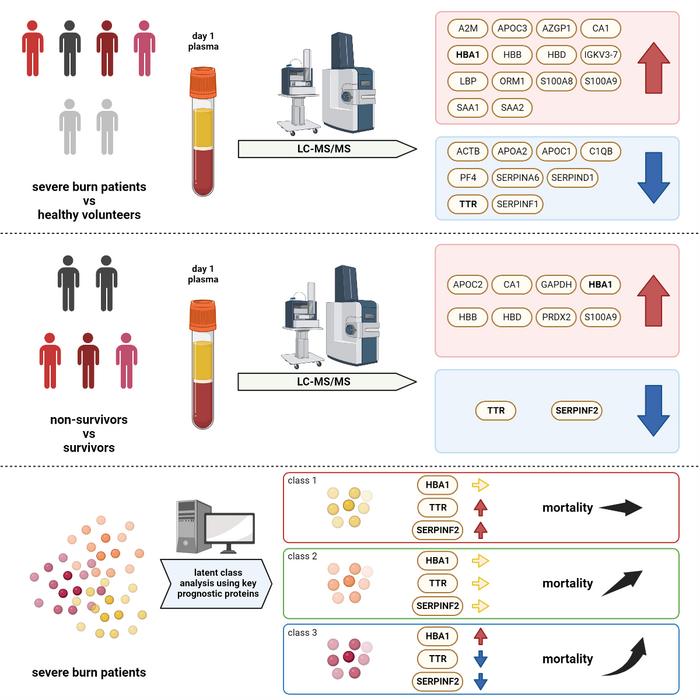
Credit: 2023, Shinya Onishi, Combination of HBA1, TTR, and SERPINF2 in plasma defines phenotype correlated with severe burn outcome, iScience
Osaka, Japan – Although many people still die from severe burns, the underlying physiology behind burns is not well understood. In an article published in iScience, researchers from Osaka University identified key proteins associated with mortality in people with life-threatening burns.
Proteomics is the large-scale study of an organism’s entire set of proteins. Recent developments in mass spectrometry—an analytic technique used to identify chemical substances—have improved the feasibility of proteomic analysis, enabling the identification of hundreds to thousands of proteins at a time.
Shinya Onishi, the study’s lead author, emphasizes that proteomic analysis of burns is still in its infancy. “Burns are known to cause severe circulatory, immune, metabolic, and coagulation system dysregulation,” he says. “For example, right after an injury, there is an immediate increase in capillary permeability, which is one of the main factors leading to circulatory failure. However, the details behind many of these mechanisms are still unclear.”
The retrospective observational study included ten healthy volunteers and 83 burn patients, 15 of whom died within 28 days of injury. Proteins in plasma samples were analyzed using mass spectrometry. The authors then performed various statistical analyses to understand how differences in protein levels correlated with burn severity.
Jun Oda, a senior author of the study, highlights the two underlying goals of the study: “The first goal is to identify previously unidentified proteins that might be associated with the pathogenesis of life-threatening burns,” he says. “The second goal is to investigate novel molecular pathways in burn victims that might be the targets of future drugs.”
Ultimately, ten proteins were identified that were strongly associated with mortality.
Furthermore, three of those proteins (HBA1, TTR, and SERPINF2) showed the highest association with mortality and were used by the researchers to classify patients (also known as clinical phenotyping) into three groups corresponding to mortality rates. The group which had the highest mortality, was characterized by higher levels of HBA1 and lower levels of TTR and SERPINF2.
One of the proteins, HBA1, is associated with hemoglobin, while another, TTR, is an indicator of the breakdown of proteins in the body. Finally, the third protein, SERPINF2, is associated with the development and dissolution of blood clots. Onishi emphasizes that “these three proteins can function as important prognostic biomarkers for burn patients”. Therefore, future research on these proteins and their pathways is necessary as they are promising targets for developing new therapeutic strategies and drugs for severe burns.
###
The article, “Combination of HBA1, TTR, and SERPINF2 in plasma defines phenotype correlated with severe burn outcome” was published in iScience at DOI: https://doi.org/10.1016/j.isci.2023.107271
About Osaka University
Osaka University was founded in 1931 as one of the seven imperial universities of Japan and is now one of Japan’s leading comprehensive universities with a broad disciplinary spectrum. This strength is coupled with a singular drive for innovation that extends throughout the scientific process, from fundamental research to the creation of applied technology with positive economic impacts. Its commitment to innovation has been recognized in Japan and around the world, being named Japan’s most innovative university in 2015 (Reuters 2015 Top 100) and one of the most innovative institutions in the world in 2017 (Innovative Universities and the Nature Index Innovation 2017). Now, Osaka University is leveraging its role as a Designated National University Corporation selected by the Ministry of Education, Culture, Sports, Science and Technology to contribute to innovation for human welfare, sustainable development of society, and social transformation.
Website: https://resou.osaka-u.ac.jp/en
Journal
iScience
DOI
10.1016/j.isci.2023.107271
Method of Research
Observational study
Subject of Research
People
Article Title
Combination of HBA1, TTR, and SERPINF2 in plasma defines phenotype correlated with severe burn outcome
Article Publication Date
3-Jul-2023