Osaka, Japan – When brain cells, or neurons, are putting out processes to connect with other neurons, how do they tell the difference between their own processes and those of other neurons? One important part of this puzzle involves a molecule called clustered protocadherin (Pcdh).
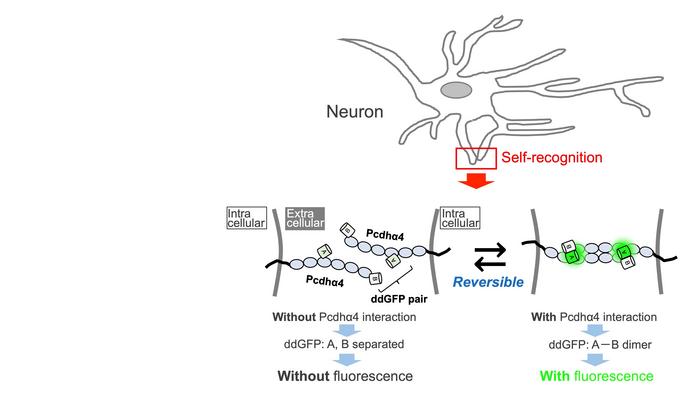
Credit: Takashi Kanadome
Osaka, Japan – When brain cells, or neurons, are putting out processes to connect with other neurons, how do they tell the difference between their own processes and those of other neurons? One important part of this puzzle involves a molecule called clustered protocadherin (Pcdh).
In a recent publication in iScience, researchers from SANKEN (The Institute of Scientific and Industrial Research) and the Graduate School of Frontier Biosciences at Osaka University reported the development of a sensor to look at Pcdh interactions in live neurons, which brings us closer to understanding this mystery.
In the brain, millions of neurons make trillions of connections with each other. To do so, each neuron puts out tiny processes that grow and travel until they find another cell’s processes to connect with. However, because each cell has so many processes all over the place, cells can accidentally make connections with themselves rather than with others. One way to avoid this involves Pcdh, which is expressed in different combinations on each neuron’s surface.
One role of Pcdh is in cell adhesion; if two neuronal processes have exactly the same combination of Pcdh molecules, the molecules bind to one another. Conversely, if the combinations are even slightly different, they are viewed as “other” rather than “self,” and do not bind. Although there are conventional techniques for detecting molecular interactions between cell surfaces, which can show us when the molecules bind, but not when they split apart again. Researchers from Osaka University wanted to tackle this issue.
“We developed a fluorescent-based sensor that we named IPAD, or Indicators for Protocadherin Alpha 4 interactions upon Dimerization,” says lead author of the study Takashi Kanadome. “This sensor allows us to see not only interactions between processes, but also the dissociation of these interactions for the first time.”
This new technique does have a few disadvantages. For example, its fluorescence is much duller than that observed using older techniques, and it is unable to differentiate connections between processes from the same cell and those from two different cells with the same combinations of Pcdh on the surface.
“Despite its current drawbacks, we think that our new sensor will be useful for a number of different research applications,” explains Tomoki Matsuda, senior author of the study. “The development of IPAD is an important step toward a better understanding of the neuronal recognition of self/other.”
The sensors developed in this study have many potential applications. In particular, the technique may be used to develop a range of fluorescent sensors to visualize neuronal self-connectivity, which is implicated in brain disorders such as autism and epilepsy. A better understanding of neuronal self-connectivity may lead to improved treatments for these disorders.
###
The article, “Visualization of trans-interactions of a protocadherin-α between processes originating from single neurons,” was published in iScience at DOI: https://doi.org/10.1016/j.isci.2023.107238
About Osaka University
Osaka University was founded in 1931 as one of the seven imperial universities of Japan and is now one of Japan’s leading comprehensive universities with a broad disciplinary spectrum. This strength is coupled with a singular drive for innovation that extends throughout the scientific process, from fundamental research to the creation of applied technology with positive economic impacts. Its commitment to innovation has been recognized in Japan and around the world, being named Japan’s most innovative university in 2015 (Reuters 2015 Top 100) and one of the most innovative institutions in the world in 2017 (Innovative Universities and the Nature Index Innovation 2017). Now, Osaka University is leveraging its role as a Designated National University Corporation selected by the Ministry of Education, Culture, Sports, Science and Technology to contribute to innovation for human welfare, sustainable development of society, and social transformation.
Website: https://resou.osaka-u.ac.jp/en
Journal
iScience
DOI
10.1016/j.isci.2023.107238
Method of Research
Imaging analysis
Subject of Research
Cells
Article Title
Visualization of trans-interactions of a protocadherin-α between processes originating from single neurons
Article Publication Date
17-Jul-2023