Low-dimensional carbon materials (LDCs), including graphene and carbon nanotubes, have attracted considerable attention due to their unique morphologies and intriguing electrical properties. However, these materials are typically less functionalized for electrochemical applications. Hence, it is crucial to devise a bottom-up synthesis route for LDCs that can enhance their electrochemical properties and establish a structure-performance relationship.
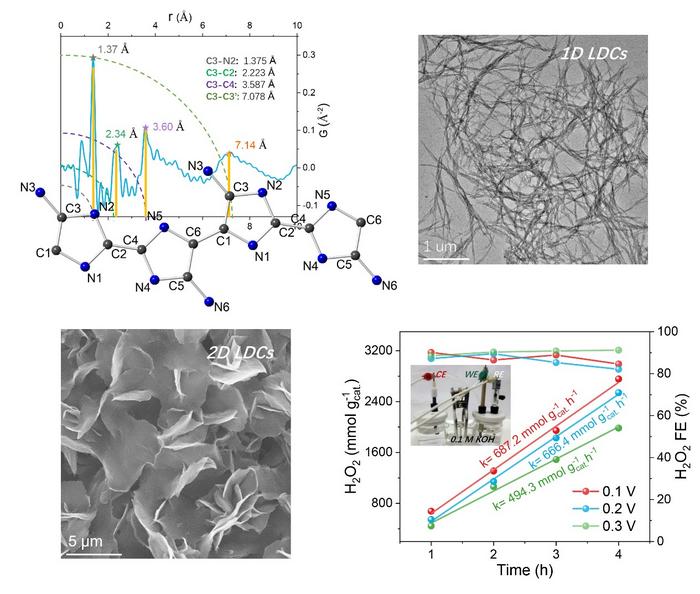
Credit: Zongge Li, Chenwei Wang, Anuj Kumar, Hongrui Jia, Yin Jia, Huifang Li, Lu Bai, Guoxin Zhang, Xiaoming Sun
Low-dimensional carbon materials (LDCs), including graphene and carbon nanotubes, have attracted considerable attention due to their unique morphologies and intriguing electrical properties. However, these materials are typically less functionalized for electrochemical applications. Hence, it is crucial to devise a bottom-up synthesis route for LDCs that can enhance their electrochemical properties and establish a structure-performance relationship.
Currently, most bottom-up methods for LDCs synthesis demand expensive precursors and tedious synthesis procedures, thereby severely impeding their electrochemical applications.
In a recent study published in the KeAi journal Advanced Powder Materials, a team of Chinese researchers proposed a novel route for constructing 1D/2D carbon nanostructures with tunable aspect ratios and a high nitrogen (N) content, employing a single starting source of small molecule-formamide. This innovative approach leads to the formation of a specific 1D-type polymerized (HCN)x, known as polyaminoimidazole (PAI). The PAI-based carbon nanostructures grown in a dimensional manner can subsequently undergo carbonization to obtain highly N-doped 1D or 2D carbon structures.
“The synthesis method proposed in this study is highly user-friendly, making it suitable for scaling up in both laboratory and industrial settings,” explains one of the study’s authors, Guoxin Zhang, a professor in controllable synthesis of carbon nanomaterials at Shandong University of Science and Technology. “The LDCs derived from formamide exhibit an extremely high N content, exceeding 40 atomic percent, as measured after undergoing solvothermal treatment.”
Notably, even after annealing at temperatures as high as 900 °C, over 10 atomic percent of N content is retained. “This fascinating finding enables the design of a wide range of electrochemical functionalities for applications in energy storage and catalysis,” added Zhang.
The team also made an interesting observation regarding the addition of melamine, a compound with three outwardly extending amino groups, during the solvothermal treatment of formamide. By introducing melamine as a “seed,” it has the ability to transform the original 1D growth pattern of formamide into a 2D structure, leading to the formation of thin layers of 2D carbon materials.
The study elucidates that the growth of both 1D and 2D low-dimensional carbon materials (LDCs) follows a specific pathway: (1) dehydration of formamide to HCN molecules, (2) polymerization of HCN into tetramers and subsequent 12-mers (polyamines), (3) decyanation of the 12-mers, and finally (4) intramolecular cyclization. The precise atomic structure of the LDCs product can be resolved using neutron diffraction technology, allowing the determination of the pair distribution function, as depicted in the graph, which corresponds to the structure of polyaminoimidazole (PAI).
“Until now, it has been challenging to directly grow LDCs with such high nitrogen content at mild temperatures. Our approaches pioneer the controllable synthesis of nanocarbons using small molecular building blocks,” said the study’s lead author, Zongge Li. “These materials can be effectively employed as electrocatalysts for energy-efficient production of hydrogen peroxide disinfectant.”
###
Contact the author: Guoxin Zhang, Institute of Energy Storage Technology, Shandong University of Science and Technology, China, [email protected].
The publisher KeAi was established by Elsevier and China Science Publishing & Media Ltd to unfold quality research globally. In 2013, our focus shifted to open access publishing. We now proudly publish more than 100 world-class, open access, English language journals, spanning all scientific disciplines. Many of these are titles we publish in partnership with prestigious societies and academic institutions, such as the National Natural Science Foundation of China (NSFC).
Journal
Advanced Powder Materials
DOI
10.1016/j.apmate.2023.100138
Method of Research
Experimental study
Subject of Research
Not applicable
Article Title
Anisotropic solution growth of 1D/2D N-rich carbon
COI Statement
The authors declare that they have no known competing financial interests or personal relationships that could have appeared to influence the work reported in this paper.