Tokyo, Japan – Scientists from Tokyo Metropolitan University have shown that 5-aminolevulinic acid (5-ALA) helps bypass deficiencies in Complex I (CI), the first in a series of protein complexes that transport electrons and help power the mitochondria. They showed that fruit flies missing the analogous protein showed improved health when given a cocktail of drugs including 5-ALA. CI deficiency is responsible for the majority of mitochondrial disorders; the team’s findings might lead to new therapies.
Credit: Tokyo Metropolitan University
Tokyo, Japan – Scientists from Tokyo Metropolitan University have shown that 5-aminolevulinic acid (5-ALA) helps bypass deficiencies in Complex I (CI), the first in a series of protein complexes that transport electrons and help power the mitochondria. They showed that fruit flies missing the analogous protein showed improved health when given a cocktail of drugs including 5-ALA. CI deficiency is responsible for the majority of mitochondrial disorders; the team’s findings might lead to new therapies.
Mitochondrial diseases arise from problems in the mitochondria, a small organelle in cells which produces adenosine triphosphate (ATP), a chemical fuel that powers a vast array of biochemical processes in our bodies. Issues are particularly acute in more energy intensive parts of the body such as the brain and muscles, causing severe issues such as mitochondrial encephalopathy, lactic acidosis and stroke-like episodes (MELAS) syndrome, a debilitating condition. Sadly, there is currently no cure: scientists around the world continue to be on the lookout for effective treatments.
Complex I (CI) deficiency is a common cause of mitochondrial disorders. Complex I is the first of a series of protein complexes that help transport electrons to power reactions in the mitochondria which ultimately lead to the production of ATP. However, this is not the only way in which ATP is made; it is known that Complex II, III, IV and cytochrome c can also provide electrons to the same process, but whether this could be leveraged to counteract CI deficiency was not known.
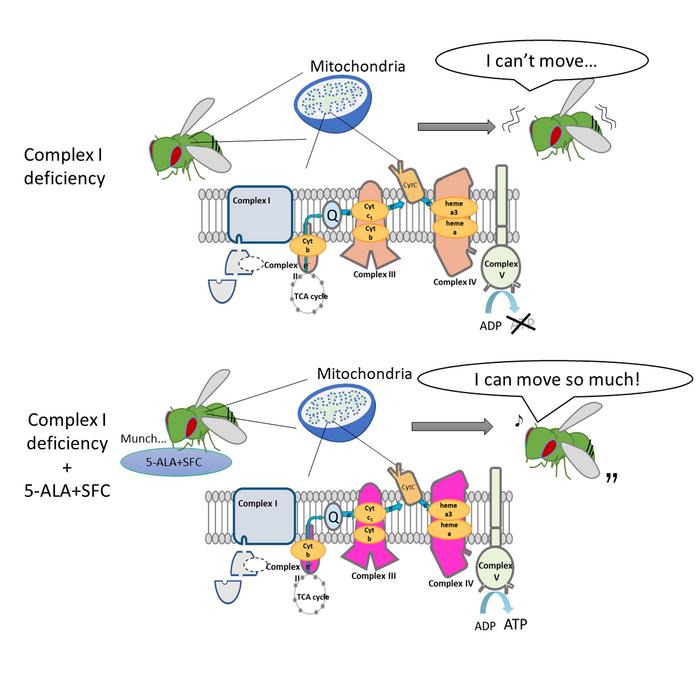
Now, a team led by Associate Professor Kanae Ando of Tokyo Metropolitan University have shown that certain chemical supplements might help selectively boost CII and CIV to bypass the lack of CI. They studied fruit flies with their equivalent of CI artificially reduced by genetic engineering; flies with this genetic “knockdown” showed problems with their movement and shorter lifespans. However, they found that feeding them a mixture of 5-aminovulenic acid and sodium ferrous citrate (SFC) helped improve their locomotor functions and neuromuscular junction development. Levels of ATP were also significantly improved, but this was not due to any elevation in the amount of CI.
On closer inspection, the team ascertained that activities of Complex II and IV were elevated and helped bypass the issues associated with CI deficiency. 5-ALA is known to be a precursor to heme, a critical part of the function of Complex II, III, IV and cytochrome c. On being fed 5-ALA, the fruit flies showed a metabolic shift which used the ability of CII and CIV to transport electrons and power the production of ATP. They also noticed that flies with CI deficiency had elevated levels of pyruvate and lactate in their cells, much like human patients with CI deficiency suffering from lactic acidosis. 5-ALA also helped bring down the levels of both.
Despite the severity of mitochondrial disorders, there is as of yet no treatment which addresses the root cause of the vast array of health issues they may cause. The team’s findings promise not only new insight but potentially new therapeutic options for a whole class of deadly diseases.
This work was supported by the Japan Foundation for Aging and Health, a Grant-in-Aid for Scientific Research on Challenging Research (Exploratory) [JSPS KAKENHI Grant Number 19K21593], and SBI Pharmaceuticals Co., Ltd.
Journal
Human Molecular Genetics
DOI
10.1093/hmg/ddad092
Article Title
5-Aminolevulinic acid bypasses mitochondrial complex I deficiency and corrects physiological dysfunctions in Drosophila
Article Publication Date
26-Jun-2023