• HOME
  • NEWS
  • EXPLORE
    • CAREER
      • Companies
      • Jobs
    • EVENTS
    • iGEM
      • News
      • Team
    • PHOTOS
    • VIDEO
    • WIKI
  • BLOG
  • COMMUNITY
    • FACEBOOK
    • INSTAGRAM
    • TWITTER
Tuesday, September 1, 2026
BIOENGINEER.ORG
No Result
View All Result
  • Login
  • HOME
  • NEWS
  • EXPLORE
    • CAREER
      • Companies
      • Jobs
        • Lecturer
        • PhD Studentship
        • Postdoc
        • Research Assistant
    • EVENTS
    • iGEM
      • News
      • Team
    • PHOTOS
    • VIDEO
    • WIKI
  • BLOG
  • COMMUNITY
    • FACEBOOK
    • INSTAGRAM
    • TWITTER
  • HOME
  • NEWS
  • EXPLORE
    • CAREER
      • Companies
      • Jobs
        • Lecturer
        • PhD Studentship
        • Postdoc
        • Research Assistant
    • EVENTS
    • iGEM
      • News
      • Team
    • PHOTOS
    • VIDEO
    • WIKI
  • BLOG
  • COMMUNITY
    • FACEBOOK
    • INSTAGRAM
    • TWITTER
No Result
View All Result
Bioengineer.org
No Result
View All Result
Home NEWS Science News Biology

How COVID-19 crosses the placenta – study using placental tissue grown in the lab

Bioengineer by Bioengineer
July 13, 2023
in Biology
Reading Time: 3 mins read
0
Placenta cells infected with the SARS-CoV-2 virus
Share on FacebookShare on TwitterShare on LinkedinShare on RedditShare on Telegram

RESEARCH REVEALS HOW COVID-19 VIRUS INFECTS THE PLACENTA, AND HOW THIS CAN BE PREVENTED
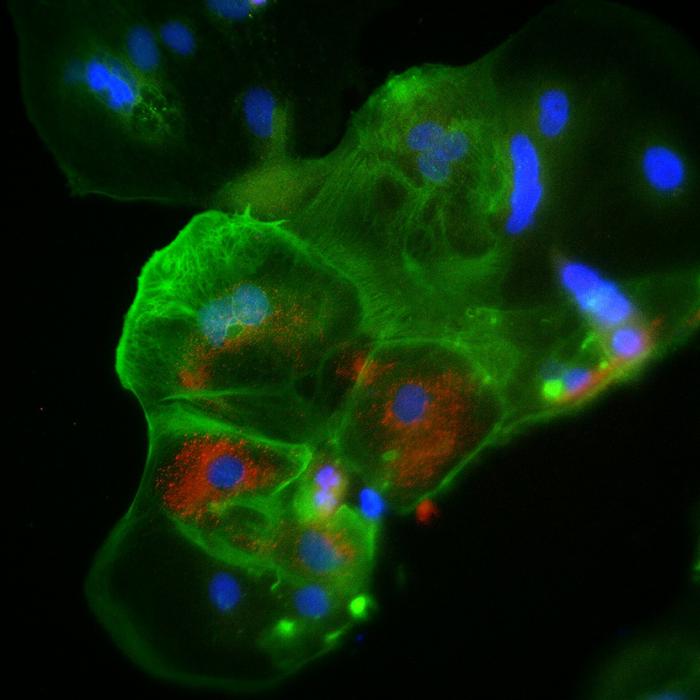
Placenta cells infected with the SARS-CoV-2 virus

Credit: Monash University

RESEARCH REVEALS HOW COVID-19 VIRUS INFECTS THE PLACENTA, AND HOW THIS CAN BE PREVENTED

In a landmark study published in Nature Cell Biology, Australian researchers, led by Professor Jose Polo from Monash University and the University of Adelaide and University of Melbourne’s Professor Kanta Subbarao from the Peter Doherty Institute for Infection and Immunity (Doherty Institute), have revealed how COVID-19 can infect the human placenta.

Research has shown that COVID-19 infections during pregnancy may lead to adverse outcomes, but little is known about the mechanisms behind the effects of SARS-CoV-2 infection in pregnancy.

The Australian research team grew placenta tissue in the lab, using a state-of-the-art method developed by Professor Polo and colleagues where human skin cells are “reprogrammed” into trophoblast stem cells (the cells that help a developing embryo attach to the wall of the uterus, forming part of the placenta). They found that ACE2, a protein that acts as the doorway for SARS-CoV-2 to enter organs such as the lung, is present in specific placental cells, like syncytiotrophoblasts (ST cells).

Importantly, ST cells were susceptible to the virus – a major finding as these placental cells produce the key hormone for maintaining pregnancy (hCG).

Dr Joseph Chen, a stem cell biologist at Monash University and co-first author of the report, said this discovery explains several clinical reports indicating inflammation of the placenta due to COVID-19.

“We observed that SARS-CoV-2 infection led to a significant reduction in the survival and differentiation of ST cells, which in turn resulted in lower production of hCG,” he said. “It suggests that this is how COVID-19 could impact pregnancy, though further investigations are needed.”

Virologist at Doherty Institute and co-first author of the study Dr Jessica Neil said, “our team also discovered that anti-ACE2 antibodies and antiviral drugs were effective in preventing SARS-CoV-2 infection and restoring normal ST differentiation and function”.

Professor Subbarao said that this study is a significant advance for the broader understanding of viral infections in pregnancy.

“Our study provides valuable insights into the link between SARS-CoV-2 infection and placenta pathology. This is a game changer as we are now equipped to explore how the early placenta may be affected by other viruses as well,” she said.

Professor Polo emphasised the importance of the research in establishing a platform to study early placental cell types.

“This study not only helps us to understand what happens when the placenta is infected with the COVID-19 virus during pregnancy, it also means we have established a broader, scalable and tractable platform to study early placental cell types,” he said.

——


Journal

Nature Cell Biology

DOI

10.1038/s41556-023-01182-0

Method of Research

Experimental study

Subject of Research

Cells

Article Title

A placental model of SARS-CoV-2 infection reveals ACE2-dependent susceptibility and differentiation impairment in syncytiotrophoblasts

Article Publication Date

13-Jul-2023

Share12Tweet8Share2ShareShareShare2

Related Posts

Methylation puts parasites in motion

Methylation puts parasites in motion

August 31, 2026
Desiccation promotes DNA damage and rifampin resistance in Mycobacterium tuberculosis

Desiccation promotes DNA damage and rifampin resistance in Mycobacterium tuberculosis

August 31, 2026

Gastrointestinal Parasitism in Cattle and Water Buffaloes in Pakistan: Prevalence and Associated Risk Factors

August 31, 2026

Development of HPLC–PDA method for steviol glycosides analysis in food matrices

August 31, 2026

POPULAR NEWS

  • β-Sitosterol from Ipomoea carnea Jacq. As a promising anti-inflammatory agent: Evidence from in silico modeling and in vitro validation

    29 shares
    Share 12 Tweet 7
  • Design, fabrication and characterization of a wearable Fiber Bragg grating sensor for cardiorespiratory monitoring using finger plethysmography

    29 shares
    Share 12 Tweet 7
  • KAIST opens the era of industrial-scale microbial foods, proposing growth strategies for the next-generation protein market

    29 shares
    Share 12 Tweet 7
  • Virologist awarded $2 million NIH grant to investigate how virus-infected cells live and die

    29 shares
    Share 12 Tweet 7

About

We bring you the latest biotechnology news from best research centers and universities around the world. Check our website.

Follow us

Recent News

β-Sitosterol from Ipomoea carnea Jacq. As a promising anti-inflammatory agent: Evidence from in silico modeling and in vitro validation

Design, fabrication and characterization of a wearable Fiber Bragg grating sensor for cardiorespiratory monitoring using finger plethysmography

KAIST opens the era of industrial-scale microbial foods, proposing growth strategies for the next-generation protein market

Subscribe to Blog via Email

Enter your email address to subscribe to this blog and receive notifications of new posts by email.

Join 85 other subscribers
  • Contact Us

Bioengineer.org © Copyright 2023 All Rights Reserved.

Welcome Back!

Login to your account below

Forgotten Password?

Retrieve your password

Please enter your username or email address to reset your password.

Log In
No Result
View All Result
  • Homepages
    • Home Page 1
    • Home Page 2
  • News
  • National
  • Business
  • Health
  • Lifestyle
  • Science

Bioengineer.org © Copyright 2023 All Rights Reserved.