• HOME
  • NEWS
  • EXPLORE
    • CAREER
      • Companies
      • Jobs
    • EVENTS
    • iGEM
      • News
      • Team
    • PHOTOS
    • VIDEO
    • WIKI
  • BLOG
  • COMMUNITY
    • FACEBOOK
    • INSTAGRAM
    • TWITTER
Tuesday, September 1, 2026
BIOENGINEER.ORG
No Result
View All Result
  • Login
  • HOME
  • NEWS
  • EXPLORE
    • CAREER
      • Companies
      • Jobs
        • Lecturer
        • PhD Studentship
        • Postdoc
        • Research Assistant
    • EVENTS
    • iGEM
      • News
      • Team
    • PHOTOS
    • VIDEO
    • WIKI
  • BLOG
  • COMMUNITY
    • FACEBOOK
    • INSTAGRAM
    • TWITTER
  • HOME
  • NEWS
  • EXPLORE
    • CAREER
      • Companies
      • Jobs
        • Lecturer
        • PhD Studentship
        • Postdoc
        • Research Assistant
    • EVENTS
    • iGEM
      • News
      • Team
    • PHOTOS
    • VIDEO
    • WIKI
  • BLOG
  • COMMUNITY
    • FACEBOOK
    • INSTAGRAM
    • TWITTER
No Result
View All Result
Bioengineer.org
No Result
View All Result
Home NEWS Science News Chemistry

Hidden details of Egyptian paintings revealed by chemical imaging

Bioengineer by Bioengineer
July 12, 2023
in Chemistry
Reading Time: 3 mins read
0
Hidden mysteries in ancient Egyptian paintings from the Theban Necropolis observed by in-situ XRF mapping
Share on FacebookShare on TwitterShare on LinkedinShare on RedditShare on Telegram

Portable chemical imaging technology can reveal hidden details in ancient Egyptian paintings, according to a study published July 12, 2023 in the open-access journal PLOS ONE by Philippe Martinez of Sorbonne University, France in collaboration with colleagues at the University of Liège, Belgium.
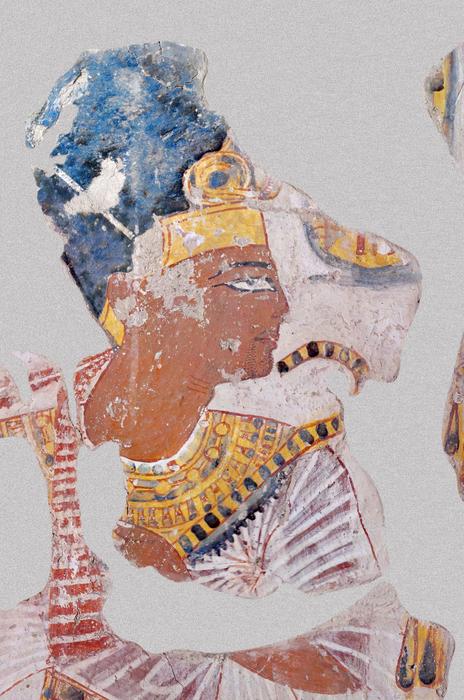
Hidden mysteries in ancient Egyptian paintings from the Theban Necropolis observed by in-situ XRF mapping

Credit: Image Credit 1: Martinez et al., CC-BY 4.0 (https://creativecommons.org/licenses/by/4.0/)

Portable chemical imaging technology can reveal hidden details in ancient Egyptian paintings, according to a study published July 12, 2023 in the open-access journal PLOS ONE by Philippe Martinez of Sorbonne University, France in collaboration with colleagues at the University of Liège, Belgium.

Ancient Egyptian paintings are commonly thought to be the result of highly formalized workflows that produced skilled works of art. However, most studies of these paintings and the process that created them take place in museums or laboratories. In this study, Martinez and colleagues use portable devices to perform chemical imaging on paintings in their original context, allowing for analysis of paint composition and layering and for the identification of alterations made to ancient paintings.

Two paintings were analyzed in detail, both located in tomb chapels in the Theban Necropolis near the River Nile, dating to the Ramesside Period. On the first painting, researchers were able to identify alterations made to the position of a figure’s arm, though the reason for this relatively small change is uncertain. On the second painting, analysis uncovered numerous adjustments to the crown and other royal items depicted on a portrait of Ramesses II, a series of changes that most likely relate to some change in symbolic meaning over time.

Such alterations to paintings are thought to be rare among such art, but the researchers suggest that these discoveries call for further investigation. Many uncertainties remain about the reasoning and the timing behind the alterations observed, some of which might be resolved by future analysis. This study also serves to prove the utility of portable chemical imaging technology for studying ancient paintings in-situ.

The authors add: “These discoveries clearly call for a systematized and closer inspection of paintings in Egypt using physicochemical characterization.”

#####

In your coverage please use this URL to provide access to the freely available article in PLOS ONE: https://journals.plos.org/plosone/article?id=10.1371/journal.pone.0287647

Citation: Martinez P, Alfeld M, Defeyt C, Elleithy H, Glanville H, Hartwig M, et al. (2023) Hidden mysteries in ancient Egyptian paintings from the Theban Necropolis observed by in-situ XRF mapping. PLoS ONE 18(7): e0287647. https://doi.org/10.1371/journal.pone.0287647

Author Countries: France, Egypt, Netherlands, Belgium, USA

Funding: PW: DIM Analytics, project IMAPAT, Ile-de-France, https://www.dim-analytics.fr PW: ANR-11-IDEX-0004-02, National Research Agency under the program Future Investments (program POLYRE of Sorbonne Universités), http://anr.fr CD and DS: Prf-2019-060, The Belgian Federal Science Policy Office through the FED-tWIN program, http://www.belspo.be. The funders had no role in study design, data collection and analysis, decision to publish, or preparation of the manuscript.


Journal

PLoS ONE

DOI

10.1371/journal.pone.0287647

Method of Research

Observational study

Subject of Research

Not applicable

Article Title

Hidden mysteries in ancient Egyptian paintings from the Theban Necropolis observed by in-situ XRF mapping

Article Publication Date

12-Jul-2023

COI Statement

The authors have declared that no competing interests exist.

Share12Tweet8Share2ShareShareShare2

Related Posts

β-Sitosterol from Ipomoea carnea Jacq. As a promising anti-inflammatory agent: Evidence from in silico modeling and in vitro validation

β-Sitosterol from Ipomoea carnea Jacq. As a promising anti-inflammatory agent: Evidence from in silico modeling and in vitro validation

August 31, 2026
Graded membranes point to a sustainable route for refining complex petroleum

Graded membranes point to a sustainable route for refining complex petroleum

August 31, 2026

Round-robin tests quantify catalyst activity and deactivation in CO2 hydrogenation modelling

August 30, 2026

Researchers reveal guiding principles for electrochemical synthesis of multimetallic nanocrystals

August 30, 2026

POPULAR NEWS

  • β-Sitosterol from Ipomoea carnea Jacq. As a promising anti-inflammatory agent: Evidence from in silico modeling and in vitro validation

    29 shares
    Share 12 Tweet 7
  • Design, fabrication and characterization of a wearable Fiber Bragg grating sensor for cardiorespiratory monitoring using finger plethysmography

    29 shares
    Share 12 Tweet 7
  • KAIST opens the era of industrial-scale microbial foods, proposing growth strategies for the next-generation protein market

    29 shares
    Share 12 Tweet 7
  • Virologist awarded $2 million NIH grant to investigate how virus-infected cells live and die

    29 shares
    Share 12 Tweet 7

About

We bring you the latest biotechnology news from best research centers and universities around the world. Check our website.

Follow us

Recent News

β-Sitosterol from Ipomoea carnea Jacq. As a promising anti-inflammatory agent: Evidence from in silico modeling and in vitro validation

Design, fabrication and characterization of a wearable Fiber Bragg grating sensor for cardiorespiratory monitoring using finger plethysmography

KAIST opens the era of industrial-scale microbial foods, proposing growth strategies for the next-generation protein market

Subscribe to Blog via Email

Enter your email address to subscribe to this blog and receive notifications of new posts by email.

Join 85 other subscribers
  • Contact Us

Bioengineer.org © Copyright 2023 All Rights Reserved.

Welcome Back!

Login to your account below

Forgotten Password?

Retrieve your password

Please enter your username or email address to reset your password.

Log In
No Result
View All Result
  • Homepages
    • Home Page 1
    • Home Page 2
  • News
  • National
  • Business
  • Health
  • Lifestyle
  • Science

Bioengineer.org © Copyright 2023 All Rights Reserved.