Within the scope of a vast research program undertaken in coordination with the Egyptian Ministry of Antiquities and the University of Liège, an international team—including scientists from the CNRS, Sorbonne University, and Université Grenoble Alpes—has revealed the artistic license exercised in two ancient Egyptian funerary paintings (dating to ~1,400 and ~1,200 BCE, respectively), as evident in newly discovered details invisible to the naked eye. Their findings are published in PLOS ONE (12 July).
Credit: © LAMS-MAFTO, CNRS
Within the scope of a vast research program undertaken in coordination with the Egyptian Ministry of Antiquities and the University of Liège, an international team—including scientists from the CNRS, Sorbonne University, and Université Grenoble Alpes—has revealed the artistic license exercised in two ancient Egyptian funerary paintings (dating to ~1,400 and ~1,200 BCE, respectively), as evident in newly discovered details invisible to the naked eye. Their findings are published in PLOS ONE (12 July).
The language of ancient Egypt has no known word for ‘art’. Its civilization is often perceived as having been extremely formal in its creative expression, the works completed by the painters of its funerary chapels being no exception.
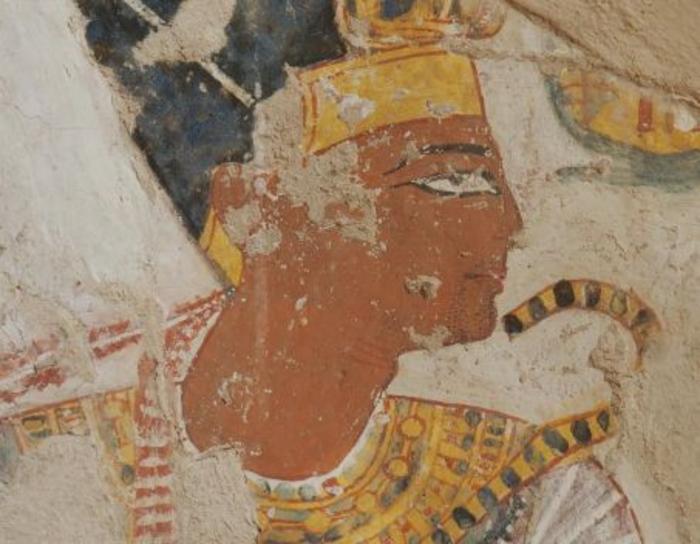
Yet an international, multidisciplinary team1 led by CNRS researchers Philippe Martinez and Philippe Walter has brought to light pictorial techniques and practices whose faint traces had long allowed them to elude detection. While studying the likeness of Ramses II in the tomb of Nakhtamon2 and the paintings of Menna’s3 tomb—among hundreds of other nobles’ tombs in Luxor—they found signs of touch-ups made to the paintings in the course of their production.
For example, the headdress, necklace, and sceptre in the image of Ramses II were substantially reworked, though this is invisible to the naked eye. And in a scene of adoration depicted in Menna’s tomb, the position and colour of an arm were modified. The pigments used to represent skin colour differ from those first applied, resulting in subtle changes whose purpose still remains uncertain. Thus, these painters, or ‘draughtsmen-scribes’—at the request of the individuals who commissioned their works, or at the initiative of the artists themselves as their own vision of the works changed—could add their personal touches to conventional motifs.
The scientists relied on novel, portable tools enabling nondestructive in situ chemical analysis and imaging to make their discovery. Altered by time and physicochemical changes, the colours in these paintings have lost their original appearance. But the chemical analysis performed by the scientists, together with their 3D digital reconstructions of the works using photogrammetry and macrophotography, should make it possible to restore the original hues—and change our perception of these masterpieces, too often viewed as static artefacts.
The team’s research demonstrates that pharaonic art and the conditions of its production were certainly more dynamic and complex than once thought. The next mission of the scientists will be to analyse other paintings in the search for new signs of the craftsmanship and intellectual identities of ancient Egyptian draughtsmen-scribes.
Notes
- The team in France is based at the Laboratory of Molecular and Structural Archaeology (CNRS/Sorbonne University) and the Institut Néel (CNRS). Its work is part of an ambitious program coordinated with the Egyptian Ministry of Antiquities and the University of Liège.
- Nakhtamon was a priest responsible for the daily provisioning of altars in the Ramesseum, or ‘House of Millions of Years’, of Ramses II.
- Menna held the title of Overseer of the Fields of the Lord of the Two Lands (i.e., Upper and Lower Egypt) and was responsible for their agricultural production.
Journal
PLoS ONE
Method of Research
Experimental study
Subject of Research
Not applicable
Article Title
Secrets of Egyptian painters revealed by chemistry
Article Publication Date
12-Jul-2023