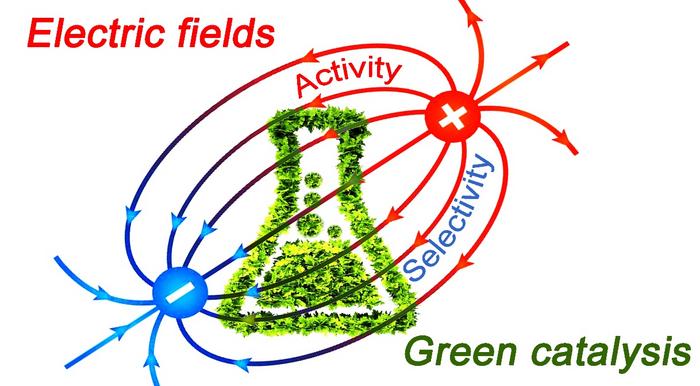
This perspective is led by Prof. Weidong Shi and Prof. Long Zhang. Developing new and more-efficient catalytic ways to control chemical reactivity and selectivity has been a constant quest for chemists in the fields of chemical manufacturing and fundamental research. Evidence is growing pointing in the direction of utilizing oriented external electric fields as “smart effector” to manipulate a range of chemical change, such as chemical bonding, selectivity, mechanistic crossover and catalysis/inhibition.
Credit: ©Science China Press
This perspective is led by Prof. Weidong Shi and Prof. Long Zhang. Developing new and more-efficient catalytic ways to control chemical reactivity and selectivity has been a constant quest for chemists in the fields of chemical manufacturing and fundamental research. Evidence is growing pointing in the direction of utilizing oriented external electric fields as “smart effector” to manipulate a range of chemical change, such as chemical bonding, selectivity, mechanistic crossover and catalysis/inhibition.
Unlike the traditional approach of accelerating rates by adding specific chemical entities – molecular catalysts – electrostatic catalysis entails the key advantages of (1) removing the trial and error work of screening for a suitable catalyst, (2) relieving the need of separating the valuable catalysts from products, (3) avoiding possible risks not only to the health of experimentalists but also to the environment, (4) adding the option of predictably being able to adjust reaction reactivity and selectivity at will, simply by altering the orientation and magnitude of the OEEFs. However, to date, the proof-of-concept of electrostatic catalysis is still at the embryonic stage of its experimental scrutiny and most of research has been theoretical.
“The concept of electrostatic catalysis is limited to some nanoscale reactions incapable of processing chemical reactions in the preparative scale, and costly and sophisticated for bulk synthesis”, Zhang says, “one needs to develop versatile platforms for expanding the branch of catalysis into the scalable technology, possible strategies includes: 1) polar materials, take the piezoelectric nanomaterial as an example, which will generate the polarized electric field inside the piezoelectrics upon mechanical stimuli, followed by inducing some free charges on the surface of nanomaterials; 2) friction-induced static charges, friction between dielectrics leads to transfer of either electrons or charged molecular fragments into the solvents, which will immediately generate a near-surface field around plastic microbeads in the absence of applied potential, connecting wires or conductive electrodes. These methods enable some reacting molecules would always randomly orient with electric fields, in particular, it was found that the molecules tend to align with the charge-induced fields when they are approaching charged surface.” In addition, microdroplet environments, biased electrodes and metal-organic frameworks would be alternative platforms for achieving electrostatic catalysis in a more effective way.
Shi Says, “the use of electric fields as green catalysts has the potential to revolutionize processing technology by enabling more efficient, sustainable, and selective chemical transformations. As research in this area continues to progress, it is likely that we will see more widespread adoption of electric field-based technologies in various industries, leading to a more sustainable and greener future.
See the article:
Electrostatics Advancing Green Catalysis Events
http://engine.scichina.com/doi/10.1007/s11426-023-1604-6
Journal
Science China Chemistry
DOI
10.1007/s11426-023-1604-6