Common drugs such as paracetamol and ibuprofen can be made from a chemical from pine trees instead of crude oil products.
Credit: University of Bath
Common drugs such as paracetamol and ibuprofen can be made from a chemical from pine trees instead of crude oil products.
- Turpentine is a waste product from the paper industry and is usually burned to generate energy.
- Around 350,000 tonnes of turpentine is generated in the world – enough to supply the global demand for paracetamol and ibuprofen (~100,000 tonnes).
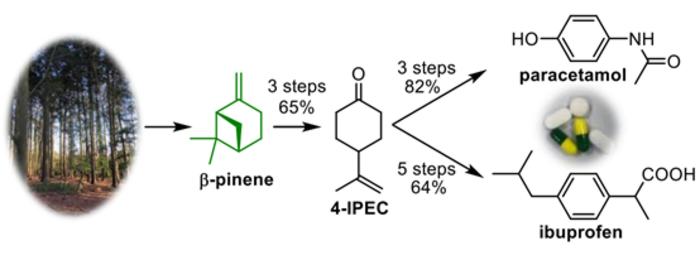
- New method converts one of the components of turpentine (β-pinene) into a range of valuable chemical starting blocks for perfumes, plastics and pharmaceuticals including paracetamol and ibuprofen.
- Turpentine is a biorenewable, sustainable starting material that could replace crude oil products, and is not subject to price fluctuations of crude oil.
A team of scientists, from the University of Bath’s Department of Chemistry and Institute for Sustainability have found a way to create two of the world’s most common painkillers, paracetamol and ibuprofen, out of a compound found in pine trees, which is also a waste product from the paper industry.
It is perhaps not widely known that many common pharmaceuticals are manufactured using chemical precursors derived from crude oil, presenting a niche sustainability challenge as the world targets Net Zero.
The research team from Bath has developed a method of creating a range of pharmaceutical precursors from biorenewable β-pinene, a component of turpentine which is a waste by-product from the paper industry (annual production >350,000 tonnes).
They successfully converted β-pinene into two everyday painkillers, paracetamol and ibuprofen, which are produced on ~100,000 tonne scales annually.
They also successfully synthesised a range of other precursor chemicals from turpentine, including 4-HAP (4-hydroxyacetophenone), which is the precursor of drugs including beta-blockers and the asthma inhaler drug, salbutamol, as well as others widely used for perfumes and in cleaning products.
They hope that this more sustainable “biorefinery” approach could replace the need for crude oil products in the chemical industry.
Dr Josh Tibbetts, Research Associate in the University’s Department of Chemistry, said: “Using oil to make pharmaceuticals is unsustainable – not only is it contributing to rising CO2 emissions, but the price fluctuates dramatically as we are greatly dependent on the geopolitical stability of countries with large oil-reserves, and it is only going to get more expensive.
“Instead of extracting more oil from the ground, we want to replace this in the future with a ‘bio-refinery’ model.
“Our turpentine-based biorefinery model uses waste chemical by-products from the paper industry to produce a spectrum of valuable, sustainable chemicals that can be used in a wide range of applications from perfumes to paracetamol.”
Instead of putting chemicals in a large reactor to create separate batches of product, the method uses continuous flow reactors, meaning production can be uninterrupted and easier to scale up.
Whilst the process in its current form may be more expensive than using oil-based feedstocks, consumers may be prepared to pay a slightly higher price for more sustainable pharmaceuticals that are completely plant-derived.
The research, funded by the Engineering and Physical Sciences Research Council, is published in the journal ChemSusChem. https://doi.org/10.1002/cssc.202300670
Journal
ChemSusChem
DOI
10.1002/cssc.202300670
Method of Research
Experimental study
Subject of Research
Not applicable
Article Title
Sustainable Syntheses of Paracetamol and Ibuprofen from Biorenewable β-pinene
Article Publication Date
18-Jun-2023