• HOME
  • NEWS
  • EXPLORE
    • CAREER
      • Companies
      • Jobs
    • EVENTS
    • iGEM
      • News
      • Team
    • PHOTOS
    • VIDEO
    • WIKI
  • BLOG
  • COMMUNITY
    • FACEBOOK
    • INSTAGRAM
    • TWITTER
Wednesday, September 2, 2026
BIOENGINEER.ORG
No Result
View All Result
  • Login
  • HOME
  • NEWS
  • EXPLORE
    • CAREER
      • Companies
      • Jobs
        • Lecturer
        • PhD Studentship
        • Postdoc
        • Research Assistant
    • EVENTS
    • iGEM
      • News
      • Team
    • PHOTOS
    • VIDEO
    • WIKI
  • BLOG
  • COMMUNITY
    • FACEBOOK
    • INSTAGRAM
    • TWITTER
  • HOME
  • NEWS
  • EXPLORE
    • CAREER
      • Companies
      • Jobs
        • Lecturer
        • PhD Studentship
        • Postdoc
        • Research Assistant
    • EVENTS
    • iGEM
      • News
      • Team
    • PHOTOS
    • VIDEO
    • WIKI
  • BLOG
  • COMMUNITY
    • FACEBOOK
    • INSTAGRAM
    • TWITTER
No Result
View All Result
Bioengineer.org
No Result
View All Result
Home NEWS Science News Chemistry

Electrosynthesis of 15N-labeled amino acids from 15N-nitrite and ketonic acids

Bioengineer by Bioengineer
June 30, 2023
in Chemistry
Reading Time: 2 mins read
0
Electrosynthesis of 15N-labeled amino acids from 15N-nitrite and ketonic acids
Share on FacebookShare on TwitterShare on LinkedinShare on RedditShare on Telegram

15N isotope-labeled amino acids (15N-amino acids) provide a safe and effective tracer tool for studying the synthesis of natural products, protein metabolism, and disease diagnosis and treatment in living organisms. In addition, it is an important synthetic block for the synthesis of 15N-labeled drugs. Currently, 15N-labeled amino acids are generally synthesized by microbial fermentation and chemical reduction amination of ketoacids, but these methods usually require complex steps, high temperature conditions or the use of toxic cyanide, causing energy and environmental problems. Therefore, it is of great significance to develop a green and mild method for the synthesis of 15N-amino acids.
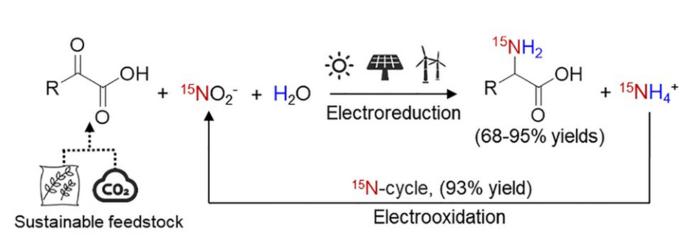
Electrosynthesis of 15N-labeled amino acids from 15N-nitrite and ketonic acids

Credit: ©Science China Press

15N isotope-labeled amino acids (15N-amino acids) provide a safe and effective tracer tool for studying the synthesis of natural products, protein metabolism, and disease diagnosis and treatment in living organisms. In addition, it is an important synthetic block for the synthesis of 15N-labeled drugs. Currently, 15N-labeled amino acids are generally synthesized by microbial fermentation and chemical reduction amination of ketoacids, but these methods usually require complex steps, high temperature conditions or the use of toxic cyanide, causing energy and environmental problems. Therefore, it is of great significance to develop a green and mild method for the synthesis of 15N-amino acids.

Recently, Zhang’s group reported an electrochemical method to synthesize 15N-amino acids from 15N-nitrite and ketonic acids over a commercial nickel foam (NF) cathode in an aqueous solution under ambient conditions. 15N-alanine with a 93% yield was achieved. Impressively, 15N-ammonium, the major byproduct, could be electrooxidized to 15N-nitrite with a yield of 93%, realizing the recycling property and atomic economy of 15N-nitrite. A 15N-nitrite→15NH2OH→15N-oxime→15N-amino acid pathway was revealed by a series of control experiments, in situ attenuated total reflection Fourier transform infrared (in situ A TR-SEIRAS) spectroscopy, and online differential electrochemical mass spectrometry (DEMS). Furthermore, the method was suitable for synthesizing six 15N-amino acids with 68%–95% yields, demonstrating the good universality of this method. A hepatitis treatment drug, 15N-tiopronin, was synthesized using 15N-glycine, highlighting the utility of this method.

The study not only offers a strategy for the room-temperature and green synthesis of 15N-amino acids but also opens a sustainable avenue to construct 15N-labeled compounds.

See the article:

Electrosynthesis of 15N-labeled amino acids from 15N-nitrite and ketonic acids

https://doi.org/10.1007/s11426-023-1613-x


Journal

Science China Chemistry

DOI

10.1007/s11426-023-1613-x

Share12Tweet8Share2ShareShareShare2

Related Posts

β-Sitosterol from Ipomoea carnea Jacq. As a promising anti-inflammatory agent: Evidence from in silico modeling and in vitro validation

β-Sitosterol from Ipomoea carnea Jacq. As a promising anti-inflammatory agent: Evidence from in silico modeling and in vitro validation

August 31, 2026
Graded membranes point to a sustainable route for refining complex petroleum

Graded membranes point to a sustainable route for refining complex petroleum

August 31, 2026

Round-robin tests quantify catalyst activity and deactivation in CO2 hydrogenation modelling

August 30, 2026

Researchers reveal guiding principles for electrochemical synthesis of multimetallic nanocrystals

August 30, 2026

POPULAR NEWS

  • β-Sitosterol from Ipomoea carnea Jacq. As a promising anti-inflammatory agent: Evidence from in silico modeling and in vitro validation

    29 shares
    Share 12 Tweet 7
  • Design, fabrication and characterization of a wearable Fiber Bragg grating sensor for cardiorespiratory monitoring using finger plethysmography

    29 shares
    Share 12 Tweet 7
  • KAIST opens the era of industrial-scale microbial foods, proposing growth strategies for the next-generation protein market

    29 shares
    Share 12 Tweet 7
  • Virologist awarded $2 million NIH grant to investigate how virus-infected cells live and die

    29 shares
    Share 12 Tweet 7

About

We bring you the latest biotechnology news from best research centers and universities around the world. Check our website.

Follow us

Recent News

β-Sitosterol from Ipomoea carnea Jacq. As a promising anti-inflammatory agent: Evidence from in silico modeling and in vitro validation

Design, fabrication and characterization of a wearable Fiber Bragg grating sensor for cardiorespiratory monitoring using finger plethysmography

KAIST opens the era of industrial-scale microbial foods, proposing growth strategies for the next-generation protein market

Subscribe to Blog via Email

Success! An email was just sent to confirm your subscription. Please find the email now and click 'Confirm' to start subscribing.

Join 85 other subscribers
  • Contact Us

Bioengineer.org © Copyright 2023 All Rights Reserved.

Welcome Back!

Login to your account below

Forgotten Password?

Retrieve your password

Please enter your username or email address to reset your password.

Log In
No Result
View All Result
  • Homepages
    • Home Page 1
    • Home Page 2
  • News
  • National
  • Business
  • Health
  • Lifestyle
  • Science

Bioengineer.org © Copyright 2023 All Rights Reserved.