• HOME
  • NEWS
  • EXPLORE
    • CAREER
      • Companies
      • Jobs
    • EVENTS
    • iGEM
      • News
      • Team
    • PHOTOS
    • VIDEO
    • WIKI
  • BLOG
  • COMMUNITY
    • FACEBOOK
    • INSTAGRAM
    • TWITTER
Saturday, February 7, 2026
BIOENGINEER.ORG
No Result
View All Result
  • Login
  • HOME
  • NEWS
  • EXPLORE
    • CAREER
      • Companies
      • Jobs
        • Lecturer
        • PhD Studentship
        • Postdoc
        • Research Assistant
    • EVENTS
    • iGEM
      • News
      • Team
    • PHOTOS
    • VIDEO
    • WIKI
  • BLOG
  • COMMUNITY
    • FACEBOOK
    • INSTAGRAM
    • TWITTER
  • HOME
  • NEWS
  • EXPLORE
    • CAREER
      • Companies
      • Jobs
        • Lecturer
        • PhD Studentship
        • Postdoc
        • Research Assistant
    • EVENTS
    • iGEM
      • News
      • Team
    • PHOTOS
    • VIDEO
    • WIKI
  • BLOG
  • COMMUNITY
    • FACEBOOK
    • INSTAGRAM
    • TWITTER
No Result
View All Result
Bioengineer.org
No Result
View All Result
Home NEWS Science News Chemistry

Scientists edge toward scalable quantum simulations on a photonic chip

Bioengineer by Bioengineer
June 29, 2023
in Chemistry
Reading Time: 2 mins read
0
Quantum Simulator Model
Share on FacebookShare on TwitterShare on LinkedinShare on RedditShare on Telegram

Scientists have made an important step toward developing computers advanced enough to simulate complex natural phenomena at the quantum level. While these types of simulations are too cumbersome or outright impossible for classical computers to handle, photonics-based quantum computing systems could provide a solution.
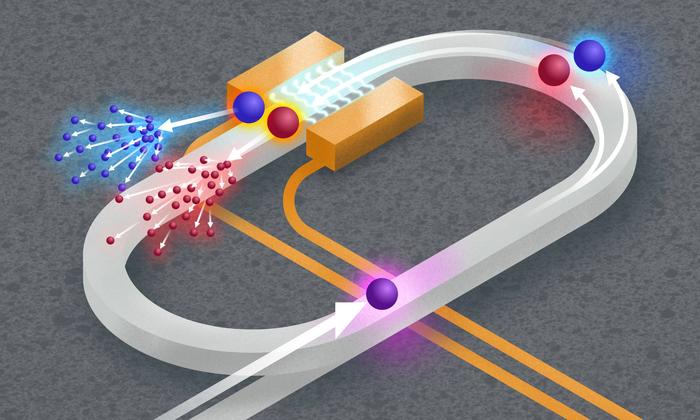
Quantum Simulator Model

Credit: University of Rochester illustration / Michael Osadciw

Scientists have made an important step toward developing computers advanced enough to simulate complex natural phenomena at the quantum level. While these types of simulations are too cumbersome or outright impossible for classical computers to handle, photonics-based quantum computing systems could provide a solution.

A team of researchers from the University of Rochester’s Hajim School of Engineering & Applied Sciences developed a new chip-scale optical quantum simulation system that could help make such a system feasible. The team, led by Qiang Lin, a professor of electrical and computer engineering and optics, published their findings in Nature Photonics.

Lin’s team ran the simulations in a synthetic space that mimics the physical world by controlling the frequency, or color, of quantum entangled photons as time elapses. This approach differs from the traditional photonics-based computing methods in which the paths of photons are controlled, and also drastically reduces the physical footprint and resource requirements.

“For the first time, we have been able to produce a quantum-correlated synthetic crystal,” says Lin. “Our approach significantly extends the dimensions of the synthetic space, enabling us to perform simulations of several quantum-scale phenomena such as random walks of quantum entangled photons.”

The researchers say that this system can serve as a basis for more intricate simulations in the future.

“Though the systems being simulated are well understood, this proof-of-principle experiment demonstrates the power of this new approach for scaling up to more complex simulations and computation tasks, something we are very excited to investigate in the future,” says Usman Javid ’23 PhD (optics), the lead author on the study.

Other coauthors from Lin’s group include Raymond Lopez-Rios, Jingwei Ling, Austin Graf, and Jeremy Staffa.

The project was supported with funding from the National Science Foundation, the Defense Threat Reduction Agency’s Joint Science and Technology Office for Chemical and Biological Defense, and the Defense Advanced Research Projects Agency.


Journal

Nature Photonics

DOI

10.1038/s41566-023-01236-7

Method of Research

Computational simulation/modeling

Subject of Research

Not applicable

Article Title

Chip-scale simulations in a quantum-correlated synthetic space

Article Publication Date

22-Jun-2023

Share12Tweet8Share2ShareShareShare2

Related Posts

blank

Breakthrough in Environmental Cleanup: Scientists Develop Solar-Activated Biochar for Faster Remediation

February 7, 2026
blank

Cutting Costs: Making Hydrogen Fuel Cells More Affordable

February 6, 2026

Scientists Develop Hand-Held “Levitating” Time Crystals

February 6, 2026

Observing a Key Green-Energy Catalyst Dissolve Atom by Atom

February 6, 2026

POPULAR NEWS

  • Robotic Ureteral Reconstruction: A Novel Approach

    Robotic Ureteral Reconstruction: A Novel Approach

    82 shares
    Share 33 Tweet 21
  • Digital Privacy: Health Data Control in Incarceration

    63 shares
    Share 25 Tweet 16
  • Study Reveals Lipid Accumulation in ME/CFS Cells

    57 shares
    Share 23 Tweet 14
  • Breakthrough in RNA Research Accelerates Medical Innovations Timeline

    53 shares
    Share 21 Tweet 13

About

We bring you the latest biotechnology news from best research centers and universities around the world. Check our website.

Follow us

Recent News

Evaluating Pediatric Emergency Care Quality in Ethiopia

TPMT Expression Predictions Linked to Azathioprine Side Effects

Improving Dementia Care with Enhanced Activity Kits

Subscribe to Blog via Email

Success! An email was just sent to confirm your subscription. Please find the email now and click 'Confirm' to start subscribing.

Join 73 other subscribers
  • Contact Us

Bioengineer.org © Copyright 2023 All Rights Reserved.

Welcome Back!

Login to your account below

Forgotten Password?

Retrieve your password

Please enter your username or email address to reset your password.

Log In
No Result
View All Result
  • Homepages
    • Home Page 1
    • Home Page 2
  • News
  • National
  • Business
  • Health
  • Lifestyle
  • Science

Bioengineer.org © Copyright 2023 All Rights Reserved.