Fibre optics is now the fastest and most reliable technology to deliver internet connection. Data is transmitted through fast-travelling pulses of light that bounce off the walls of the fibre cables to allow the signal to travel further with less attenuation. However, fibre data transmission is subject to dispersion, or signal degradation from impairments in the optical fibre. This causes different wavelengths of light to travel at various speeds, spreading the signal over time and causing errors.
Credit: SUTD
Fibre optics is now the fastest and most reliable technology to deliver internet connection. Data is transmitted through fast-travelling pulses of light that bounce off the walls of the fibre cables to allow the signal to travel further with less attenuation. However, fibre data transmission is subject to dispersion, or signal degradation from impairments in the optical fibre. This causes different wavelengths of light to travel at various speeds, spreading the signal over time and causing errors.
Dispersion compensation methods can overcome this problem, with on-chip devices being especially promising as they can be put into the transceivers to increase signal reach. While on-chip dispersive devices exist, none have demonstrated dispersion compensation of high-speed data. This is the gap that researchers from the Photonics Devices and Systems Group of the Singapore University of Technology and Design (SUTD), led by Associate Professor Dawn Tan, aimed to close.
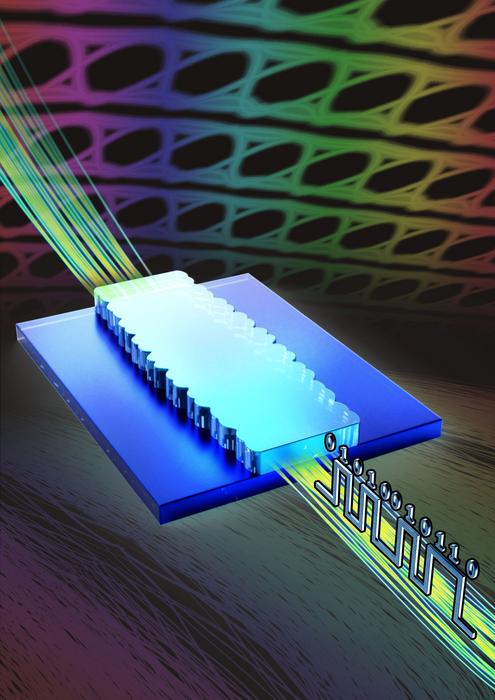
Many integrated dispersive devices are possible, but gratings seemed the most promising due to their advantageous transmission and phase properties. With gratings as their specialty, Associate Professor Tan and her team developed a breakthrough dispersive device and published their findings in the paper ‘Slow-light-based dispersion compensation of high-speed data on a silicon nitride chip’ in Advanced Photonics Research. Their paper was even selected as the June issue inside cover of the journal, signifying the promising application of the novel device.
“Our group has been working with gratings for various applications throughout the years. For example, we’ve used gratings for slow light, optical amplifiers, and solitons. Our experience in grating design and development as well as our interactions with the industry have helped us to address the current pain point in high-speed data movement,” said Associate Professor Tan.
Her research group designed and demonstrated a low loss, complementary metal-oxide semiconductor (CMOS)-compatible silicon nitride grating device for the dispersion compensation of high-speed data. The criteria they set out to fulfil in creating this device are three-fold: high dispersion, low data loss, and the small form factor required for on-chip integration.
Existing dispersive devices that generate high dispersion show high data loss, while devices that allow low data loss do not generate high dispersion. A device that could do both and be integrated onto a chip would be a significant advancement in data transmission technology. To address this, the researchers designed two grating devices—one with a single grating pitch of 434 nanometres (single grating device; SGD) and another with two overlaid gratings with dissimilar pitches of 434 and 440 nanometres (overlaid grating device; OGD).
The transmission spectra of both SGD and OGD are similar. A stopband at both spectra induces forward and backward propagating modes in the gratings. These modes interact and give rise to a slow-light effect, which is the reduction in the velocity of the light pulses. Slow-light effect varies rapidly with wavelength, generating areas of high dispersion. Due to the unique dispersive mechanism of the devices, data loss is minimally affected even with high dispersion.
“In this study, both SGD and OGD allowed the dispersion compensation of long fibre reaches (up to 20 kilometres) with minimal loss. Moreover, both devices achieved improved error correction performance, reducing bit error rates by nine orders of magnitude from 5×10⁻¹ to 1×10⁻¹⁰,” described Kenny Ong, PhD candidate at SUTD and the first author of the paper.
The OGD can also provide a range of dispersion values useful for dynamic dispersion compensation. “Using thermo-optic tuning, one could control the OGD dynamically to compensate for dispersion of various magnitudes, or dispersion associated with various fibre lengths,” Associate Professor Tan added.
This can simplify dispersion compensation systems used in different optical communication systems and help reduce temperature or fibre stress effects on data transmission. Since the dispersion profile of the OGD can be altered with small changes in wavelength, a smaller degree of thermo-optic tuning (that is, less power) is needed to bring about the required dispersion.
Integrating SGD and OGD into commercial transceivers, either within the transmitter or the receiver chip, was shown to be possible and advantageous. These devices are compatible with CMOS manufacturing and can be integrated within transceiver chips, enabling a wider reach of the fibre and also higher data rates to be used.
“The devices are most suited for transceivers that serve data centre communications. This industry is cost and power-sensitive, and do not typically use digital signal processing for data correction,” explained Associate Professor Tan.
At present, she hopes to collaborate with industry partners to commercialise the novel grating devices. She mentions that the ideal partnership would be with a company that manufactures transceivers, so the dispersion compensation devices can be integrated within their chips to augment their performance.
For future research, she plans to augment the dispersion performance of the devices and investigate the data rates and fibre reaches that they can support. Her team is also looking into fine-tuning the mechanisms, creating new designs for the gratings, and using gratings in other applications.
Journal
Advanced Photonics Research
DOI
10.1002/adpr.202200290
Article Title
Slow-light-based dispersion compensation of high-speed data on a silicon nitride chip
Article Publication Date
2-Apr-2023