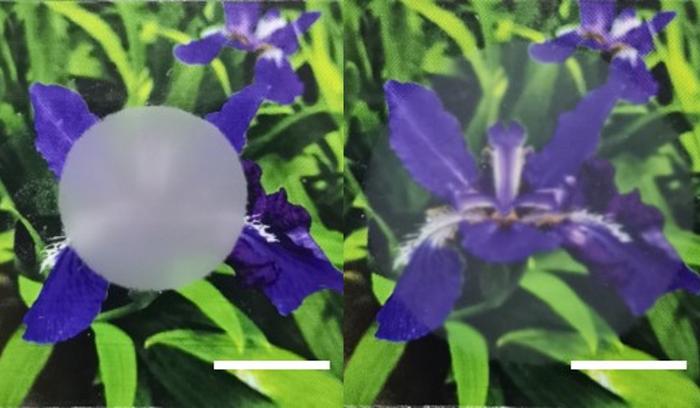
With a flick of a switch, current technologies allow you to quickly change materials from being dark to light, or cold to hot, just by blocking or transmitting specific wavelengths. But now, inspired by squid skin, researchers in ACS Nano report a soft film that can regulate its transparency across a large range of wavelengths — visible, infrared and microwave — simultaneously. They demonstrated the material in smart windows and in health monitoring and temperature management applications.
Credit: Adapted from ACS Nano 2023, DOI: 10.1021/acsnano.3c01836
With a flick of a switch, current technologies allow you to quickly change materials from being dark to light, or cold to hot, just by blocking or transmitting specific wavelengths. But now, inspired by squid skin, researchers in ACS Nano report a soft film that can regulate its transparency across a large range of wavelengths — visible, infrared and microwave — simultaneously. They demonstrated the material in smart windows and in health monitoring and temperature management applications.
Unique to the skin of squid and other cephalopods, iridocytes and chromatophores reversibly change their orientation and alter the animals’ appearance. Similarly, scientists have developed artificial materials that transition from reflecting to transmitting visible and infrared wavelengths by shifting from wrinkly to cracked. Because microwaves are much larger than these surface structures, they aren’t impacted. However, researchers recently found that dense networks of electrically conductive materials, such as silver nanowires, could block microwaves. So, Yi Yang, Guangbin Ji, Zhichuan J. Xu and colleagues wanted to integrate surface structures with a conductive network in a soft film that could quickly transition between shielding visible-to-microwave bands and allowing them through.
The researchers created a two-layer film by spraying a thin coating of silver nanowires onto a stretched elastomer. Stretching and contracting the material produced cracks and bumpy wrinkles, respectively, in the metal surface. Then, when the researchers contracted the material to a -30% strain, it blocked light, trapped infrared heat and shielded up to 99.9% of microwaves that could interfere with devices. And as the material stretched apart, the expansion was directly related to an increase in optical transparency and heat and microwaves it transmitted. Additionally, the team demonstrated how the material could be used for various applications:
- To transmit or block wireless electrocardiography signals.
- As a blanket to trap body heat or allow it to escape.
- For tracking movements because the materials produce temperature changes that are detectable by infrared cameras.
The researchers say that their system’s ability to modify its transparency repeatedly and rapidly could benefit dynamic camouflage technologies, energy-efficient buildings, and adaptive personal and healthcare devices.
The authors acknowledge funding from the National Nature Science Foundation of China and the National Science and Technology Major Project of China.
The paper’s abstract will be available on June 28 at 8 a.m. Eastern time here: http://pubs.acs.org/doi/abs /10.1021/acsnano.3c01836
For more of the latest research news, register for our upcoming meeting, ACS Fall 2023. Journalists and public information officers are encouraged to apply for complimentary press registration by completing this form.
The American Chemical Society (ACS) is a nonprofit organization chartered by the U.S. Congress. ACS’ mission is to advance the broader chemistry enterprise and its practitioners for the benefit of Earth and all its people. The Society is a global leader in promoting excellence in science education and providing access to chemistry-related information and research through its multiple research solutions, peer-reviewed journals, scientific conferences, eBooks and weekly news periodical Chemical & Engineering News. ACS journals are among the most cited, most trusted and most read within the scientific literature; however, ACS itself does not conduct chemical research. As a leader in scientific information solutions, its CAS division partners with global innovators to accelerate breakthroughs by curating, connecting and analyzing the world’s scientific knowledge. ACS’ main offices are in Washington, D.C., and Columbus, Ohio.
To automatically receive news releases from the American Chemical Society, contact [email protected].
Follow us: Twitter | Facebook | LinkedIn | Instagram
Journal
ACS Nano
DOI
10.1021/acsnano.3c01836
Article Title
An Adaptive Multispectral Mechano-Optical System for Multipurpose Applications
Article Publication Date
28-Jun-2023