In their paper the team discusses their novel view of euchromatin in the cell and shows how the revealed organization is relevant to genome functions. “Our ultimate goal is to reveal how genomic information is searched and read out in living cells,” said Kazuhiro Maeshima, a leading author and a professor with the National Institute of Genetics and SOKENDAI, Japan.
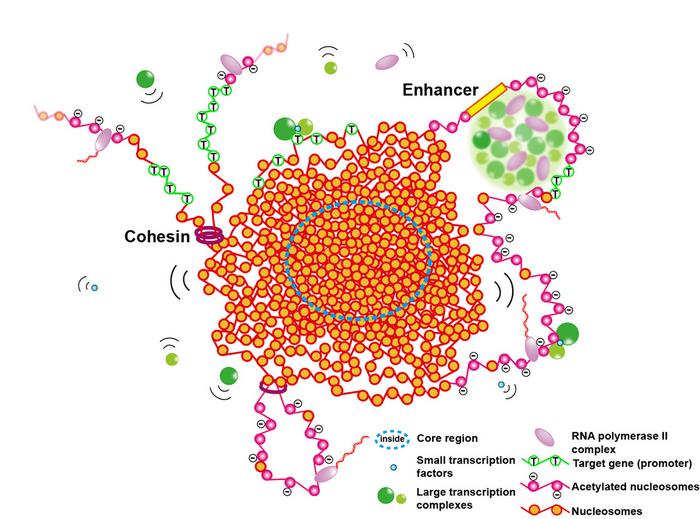
Credit: Sachiko Tamura & Kazuhiro Maeshima, National Institute of Genetics, ROIS.
Reproduced from Trends in Cell Biology.
In their paper the team discusses their novel view of euchromatin in the cell and shows how the revealed organization is relevant to genome functions. “Our ultimate goal is to reveal how genomic information is searched and read out in living cells,” said Kazuhiro Maeshima, a leading author and a professor with the National Institute of Genetics and SOKENDAI, Japan.
Chromatin describes the combination of DNA and proteins in the cells of humans and other eukaryotes. According to typical textbook models, chromatin occurs in two forms— euchromatin, that is less condensed and can be transcribed, and heterochromatin, that is more condensed and usually not transcribed. Transcription is the activity where a cell makes an RNA copy of a DNA molecule, a process necessary for life. The research team focused their study on euchromatin.
The team suggests in their opinion paper that the euchromatin in higher eukaryotic cells like human cells is not necessarily open. Instead, they propose that euchromatin forms condensed liquid-like domains, with sizes ranging from 100 to 300 nm in diameter. Recent advanced imaging studies involving 3D structured illumination microscopy (SIM), focused ion beam scanning electron microscopy, and single molecule imaging unveiled local chromatin conformation and have shown evidence that euchromatin forms condensed domains. Complementary to this, recent genomics techniques also revealed that only limited genomic regions are constantly accessible. These studies suggest that condensed domains are irregularly and dynamically folded and have liquid-like property. The euchromatic domains are smaller in size than the heterochromatic domains, leading to an increased surface area-to-volume-ration in euchromatin, which could also explain the difference in transcriptional activity.
“Open chromatin regions where transcription happens seem to be limited at the domain surfaces or boundaries between domains. Also, condensed domains have dynamic liquid-like properties, which give certain accessibility for the inside, and allow cells to activate transcription and other DNA transactions, such as DNA replication and repair,” said Shiori Iida, a co-first author.
Chromatin cannot simply be categorized into euchromatin and heterochromatin by its open/closed form. Contrary to accepted dogma, euchromatin domains are not fully open, but rather condensed. “Condensed chromatin seems to be the default chromatin state in higher eukaryotic cells, possibly functional units in DNA transactions, and assembly units like Lego blocks for the chromosome during cell division,” said Kazuhiro Maeshima.
Looking ahead, the team hopes that their work will deepen the understanding of transcriptional regulation and other DNA transactions. “The next step is to investigate how the condensed domains are regulated during cell differentiation or developmental processes to execute specific cellular functions,” said Masa Shimazoe, one of the coauthors.
The research team includes Kazuhiro Maeshima, Shiori Iida, Masa A. Shimazoe, and Satoru Ide who work at the National Institutes of Genetics, Mishima, Shizuoka, and the Graduate Institute for Advanced Studies, (SOKENDAI); and Sachiko Tamura, who works at the National Institutes of Genetics, Mishima, Shizuoka.
###
About National Institute of Genetics (NIG)
National Institute of Genetics (NIG) was established to carry out broad and comprehensive research in genetics. NIG contributes to the development of academic research as one of the inter-university research institutes constituting the Research Organization of Information and Systems (ROIS).
About the Research Organization of Information and Systems (ROIS)
ROIS is a parent organization of four national institutes (National Institute of Polar Research, National Institute of Informatics, the Institute of Statistical Mathematics and National Institute of Genetics) and the Joint Support-Center for Data Science Research. It is ROIS’s mission to promote integrated, cutting-edge research that goes beyond the barriers of these institutions, in addition to facilitating their research activities, as members of inter-university research institutes.
Journal
Trends in Cell Biology
DOI
10.1016/j.tcb.2023.05.007