Isaac Newton formulated his theory of gravity as an action at a distance: a planet instantly feels the influence of another celestial body, no matter the distance between them. This characteristic motivated Einstein to develop the famous theory of general relativity, where gravity becomes a local deformation of spacetime. The principle of locality states that an object is directly influenced only by its surrounding environment: distant objects cannot communicate instantaneously, only what is here right now matters. However, in the past century, with the birth and development of quantum mechanics, physicists discovered that non-local phenomena not only exist but are fundamental to understanding the nature of reality. Now, a new study from SISSA – Scuola Internazionale Superiore di Studi Avanzati, recently published in The Astrophysical Journal, suggests that dark matter, one of the most mysterious components of the Universe, interacts with gravity in a non-local way. According to the authors, PhD students Francesco Benetti and Giovanni Gandolfi, along with their supervisor Andrea Lapi, this discovery could provide a fresh perspective on the still unclear nature of dark matter.
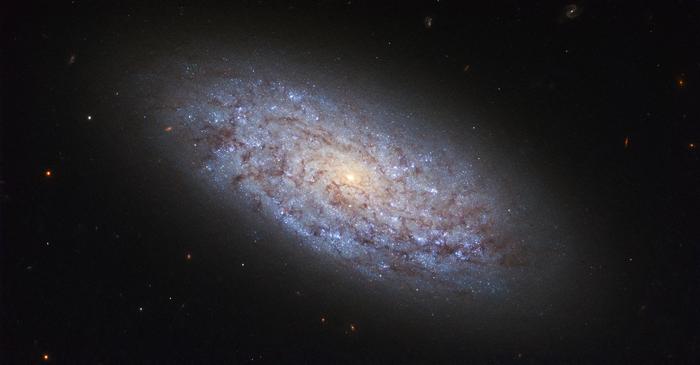
Credit: NASA’s Goddard Space Flight Center/Jenny Hottle
Isaac Newton formulated his theory of gravity as an action at a distance: a planet instantly feels the influence of another celestial body, no matter the distance between them. This characteristic motivated Einstein to develop the famous theory of general relativity, where gravity becomes a local deformation of spacetime. The principle of locality states that an object is directly influenced only by its surrounding environment: distant objects cannot communicate instantaneously, only what is here right now matters. However, in the past century, with the birth and development of quantum mechanics, physicists discovered that non-local phenomena not only exist but are fundamental to understanding the nature of reality. Now, a new study from SISSA – Scuola Internazionale Superiore di Studi Avanzati, recently published in The Astrophysical Journal, suggests that dark matter, one of the most mysterious components of the Universe, interacts with gravity in a non-local way. According to the authors, PhD students Francesco Benetti and Giovanni Gandolfi, along with their supervisor Andrea Lapi, this discovery could provide a fresh perspective on the still unclear nature of dark matter.
Dark matter is a fundamental component of nature: it is responsible for the formation of the structures we observe in the Universe today and surrounds luminous matter in galaxies, contributing to the motion of the stars we see in the sky. However, the nature of dark matter, especially its interaction with gravity in smaller galaxies, remains mysterious. “In recent decades, the scientific community has made great efforts to understand these enigmatic phenomena, but many questions remain unanswered. To explore the nature of dark matter and its interaction with gravity, a new approach may be necessary,” explain the authors of the study. The new research from SISSA has precisely explored this intriguing path.
The study proposes a new model of non-local interaction between the dark matter of a galaxy and gravity: “It’s as if all the matter in the universe tells the dark matter in a galaxy how to move,” state the authors. To model this non-locality, fractional calculus has been employed, a mathematical tool first developed in the 17th century and recently found applications in various areas of physics. The power of this calculus had never been tested in astrophysics before. “We wondered if fractional calculus could be the key to understanding the mysterious nature of dark matter and its interaction with gravity, and surprisingly, experimental results on thousands of galaxies of different types have shown that the new model more accurately describes the motion of stars compared to the standard theory of gravity,” explain the authors. This non-locality appears to emerge as a collective behavior of dark matter’s particles within a confined system, proving particularly relevant in small-sized galaxies. A thorough understanding of this phenomenon could bring us closer what dark matter really is.
“However, many questions remain to be answered,” emphasize the authors. “How does non-locality precisely emerge? What are its implications within larger structures, such as galaxy clusters, or in the phenomenon of gravitational lensing, which allows us to observe distant celestial objects?” Moreover, it will be necessary to reconsider the standard model of cosmology considering this new mechanism. “Further studies will be conducted to explore all these implications and more. We wouldn’t be surprised to discover that other unresolved questions about the Universe could be resolved by the newly proposed non-locality.” Advancements in understanding the nature of dark matter represent a significant step towards a better knowledge of our Universe. Ongoing research continues to provide new perspectives and brings us closer to a comprehensive understanding of the phenomena that surround us.
Journal
The Astrophysical Journal
DOI
10.3847/1538-4357/acc8ca
Method of Research
Data/statistical analysis
Subject of Research
Not applicable
Article Title
Dark Matter in Fractional Gravity. I. Astrophysical Tests on Galactic Scales
Article Publication Date
31-May-2023