• HOME
  • NEWS
  • EXPLORE
    • CAREER
      • Companies
      • Jobs
    • EVENTS
    • iGEM
      • News
      • Team
    • PHOTOS
    • VIDEO
    • WIKI
  • BLOG
  • COMMUNITY
    • FACEBOOK
    • INSTAGRAM
    • TWITTER
Saturday, February 7, 2026
BIOENGINEER.ORG
No Result
View All Result
  • Login
  • HOME
  • NEWS
  • EXPLORE
    • CAREER
      • Companies
      • Jobs
        • Lecturer
        • PhD Studentship
        • Postdoc
        • Research Assistant
    • EVENTS
    • iGEM
      • News
      • Team
    • PHOTOS
    • VIDEO
    • WIKI
  • BLOG
  • COMMUNITY
    • FACEBOOK
    • INSTAGRAM
    • TWITTER
  • HOME
  • NEWS
  • EXPLORE
    • CAREER
      • Companies
      • Jobs
        • Lecturer
        • PhD Studentship
        • Postdoc
        • Research Assistant
    • EVENTS
    • iGEM
      • News
      • Team
    • PHOTOS
    • VIDEO
    • WIKI
  • BLOG
  • COMMUNITY
    • FACEBOOK
    • INSTAGRAM
    • TWITTER
No Result
View All Result
Bioengineer.org
No Result
View All Result
Home NEWS Science News Health

U-shaped association between low-density lipoprotein cholesterol levels and risk of all-cause mortality mediated by post-stroke infection in acute ischemic stroke

Bioengineer by Bioengineer
June 27, 2023
in Health
Reading Time: 2 mins read
0
The U-shaped association between LDL-C level and all-cause mortality during hospitalization and the mediation effect of infection in patients with acute ischemic stroke
Share on FacebookShare on TwitterShare on LinkedinShare on RedditShare on Telegram

The general perception supports the mantra of “lower is better” for low-density lipoprotein cholesterol (LDL-C) levels in cardiovascular disease. However, during the acute stage of ischemic stroke, it is unclear how to interpret different LDL-C levels accurately. The evidence on clinical implication of LDL-C levels was mainly derived from long-term follow-up studies. The pathophysiological features of patients under the acute stage of ischemic stroke are different from the chronic stage. Concerns exist over whether low LDL-C levels may lead to adverse outcomes, such as increased mortality risk due to infection. The crosstalk between LDL-C and infection is also garnering increasing amounts of interest.
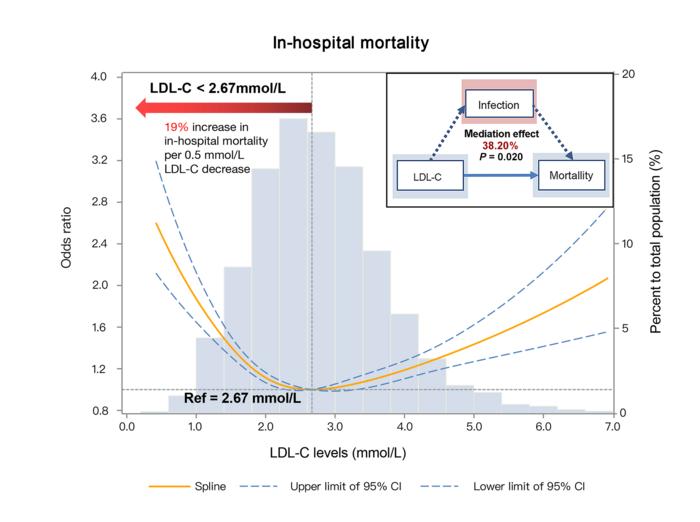
The U-shaped association between LDL-C level and all-cause mortality during hospitalization and the mediation effect of infection in patients with acute ischemic stroke

Credit: ©Science China Press

The general perception supports the mantra of “lower is better” for low-density lipoprotein cholesterol (LDL-C) levels in cardiovascular disease. However, during the acute stage of ischemic stroke, it is unclear how to interpret different LDL-C levels accurately. The evidence on clinical implication of LDL-C levels was mainly derived from long-term follow-up studies. The pathophysiological features of patients under the acute stage of ischemic stroke are different from the chronic stage. Concerns exist over whether low LDL-C levels may lead to adverse outcomes, such as increased mortality risk due to infection. The crosstalk between LDL-C and infection is also garnering increasing amounts of interest.

This study aimed to evaluate the association between LDL-C levels, post-stroke infection and all-cause mortality. 804,855 ischemic stroke patients were enrolled. Associations between LDL-C levels, infection, and mortality risk were estimated by multivariate logistic regression models. Mediation analysis was performed under counterfactual framework to elucidate the mediation effect of post-stroke infection.

The study found a U-shaped association between LDL-C and mortality risk in acute ischemic stroke patients. The lowest mortality risk was at an LDL-C level of 2.67 mmol/L. The association between LDL-C and all-cause mortality was 38.20% mediated by infection. Sensitivity analysis showed that after excluding patients with increasing numbers of cardiovascular risk factors, the U-shaped association remained consistent but the LDL-C interval with the lowest mortality risk increased progressively, where infection maintained prominent mediation effects. Subgroup analysis showed a consistent U-shaped association between LDL-C levels and mortality risk. The mediation effects of infection were largely consistent in subgroups of age ≥65 years, female, body mass index <25 kg/m2, and National Institutes of Health Stroke Scale ≥16.

Despite the known adverse effects of high LDL-C levels, in ischemic stroke patients, this study revealed that low LDL-C levels also indicate an increased risk of all-cause mortality during hospitalization, where post-stroke infection is an important mediating mechanism, indicating a potential causal chain of low LDL-C-infection-mortality in the acute stage of ischemic stroke. Further research is warranted to explore the risk-benefit relationship of approaches for rapid and substantial LDL-C reduction during the acute stage of ischemic stroke.


Journal

Science Bulletin

DOI

10.1016/j.scib.2023.05.028
Share12Tweet8Share2ShareShareShare2

Related Posts

Evaluating Pediatric Emergency Care Quality in Ethiopia

February 7, 2026

TPMT Expression Predictions Linked to Azathioprine Side Effects

February 7, 2026

Improving Dementia Care with Enhanced Activity Kits

February 7, 2026

Decoding Prostate Cancer Origins via snFLARE-seq, mxFRIZNGRND

February 7, 2026

POPULAR NEWS

  • Robotic Ureteral Reconstruction: A Novel Approach

    Robotic Ureteral Reconstruction: A Novel Approach

    82 shares
    Share 33 Tweet 21
  • Digital Privacy: Health Data Control in Incarceration

    63 shares
    Share 25 Tweet 16
  • Study Reveals Lipid Accumulation in ME/CFS Cells

    57 shares
    Share 23 Tweet 14
  • Breakthrough in RNA Research Accelerates Medical Innovations Timeline

    53 shares
    Share 21 Tweet 13

About

We bring you the latest biotechnology news from best research centers and universities around the world. Check our website.

Follow us

Recent News

Evaluating Pediatric Emergency Care Quality in Ethiopia

TPMT Expression Predictions Linked to Azathioprine Side Effects

Improving Dementia Care with Enhanced Activity Kits

Subscribe to Blog via Email

Success! An email was just sent to confirm your subscription. Please find the email now and click 'Confirm' to start subscribing.

Join 73 other subscribers
  • Contact Us

Bioengineer.org © Copyright 2023 All Rights Reserved.

Welcome Back!

Login to your account below

Forgotten Password?

Retrieve your password

Please enter your username or email address to reset your password.

Log In
No Result
View All Result
  • Homepages
    • Home Page 1
    • Home Page 2
  • News
  • National
  • Business
  • Health
  • Lifestyle
  • Science

Bioengineer.org © Copyright 2023 All Rights Reserved.