• HOME
  • NEWS
  • EXPLORE
    • CAREER
      • Companies
      • Jobs
    • EVENTS
    • iGEM
      • News
      • Team
    • PHOTOS
    • VIDEO
    • WIKI
  • BLOG
  • COMMUNITY
    • FACEBOOK
    • INSTAGRAM
    • TWITTER
Monday, July 13, 2026
BIOENGINEER.ORG
No Result
View All Result
  • Login
  • HOME
  • NEWS
  • EXPLORE
    • CAREER
      • Companies
      • Jobs
        • Lecturer
        • PhD Studentship
        • Postdoc
        • Research Assistant
    • EVENTS
    • iGEM
      • News
      • Team
    • PHOTOS
    • VIDEO
    • WIKI
  • BLOG
  • COMMUNITY
    • FACEBOOK
    • INSTAGRAM
    • TWITTER
  • HOME
  • NEWS
  • EXPLORE
    • CAREER
      • Companies
      • Jobs
        • Lecturer
        • PhD Studentship
        • Postdoc
        • Research Assistant
    • EVENTS
    • iGEM
      • News
      • Team
    • PHOTOS
    • VIDEO
    • WIKI
  • BLOG
  • COMMUNITY
    • FACEBOOK
    • INSTAGRAM
    • TWITTER
No Result
View All Result
Bioengineer.org
No Result
View All Result
Home NEWS Science News Biology

Like human, like dog

Bioengineer by Bioengineer
June 27, 2023
in Biology
Reading Time: 3 mins read
0
Pet dog Maeva is ready for data collection in the magnetic resonance imaging scanner. The bandage serves as an additional noise protection in combination with earplugs.
Share on FacebookShare on TwitterShare on LinkedinShare on RedditShare on Telegram

A study by researchers at the University of Vienna and the University of Veterinary Medicine Vienna shows that information from body postures plays a similarly important role for dogs as it does for humans. The results offer new insights into how dogs and humans perceive each other and their environment. They confirm that the temporal lobe plays a central role in social communication and perception. The study is currently published in the journal Communications Biology.
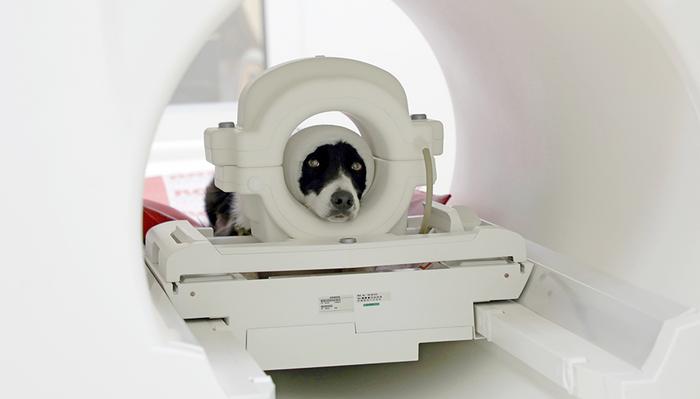
Pet dog Maeva is ready for data collection in the magnetic resonance imaging scanner. The bandage serves as an additional noise protection in combination with earplugs.

Credit: University of Vienna CCNU (ccnu.univie.ac.at)

A study by researchers at the University of Vienna and the University of Veterinary Medicine Vienna shows that information from body postures plays a similarly important role for dogs as it does for humans. The results offer new insights into how dogs and humans perceive each other and their environment. They confirm that the temporal lobe plays a central role in social communication and perception. The study is currently published in the journal Communications Biology.

Humans and primates have brain regions in the temporal lobe that are specialised in perceiving faces and bodies. Dogs also possess a temporal lobe that evolved independently of the primate brain. In recent years, behavioural research has shown that dogs, like humans, are experts in perceiving facial expressions and bodily gestures such as hand signals. “Whether this behavioural expertise is also reflected in the dog brain was the content of our study. Only a few research groups can conduct comparative magnetic resonance imaging studies with dogs,” explains first author Magdalena Boch.

The research group led by Magdalena Boch, Claus Lamm and Ludwig Huber is one of currently only four in the world conducting magnetic resonance imaging (MRI) studies with pet dogs. They developed training protocols to accustom the dogs to the MRI environment gradually. The dogs are not sedated and can leave the MRI at any time.

The study with 40 human participants and 15 pet dogs now provided the first evidence that dogs, like humans, have a brain region in the temporal lobe that is specialised in the visual perception of body postures. In addition, further regions in the dog brain are equally involved in perceiving faces and bodies. In contrast to humans, however, this did not only affect visual brain regions. When dogs look at faces and bodies, there are also differences in activation in areas responsible for processing smells.

In humans, the authors additionally identified already known regions specialised exclusively in face perception. “We humans often focus on the face when communicating with others. Our results suggest that faces are also an important source of information for dogs. However, body postures and holistic perception seem to play a superior role,” Magdalena Boch explains.

The specialised brain regions were equally active in dogs when they looked at pictures of conspecifics or humans. This underlines the close bond between dogs and humans, says Ludwig Huber. “Dogs and humans may not be closely related, but they have been close companions for thousands of years. Therefore, comparing dogs and humans also gives us new insights into the so-called convergent evolution of social perception and information processing processes,” Claus Lamm concludes.


Journal

Communications Biology

DOI

10.1038/s42003-023-05014-7

Article Title

Functionally analogous body- and animacy-responsive areas are present in the dog (Canis familiaris) and human occipito-temporal lobe.

Article Publication Date

27-Jun-2023

Share12Tweet8Share2ShareShareShare2

Related Posts

Han directs new $15M NIH center for organ-on-chip technology

Han directs new $15M NIH center for organ-on-chip technology

July 11, 2026
Bacteriophages Enable Next-Gen Smart Pathogen Detection Sensors

Bacteriophages Enable Next-Gen Smart Pathogen Detection Sensors

July 10, 2026

Temperature Fluctuations Have Greater Impact Than Previously Believed

July 10, 2026

New Study Uncovers Biology Behind Glioma Cancer Progression

July 10, 2026

POPULAR NEWS

  • Detection of EDCs in Breast Milk and Infant Urine Up to Six Months Highlights Early Exposure Risks

    77 shares
    Share 31 Tweet 19
  • New Drug Candidate Developed at McMaster Shows Potential for Treating Brain Cancer

    58 shares
    Share 23 Tweet 15
  • KTU Researchers Explore Ultrasound’s Role in Enhancing Blood Flow Beyond Diagnostics

    53 shares
    Share 21 Tweet 13
  • Experimental Therapy Simultaneously Destroys Prostate Tumor Cells and Reactivates Antitumor Immunity

    46 shares
    Share 18 Tweet 12

About

BIOENGINEER.ORG

We bring you the latest biotechnology news from best research centers and universities around the world. Check our website.

Follow us

Recent News

Blocking Siglec-binding Sialoglycans to Halt Prostate Cancer Bone Spread

Leading computer scientist claims true human-level AI might be impossible

Top Companies Pledge Nature Goals but Fail to Ensure Accountability

Subscribe to Blog via Email

Enter your email address to subscribe to this blog and receive notifications of new posts by email.

Join 85 other subscribers
  • Contact Us

Bioengineer.org © Copyright 2023 All Rights Reserved.

Welcome Back!

Login to your account below

Forgotten Password?

Retrieve your password

Please enter your username or email address to reset your password.

Log In
No Result
View All Result
  • Homepages
    • Home Page 1
    • Home Page 2
  • News
  • National
  • Business
  • Health
  • Lifestyle
  • Science

Bioengineer.org © Copyright 2023 All Rights Reserved.