The gigantic, slimy salamanders known as hellbenders, once the apex predators of many freshwater streams, have been in decline for decades, their population constantly shrinking. No one knew why. William Hopkins, professor in the Department of Fish and Wildlife Conservation and director of the Global Change Center at Virginia Tech, suspected the hellbenders’ plight had connections with environmental changes engineered by humans.
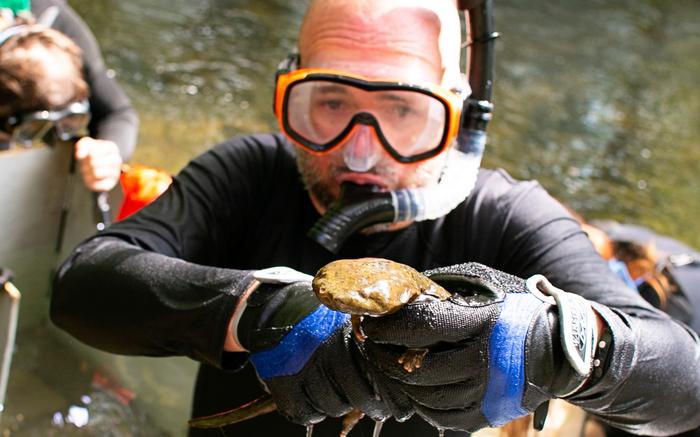
Credit: Photo by Lara Hopkins for Virginia Tech
The gigantic, slimy salamanders known as hellbenders, once the apex predators of many freshwater streams, have been in decline for decades, their population constantly shrinking. No one knew why. William Hopkins, professor in the Department of Fish and Wildlife Conservation and director of the Global Change Center at Virginia Tech, suspected the hellbenders’ plight had connections with environmental changes engineered by humans.
Hellbender males select nesting sites on stream bottoms and guard the eggs laid there by females — and occasionally the salamander dads snack on the eggs, consuming them before they ever get to hatch. A study that Hopkins led, conducted through eight years of snorkeling in ice-cold Southwest Virginia streams and scheduled to be published July 1 in The American Naturalist, determined that in deforested areas, hellbender fathers are far more likely to eat their entire brood than in areas that still have lush foliage.
This behavior, known as filial cannibalism, probably evolved as a survival tactic for enduring harsh conditions. Prior to Hopkins’ results, scientists were not aware that hellbenders’ filial cannibalism drastically increased in cleared lands, actively speeding the species out of existence.
“This is an animal that has been resilient over millions and millions of years, and something that we’re doing to the planet is severe enough that it’s causing them to disappear, and disappear quickly,” Hopkins said. “I feel like we have an obligation to solve this problem.”
Creating concrete nests
A solution to the mystery of the large salamanders’ accelerating disappearance stayed out of reach because the animal’s reproductive cycle was so difficult to study. “These animals nest under large boulders in streams, and you can’t get under the boulders to study the nest,” Hopkins said. “Even if you could lift the boulder, you would destroy the nest site and there would be nothing left of it.”
Years ago at a conference, Hopkins learned of a project undertaken in concert with the Saint Louis Zoo that involved placing concrete boxes in streams where hellbenders live. Hellbenders nested in the boxes, from which eggs could be collected for captive rearing at the zoo. “I almost came out of my seat. I realized this could be a research tool, something we could actually apply in the field to study these animals. I wanted to have these out all over the place in good habitats, bad habitats, so we could start to study this animal’s reproductive biology.”
Once the study began, it took years of trial and error to perfect the use of the concrete boxes in the Tennessee Valley streams. Yet almost right away, Hopkins and his team noticed a pattern, that became increasingly evident as more and more of the salamanders used the boxes as nest sites. “Within a couple of years, I started to realize that what was happening with reproduction was really different in bad habitats and good habitats,” Hopkins said. “We were immediately seeing this pattern, that males were eating their eggs and that this was more pronounced at these degraded sites.”
Scaling up and conducting the study was a cold, wet, painstaking process. “We put out hundreds of these shelters underwater and observed them closely. We do it all by snorkeling, and you wear a full wetsuit because the streams are so cold,” he said. “It took us eight years of field work to collect enough data to publish that paper.”
Much more to explore
The unprecedented long-term access to these creatures has yielded more than the study originally sought. “We’ve discovered two parasites new to science that nobody knew existed, one is a leech that we think specializes on hellbenders, and the other is a microscopic blood parasite, a trypanosome. We’ve also been able to describe the hellbenders’ hormone cycles. Now we’re equipping these boxes with infrared underwater video cameras that record nonstop, so we can document their behaviors for the first time.”
There’s plenty more to investigate. “We still don’t know the mechanism that triggers this cannibalistic behavior in males. But by showing that this abnormally high frequency of the behavior is related to upstream forest cover, we answered this really big question, and potentially we’re getting closer and closer to solving this entire mystery, which can lead to solutions.”
Yet even without the specific mechanism identified, the results suggest urgent steps to take. “Things we can do include protecting and re-establishing forest cover around streams, and adopting best agricultural management practices that prevent livestock from entering streams,” Hopkins said. “The benefits of doing so are far reaching — what is good for hellbenders is also good for other aquatic animals like mussels and fish, many of which are also declining. Reforesting stream corridors is also good for terrestrial wildlife like migratory birds. And of course, better water quality is good for us.”
Journal
The American Naturalist
DOI
10.1086/724819
Method of Research
Observational study
Subject of Research
Animals
Article Title
Filial Cannibalism Leads to Chronic Nest Failure of EasternHellbender Salamanders (Cryptobranchus alleganiensis)
Article Publication Date
25-May-2023