Since 2013 the FHI Free-Electron Laser (FHI FEL) provides intense, pulsed mid-infrared (MIR) radiation continuously tunable from 2.8 to 50 micron wavelength. The generation of molecular vibrational spectra is one of the main uses of the FHI FEL. The infrared spectral region is often referred to as the “molecular fingerprint” region, as it is the region in which the fundamental vibrational modes of molecules, clusters or solid materials are located. These vibrational modes are directly connected to the forces that hold the atoms together and to their geometrical structure. The FHI FEL has enabled FHI research groups and their collaborators to run experiments in diverse fields ranging from spectroscopy of clusters, nanoparticles, and bio-molecules in the gas phase to nonlinear solid-state spectroscopy and surface science. This has resulted in almost 100 peer-reviewed publications so far.
Credit: © FHI
Since 2013 the FHI Free-Electron Laser (FHI FEL) provides intense, pulsed mid-infrared (MIR) radiation continuously tunable from 2.8 to 50 micron wavelength. The generation of molecular vibrational spectra is one of the main uses of the FHI FEL. The infrared spectral region is often referred to as the “molecular fingerprint” region, as it is the region in which the fundamental vibrational modes of molecules, clusters or solid materials are located. These vibrational modes are directly connected to the forces that hold the atoms together and to their geometrical structure. The FHI FEL has enabled FHI research groups and their collaborators to run experiments in diverse fields ranging from spectroscopy of clusters, nanoparticles, and bio-molecules in the gas phase to nonlinear solid-state spectroscopy and surface science. This has resulted in almost 100 peer-reviewed publications so far.
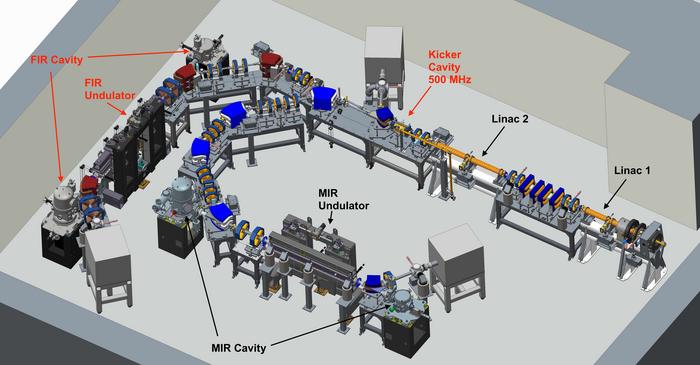
Over the last few years the FHI FEL team has been working on a machine upgrade including the installation of a second FEL branch designed to generate far-infrared (FIR) radiation at wavelength up to 165 micron. The FIR FEL includes a new hybrid-magnet undulator which was built in-house at the FHI. In addition, a 500 MHz kicker cavity has been installed downstream of the electron linear accelerator (LINAC). When powered, the kicker cavity will enable simultaneous 2-color operation of both MIR and FIR FEL.
On June 8, 2023 the FHI FEL Team observed first lasing of the new FIR FEL. Based on his experience in operating the FHI FEL, team member Sandy Gewinner tuned the electron accelerator and beamline, and lasing was achieved within just a few hours. At an electron energy of 36 MeV lasing was observed at wavelengths ranging from 9 to 34 micron. This large continuous tuning range is made possible by mechanical variation of the undulator gap. Pulse energies in excess of 100 mJ were observed on the first day indicating powerful performance in agreement with design goals. Next, the FHI FEL Team is going to explore the full design wavelength range from 4.5 to 165 micron by operating the LINAC at various electron energies.
The next major goal will be to demonstrate 2-color operation by running the MIR and FIR FEL simultaneously. To this end, the new kicker cavity was designed to deflect every second electron bunch coming from the accelerator to the MIR branch, and every other second bunch to the FIR branch. In this 2-color mode both FEL’s run in parallel each generating infrared pulses at independently tunable wavelengths. The 2-color mode will open up new possibilities to FHI FEL user groups including, for instance, MIR/FIR pump-probe experiments.