A new farming system developed by researchers at The University of Texas at Austin aims to solve one of the biggest problems in modern agriculture: the overuse of fertilizers to improve crop yields and the resulting chemical runoff that pollutes the world’s air and water.
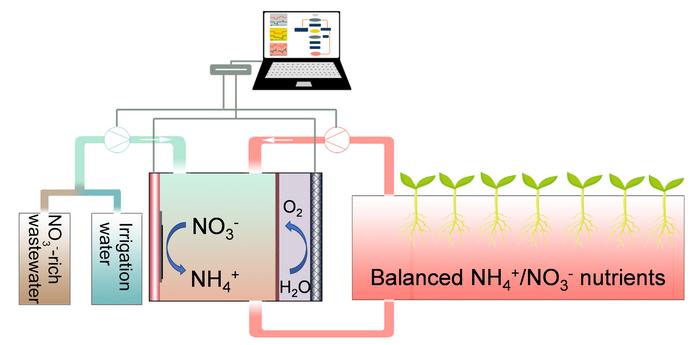
Credit: The University of Texas at Austin
A new farming system developed by researchers at The University of Texas at Austin aims to solve one of the biggest problems in modern agriculture: the overuse of fertilizers to improve crop yields and the resulting chemical runoff that pollutes the world’s air and water.
The smart farming system uses a copper-based hydrogel that captures excess nitrate waste from fertilizer runoff and transforms it into ammonia – a critical element in fertilizers – that can then be reused. In tests, the system had the ability to match or increase crop yields over traditional methods while also minimizing environmental impacts.
“We designed this system and showed that it can grow the same or more crops without overusing nitrogen, which can contaminate groundwater and lead to harmful greenhouse gasses,” said Guihua Yu, a professor of materials science in the Cockrell School of Engineering’s Walker Department of Mechanical Engineering and Texas Materials Institute.
The smart farming system (SSFS) produced wheat and rice plants that grew taller with bigger leaves, compared with other methods, with less nitrogen runoff.
The study, published in the Proceedings of the National Academy of Sciences, shows that the copper-based gel film not only produces ammonia from nitrate waste but also senses nitrogen levels in the soil. This detection capability helps determine the optimal time to drain nitrate, a nitrogen compound that is important for plant growth but can be a pollutant, from the soil to convert to ammonia, keeping it from escaping and contaminating the surrounding environment.
As part of the project, the researchers worked with agricultural experts to compare their work to traditional farming methods. The smart farming system produced wheat and rice plants that grew taller with bigger leaves, compared with other methods, with less nitrogen runoff.
In addition to environmental impacts, excess use of nitrogen fertilizers can also stunt the growth of crops, defeating their purpose of improving production. By simultaneously producing ammonia and monitoring nitrogen levels, this new technology improves crop growth by helping plants take in and use nitrogen more efficiently.
So-called smart farming is a growing research area. World leaders are grappling with how to produce enough food for the global population expected to increase by more than 2 billion people by 2050 with tight land availability and the need to minimize harmful emissions.
Farming isn’t the only industry that creates significant nitrogen pollution. Industrial and municipal wastewater often features high levels of nitrate because of production of electronics, food processing, textile manufacturing and more.
“We need to feed our growing population, but we also need to protect our water and air,” Yu said. “Finding ways to capture and recycle nitrate-heavy wastewater could have tremendous benefits across the board.”
The research builds on previous agricultural breakthroughs from Yu and his team, including the creation of self-watering soil and an innovative way to produce urea, another key element in fertilizers. The researchers’ next step will be to infuse artificial intelligence into this farming platform. By doing that, they aim to expand the range of crops they can work on and further scale up fertilizing operations.
This project is supported by the U.S. Department of Energy’s Basic Energy Sciences Office, the Norman Hackerman Award in Chemical Research from the Welch Foundation and the Camille Dreyfus Teacher-Scholar Award. The project team includes from UT Austin’s Materials Science and Engineering program Zhiwei Fang and Panpan Li (who is also a part of the College of Materials Science and Engineering at Sichuan University in China); Ling Liao and Gehong Su of Sichuan Agricultural University’s College of Horticulture and College of Science; and Zhaoyu Jin of the University of Electronic Science and Technology in China.
Journal
Proceedings of the National Academy of Sciences
DOI
10.1073/pnas.2305489120
Article Title
A multifunctional copper single-atom electrocatalyst aerogel for smart sensing and producing ammonia from nitrate
Article Publication Date
23-Jun-2023