Digesting fish waste can allow circular fish and vegetable farms (aquaponics) to produce biogas that can be fed back into the energy system of these farms. This also generates excellent nutrition for plants, according to new research from the University of Gothenburg.
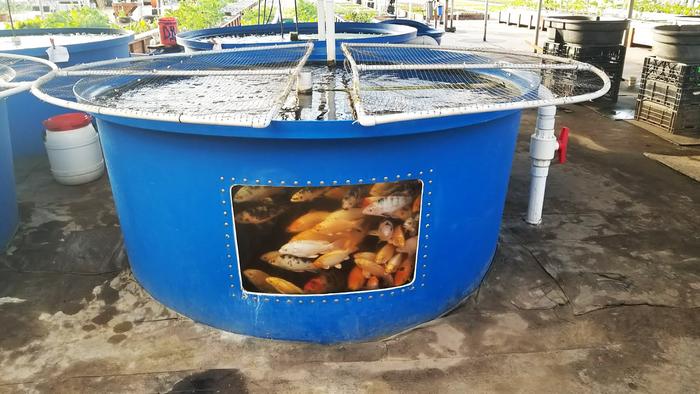
Credit: Victor Lobanov
Digesting fish waste can allow circular fish and vegetable farms (aquaponics) to produce biogas that can be fed back into the energy system of these farms. This also generates excellent nutrition for plants, according to new research from the University of Gothenburg.
There is increasing growth in circular, land-based, combined fish and vegetable farms- often referred to as aquaponics. Aquaponics makes use of nutrient-rich water produced by fish (aquaculture) which can be used to fertilise plants (hydroponics) in a closed, soil-less system with the help of bacteria that grow naturally within the systems. These food production models imitates the fertilisation that occurs in river and lake ecosystems. The solid waste of fish has been a by-product with no particular value until now. But a research project at the University of Gothenburg has used the waste to make biogas that can contribute to meeting the energy needs of the aquaponic farms. This is described in Victor Lobanov’s dissertation.
Waste is broken down in an anaerobic environment
“By breaking down fish faecal matter in an anaerobic environment – known as digestion – we can obtain a concentrated gas mixture of 70 percent methane that can be used as fuel. This can make aquaponics a source of energy,” says Victor Lobanov, doctoral student of marine biology at the University of Gothenburg.
The study also shows that the nutrients released in the digestion of waste are more easily available for plants compared to synthetic nutrition solutions.
“Fish waste contains a lot of nutrients. These should also be usable in aquaponics to enable even more sustainable food production than today,” says Victor Lobanov.
Another benefit is that carbon dioxide is produced when the biogas is used as fuel, which is a necessary supplement when plants are grown in an enclosed space, like a greenhouse.
Pilot starts this summer
For now, the digestion process has only been tested in a lab environment, but a pilot in a commercial aquaponics facility is starting this summer. It will give researchers insights into how well the method can handle perturbations to the system and what needs to be done to create a more robust digestion pipeline. Victor Lobanov’s goal is to create modular digestion systems that can be Integrated into existing aquaculture and aquaponic facilities.
There is significant interest from the industry, and the technology could also be used in other animal husbandry applications such as piggeries. The sludge left over after digestion is still extremely nutritious and can be used for traditional fertilisation of fields. In this new process, the residual sludge leftover and, crucually, its eutrophication potential, is reduced.
“In many countries, the quantity of fertiliser produced in livestock farming is a problem. It can only be spread on fields during certain times of the year and removing wastes from the farm is associated with extra costs during pumping and transportation. Digestion of the fish solids reduces the quantity of waste produced by farms while additionally producing energy and a great fertiliser for hydroponics,” says Victor Lobanov.
Journal
Aquacultural Engineering
DOI
10.1016/j.aquaeng.2023.102328
Method of Research
Experimental study
Article Title
Simultaneous Biomethane Production and Solids Waste Treatment in Aquaculture
Article Publication Date
15-May-2023