Shape memory alloys (SMA) remember their original shape and return to it after being heated. Similar to how a liquid transforms into a gas when boiled, SMAs undergo a phase transformation when heated or cooled. The phase transformation occurs with the movement of atoms, which is invisible to the naked eye.
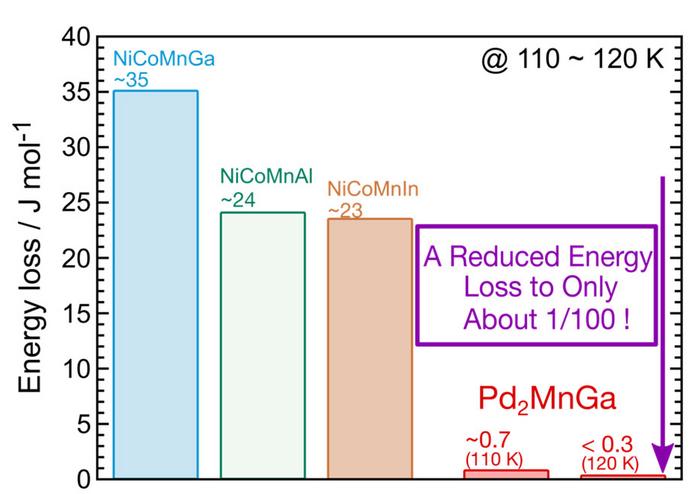
Credit: Xiao Xu et al.
Shape memory alloys (SMA) remember their original shape and return to it after being heated. Similar to how a liquid transforms into a gas when boiled, SMAs undergo a phase transformation when heated or cooled. The phase transformation occurs with the movement of atoms, which is invisible to the naked eye.
SMAs are utilized in a diverse array of applications, including as actuators and sensors. However, the need to cool or heat SMAs means there is a delay in their phase transformation.
As a recently invented type of SMA, metamagnetic shape memory alloys (MMSMA) negate this limited response rate thanks to their ability to undergo phase transformation when exposed to an external magnetic field. Yet to date, MMSMAs have failed to solve another common problem with most SMAs: the fact that they lose a large amount of energy when phase transforming – something that worsens substantially in low temperatures.
Now, a research group from Tohoku University has made a significant breakthrough, developing a palladium-based (Pd) MMSMA that exhibits low energy loss. Even at low temperatures of around 100 K this energy loss was lowered to only about 1/100 when compared to existing MMSMAs.
“We were astonished at the small energy loss in our new Pd-based alloy. Thus, our study also sought to answer two questions. How does the energy loss behave when the temperature lowers even further, such as at the liquid-helium temperature (4.2 K), and why did our material exhibit such a small energy loss?” said Xiao Xu, corresponding author of the paper and assistant professor at Tohoku University’s Graduate School of Engineering.
To do so, Xu and his colleagues at Tohoku University’s Institute for Materials Research (IMR) teamed up with the University of Tokyo’s Institute for Solid State Physics (ISSP). They first conducted magnetization measurements by using pulsed high magnetic fields at liquid-helium temperature. Much like previous SMAs, the newly developed Pd-based SMA also demonstrated an increase in energy loss as the temperature dropped. But the energy loss was still significantly smaller than current SMAs.
The group then performed X-ray diffraction measurements, both at low temperatures and under strong magnetic fields, revealing that the new Pd-base alloy had better lattice compatibility for phase transformation. The crystals within the structures could change easier and this explained why it displayed a smaller energy loss compared to existing SMAs.
“We are also surprised to see that our Pd-based alloy can show a large magnetostriction (the ability to change the dimension when an external magnetic field is present) comparable to rare-earth materials at low temperatures. This breakthrough has wider benefits for creating a sustainable future,” adds Xu. “Hydrogen energy is becoming increasingly prominent as a clean energy source. Since transporting hydrogen often involves converting it to liquified helium, the need for technology that can operate at low temperature is growing. Our Pd-based alloy functions with limited energy loss even at low-temperatures and could be employed as magnetic sensors and actuators.”
Details of the group’s research were published in the journal Advanced Science on June 13, 2023.
Journal
Advanced Science
DOI
10.1002/advs.202207779
Article Title
Pd2MnGa metamagnetic shape memory alloy with small energy loss
Article Publication Date
13-Jun-2023