Cephalopods are a large family of marine animals that includes octopuses, cuttlefish and squid. They live in every ocean, from warm, shallow tropical waters to near-freezing, abyssal depths. More remarkably, report two scientists at University of California San Diego in a new study, at least some cephalopods possess the ability to recode protein motors within cells to adapt “on the fly” to different water temperatures.
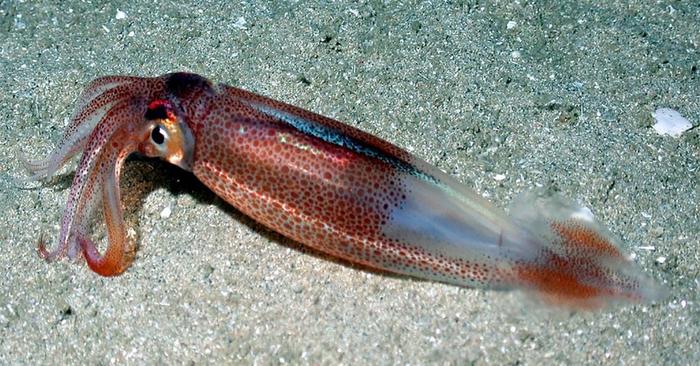
Credit: UC San Diego, Sea Grant California
Cephalopods are a large family of marine animals that includes octopuses, cuttlefish and squid. They live in every ocean, from warm, shallow tropical waters to near-freezing, abyssal depths. More remarkably, report two scientists at University of California San Diego in a new study, at least some cephalopods possess the ability to recode protein motors within cells to adapt “on the fly” to different water temperatures.
Writing in the June 8, 2023 edition of Cell, first author Kavita J. Rangan, PhD, a postdoctoral researcher in the lab of senior author Samara L. Reck-Peterson, PhD, a professor in the departments of Cellular and Molecular Medicine at UC San Diego School of Medicine and Cell and Developmental Biology at UC San Diego and an Investigator of the Howard Hughes Medical Institute, describe how opalescent inshore squid (Doryteuthis opalescens) employ RNA recoding to change amino acids at the protein level, improving the function of molecular motors that carry out diverse functions within cells in colder waters.
RNA recoding allows organisms to edit genetic information from the genomic blueprint to create new proteins. The process is rare in humans but is common in soft-bodied cephalopods, such as D. opalescens, which makes seasonal spawning migrations along the coast of San Diego.
“Cephalopods like D. opalescens are remarkable for their large nervous systems, body innovations and complex behaviors” said Rangan, “and their extensive use of RNA recoding has raised many questions about how this process might be involved in responding to environmental cues like temperature.”
In the new study, Rangan and Reck-Peterson looked at changes to a pair of proteins in squid cells that serve as molecular motors transporting a variety of intracellular cargoes along cellular highways called microtubules. Specifically, the researchers focused on molecular motor proteins called kinesin and dynein, both of which are fundamental to transportation within all cells, including neurons. In humans, mutations in both motors are linked to neurodegenerative diseases.
Working with live squid hatchlings at Scripps Institution of Oceanography, Rangan found that recoding of kinesin increased in animals as they experienced colder ocean water temperatures. Rangan then recreated recoded kinesin proteins using recombinant DNA technology and biochemistry. She then measured the movement of single motor molecules using advanced light microscopy and found that the recoded kinesin motors functioned better at cold temperatures.
“The work suggests that squid can tune their proteome (an organism’s entire complement of proteins) on the fly in response to changes in ocean temperature,” said Reck-Peterson. “One can speculate that this allows these marine ectotherms — animals that depend on external sources of body heat — to survive and thrive in a broad range of ocean temperatures.”
The scientists also found that RNA recoding varied across tissues, generating new kinesin variants with distinct movement properties.
“This work supports the idea that recoding in cephalopods is important for dynamically tuning protein function to support physiological needs and acclimate to changing environmental conditions” said Reck-Peterson. “These animals are taking a completely unique approach to adapting to their surroundings.”
Rangan said the findings also suggest the squid “editome” may be a valuable resource for highlighting regions of molecules that are amenable to plasticity or change. She is currently developing a database that includes the entire squid editome across different ocean temperatures.
“In highly conserved proteins, like kinesin and dynein, cephalopod recoding sites can point to overlooked residues of functional significance, said Rangan, “and this has broader implications for understanding basic protein function as well as for engineering proteins with specific functions. Cephalopods may be able to show us where to look and what changes to make.”
Journal
Cell
DOI
10.1016/j.cell.2023.04.032