

• HOME
  • NEWS
  • EXPLORE
    • CAREER
      • Companies
      • Jobs
    • EVENTS
    • iGEM
      • News
      • Team
    • PHOTOS
    • VIDEO
    • WIKI
  • BLOG
  • COMMUNITY
    • FACEBOOK
    • INSTAGRAM
    • TWITTER
Wednesday, April 29, 2026
BIOENGINEER.ORG
No Result
View All Result
  • Login
  • HOME
  • NEWS
  • EXPLORE
    • CAREER
      • Companies
      • Jobs
        • Lecturer
        • PhD Studentship
        • Postdoc
        • Research Assistant
    • EVENTS
    • iGEM
      • News
      • Team
    • PHOTOS
    • VIDEO
    • WIKI
  • BLOG
  • COMMUNITY
    • FACEBOOK
    • INSTAGRAM
    • TWITTER
  • HOME
  • NEWS
  • EXPLORE
    • CAREER
      • Companies
      • Jobs
        • Lecturer
        • PhD Studentship
        • Postdoc
        • Research Assistant
    • EVENTS
    • iGEM
      • News
      • Team
    • PHOTOS
    • VIDEO
    • WIKI
  • BLOG
  • COMMUNITY
    • FACEBOOK
    • INSTAGRAM
    • TWITTER
No Result
View All Result
Bioengineer.org
No Result
View All Result
Home NEWS Science News Health

When it comes to bumblebees, does size matter?

Bioengineer by Bioengineer
June 7, 2023
in Health
Reading Time: 2 mins read
0
Bumblebees
Share on FacebookShare on TwitterShare on LinkedinShare on RedditShare on Telegram

Certain crops, like greenhouse tomatoes, eggplant, peppers, and blueberries, rely on bumblebees for a style of pollination that only bumblebees can perform. Among growers, the preference can be for bigger-bodied bumblebees because they’re thought to be more efficient pollinators. 
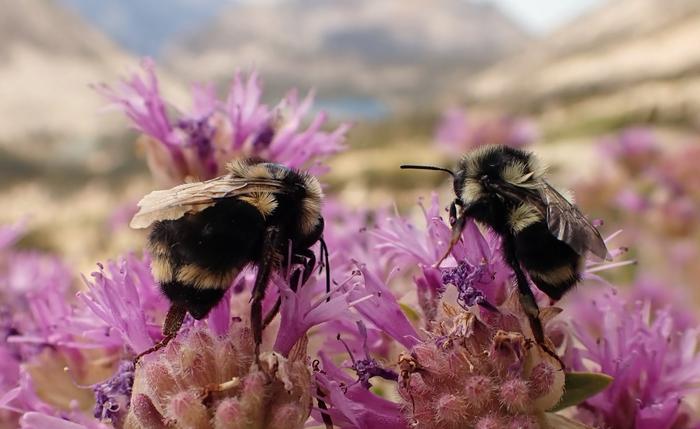
Bumblebees

Credit: Hollis Woodard/UCR

Certain crops, like greenhouse tomatoes, eggplant, peppers, and blueberries, rely on bumblebees for a style of pollination that only bumblebees can perform. Among growers, the preference can be for bigger-bodied bumblebees because they’re thought to be more efficient pollinators. 

Enabled by a $750,000 grant from the National Institute of Food and Agriculture, the research team will investigate factors suspected of influencing bumblebee biology and body size, including climate change, wildfires, and the presence of nearby honeybee colonies.

In many cases, individual animals are born smaller when their habitat has less nutrition available. The researchers want to know if this is also true for bees. “One idea is that honeybees are taking more food resources, resulting in smaller bumbles. This is part of what we will be testing,” said UCR entomologist and project lead Hollis Woodard.

To test this, the researchers will collect bumblebee size data over the next four years from places both with and without honeybees nearby. “It’s hard to find anywhere in the lower 48 without either managed or feral honeybees. For this reason, we’re headed to Alaska for part of the study,” Woodard said.

Fire may also play a role in bumblebee development. Some research has shown that bumblebees are born bigger, and in higher numbers, during the years following a wildfire. Since wildfires are common in California, the research team will also be collecting data from places throughout the state with different types of fire histories.

“Fires are good in some ways for bees,” Woodard said. “As the land recovers from the burn, a lot of flowers appear, offering food.”

In addition to the mystery of what influences the bees’ body size, it’s also unclear what role size plays in a bumble colony. While all bumblebee workers perform the same functions, variation in size could allow the hive as a whole to collect pollen from a wider variety of flowers. 

Though bigger bees can collect more pollen, they might not be right for every plant species. For some flowers, especially those that are trumpet-shaped, smaller bumblebees are better pollinators. 

“There are theories that bumblebee sizes are just random, or that it’s just generally good to have variation,” Woodard said. ‘Right now, we don’t yet know exactly what this variation in size does for colonies.”

In addition to benefitting crop growers, the team’s findings could ultimately benefit the bees themselves. “Any insights we gain into factors affecting the bumblebees could help us better understand how to bolster their dwindling populations,” Woodard said. “Helping them in turn helps ensure the health of wildflowers, as well as our food supply.”



Share12Tweet8Share2ShareShareShare2

Related Posts

Tracing the Journey of Antibiotic-Resistant Bacteria: From Poultry Farms to Fresh Produce

April 29, 2026

Uromodulin Mutation Triggers Renal Inflammation via Pyroptosis

April 29, 2026

Toxicants in Sexual Health Products: A Critical Gap

April 29, 2026

Talking Mats Boosts Dementia Care Involvement in Sweden

April 29, 2026

POPULAR NEWS

  • Research Indicates Potential Connection Between Prenatal Medication Exposure and Elevated Autism Risk

    827 shares
    Share 331 Tweet 207
  • New Study Reveals Plants Can Detect the Sound of Rain

    703 shares
    Share 281 Tweet 176
  • Scientists Investigate Possible Connection Between COVID-19 and Increased Lung Cancer Risk

    67 shares
    Share 27 Tweet 17
  • Salmonella Haem Blocks Macrophages, Boosts Infection

    60 shares
    Share 24 Tweet 15

About

We bring you the latest biotechnology news from best research centers and universities around the world. Check our website.

Follow us

Recent News

Tracing the Journey of Antibiotic-Resistant Bacteria: From Poultry Farms to Fresh Produce

SKKU Advances Battery Manufacturing Using Density Dry Electrode Technology, Aims for Foundry Commercialization

UT MD Anderson Launches Center for Cellular Language Intelligence Following $10 Million Gift from Peggy and Carl Sewell

Subscribe to Blog via Email

Enter your email address to subscribe to this blog and receive notifications of new posts by email.

Join 82 other subscribers
  • Contact Us

Bioengineer.org © Copyright 2023 All Rights Reserved.

Welcome Back!

Login to your account below

Forgotten Password?

Retrieve your password

Please enter your username or email address to reset your password.

Log In
No Result
View All Result
  • Homepages
    • Home Page 1
    • Home Page 2
  • News
  • National
  • Business
  • Health
  • Lifestyle
  • Science

Bioengineer.org © Copyright 2023 All Rights Reserved.