• HOME
  • NEWS
  • EXPLORE
    • CAREER
      • Companies
      • Jobs
    • EVENTS
    • iGEM
      • News
      • Team
    • PHOTOS
    • VIDEO
    • WIKI
  • BLOG
  • COMMUNITY
    • FACEBOOK
    • INSTAGRAM
    • TWITTER
Wednesday, April 29, 2026
BIOENGINEER.ORG
No Result
View All Result
  • Login
  • HOME
  • NEWS
  • EXPLORE
    • CAREER
      • Companies
      • Jobs
        • Lecturer
        • PhD Studentship
        • Postdoc
        • Research Assistant
    • EVENTS
    • iGEM
      • News
      • Team
    • PHOTOS
    • VIDEO
    • WIKI
  • BLOG
  • COMMUNITY
    • FACEBOOK
    • INSTAGRAM
    • TWITTER
  • HOME
  • NEWS
  • EXPLORE
    • CAREER
      • Companies
      • Jobs
        • Lecturer
        • PhD Studentship
        • Postdoc
        • Research Assistant
    • EVENTS
    • iGEM
      • News
      • Team
    • PHOTOS
    • VIDEO
    • WIKI
  • BLOG
  • COMMUNITY
    • FACEBOOK
    • INSTAGRAM
    • TWITTER
No Result
View All Result
Bioengineer.org
No Result
View All Result
Home NEWS Science News Biology

BRAIN LOGISTICS: Missing link explains mRNA delivery in brain cells

Bioengineer by Bioengineer
June 2, 2023
in Biology
Reading Time: 2 mins read
0
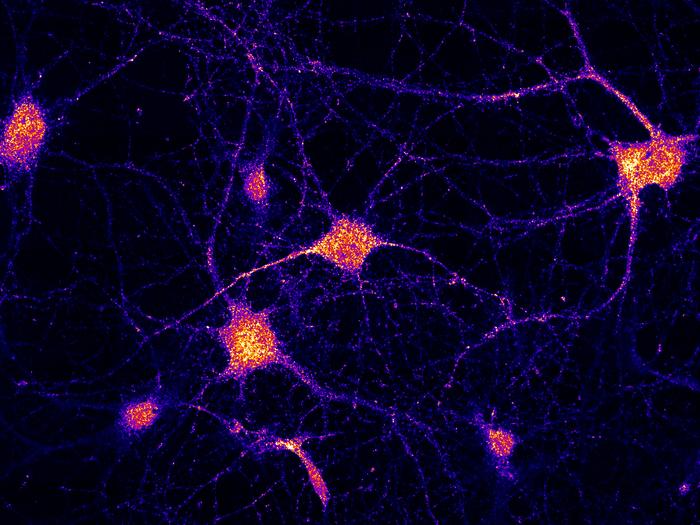
Localization of the FERRY complex in neurons.
Share on FacebookShare on TwitterShare on LinkedinShare on RedditShare on Telegram

Faraway, so close!

Localization of the FERRY complex in neurons.

Credit: Schuhmacher et al. (2023) / MPI-CBG

Faraway, so close!

“These publications provide a major advancement to elucidate the mechanisms underlying mRNA distribution in brain cells,” Marino Zerial says. Cells produce vital proteins using mRNA as a blueprint and ribosomes as 3D printers. Yet, brain cells have a logistic challenge to overcome: A tree-like shape with branches that can span centimeters in the brain. “This implies that thousands of mRNAs need to be transported far away from the nucleus, resembling the logistic effort of properly supplying supermarkets in an entire country,”  Jan Schuhmacher says, first author of the study.

So far, researchers attributed the carrier role to spherical compartments inside the cell, called Late Endosomes. However, MPI scientists argue that a different form of the compartments, called Early Endosomes (EEs), are also suitable as mRNA carriers, due to their ability to travel in both directions along intracellular road networks. In the first publication, led by Marino Zerial from MPI in Dresden, scientists discovered the function of a protein complex that they called FERRY (Five-subunit Endosomal Rab5 and RNA/ribosome intermediarY). In neurons, FERRY is linked to EEs and works similarly to a tie-down strap during transport: It interacts directly with mRNA and holds it onto EEs, which hence become logistic carriers for mRNA transport and distribution in brain cells.


Complex details

But how does FERRY bind to mRNA? That’s when Stefan Raunser’s group from the MPI Dortmund comes into play. In the second publication, Dennis Quentin et al. used cryo-electron microscopy (cryo-EM) to infer the structure of FERRY and the molecular features that allow the complex to bind to both EEs and mRNAs. The new 3D atomic model of FERRY, with a resolution of 4 Ångstroms, shows a novel mode of binding RNA, which involves coiled-coil domains. Scientists also explained how some genetic mutations affect FERRY’s ability to link mRNA thus leading to neurological disorders. “Our research sets the groundwork for a more comprehensive understanding of neurological disorders caused by a failure of mRNA transport or distribution that might also lead to the identification of therapeutically relevant targets,” Raunser says.


Journal

Molecular Cell

DOI

10.1016/j.molcel.2023.05.009

Method of Research

Experimental study

Subject of Research

Cells

Article Title

Structural basis of mRNA binding by the human FERRY Rab5 effector complex

Article Publication Date

1-Jun-2023

Share12Tweet8Share2ShareShareShare2

Related Posts

How Cells Determine When to Respond Could Transform Future Cancer and Fibrosis Treatments — Biology

How Cells Determine When to Respond Could Transform Future Cancer and Fibrosis Treatments

April 29, 2026
Effortless Learning: How the Single-Celled Stentor Masters New Information — Biology

Effortless Learning: How the Single-Celled Stentor Masters New Information

April 29, 2026

UH Professor Advocates Enhanced Prevention and Treatment Strategies to Alleviate Liver Disease Impact

April 28, 2026

Impact of Toxic PCBs on Sex-Biased Genes and Brain Development

April 28, 2026

POPULAR NEWS

  • Research Indicates Potential Connection Between Prenatal Medication Exposure and Elevated Autism Risk

    827 shares
    Share 331 Tweet 207
  • New Study Reveals Plants Can Detect the Sound of Rain

    703 shares
    Share 281 Tweet 176
  • Scientists Investigate Possible Connection Between COVID-19 and Increased Lung Cancer Risk

    67 shares
    Share 27 Tweet 17
  • Salmonella Haem Blocks Macrophages, Boosts Infection

    60 shares
    Share 24 Tweet 15

About

We bring you the latest biotechnology news from best research centers and universities around the world. Check our website.

Follow us

Recent News

AI Reveals How Menopause Molecularly Affects Different Organs Across the Female Body

How Cells Determine When to Respond Could Transform Future Cancer and Fibrosis Treatments

Breakthrough or Mystery? The Enigma of Unexpected Superconductivity

Subscribe to Blog via Email

Enter your email address to subscribe to this blog and receive notifications of new posts by email.

Join 82 other subscribers
  • Contact Us

Bioengineer.org © Copyright 2023 All Rights Reserved.

Welcome Back!

Login to your account below

Forgotten Password?

Retrieve your password

Please enter your username or email address to reset your password.

Log In
No Result
View All Result
  • Homepages
    • Home Page 1
    • Home Page 2
  • News
  • National
  • Business
  • Health
  • Lifestyle
  • Science

Bioengineer.org © Copyright 2023 All Rights Reserved.