Atoms in a crystal form a regular lattice, in which they can move over small distances from their equilibrium positions. Such phonon excitations are represented by quantum states. A superposition of phonon states defines a so-called phonon wavepacket, which is connected with collective coherent oscillations of the atoms in the crystal. Coherent phonons can be generated by excitation of the crystal with a femtosecond light pulse and their motions in space and time be followed by scattering an ultrashort x-ray pulse from the excited material. The pattern of scattered x-rays gives direct insight in the momentary position of and distances between the atoms. A sequence of such patterns provides a ‘movie’ of the atomic motions.
Credit: MBI/M. Runge
Atoms in a crystal form a regular lattice, in which they can move over small distances from their equilibrium positions. Such phonon excitations are represented by quantum states. A superposition of phonon states defines a so-called phonon wavepacket, which is connected with collective coherent oscillations of the atoms in the crystal. Coherent phonons can be generated by excitation of the crystal with a femtosecond light pulse and their motions in space and time be followed by scattering an ultrashort x-ray pulse from the excited material. The pattern of scattered x-rays gives direct insight in the momentary position of and distances between the atoms. A sequence of such patterns provides a ‘movie’ of the atomic motions.
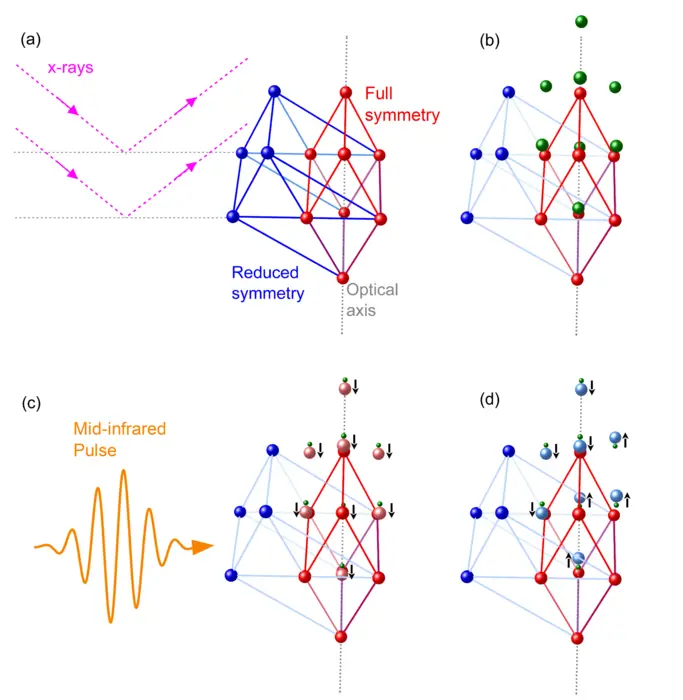
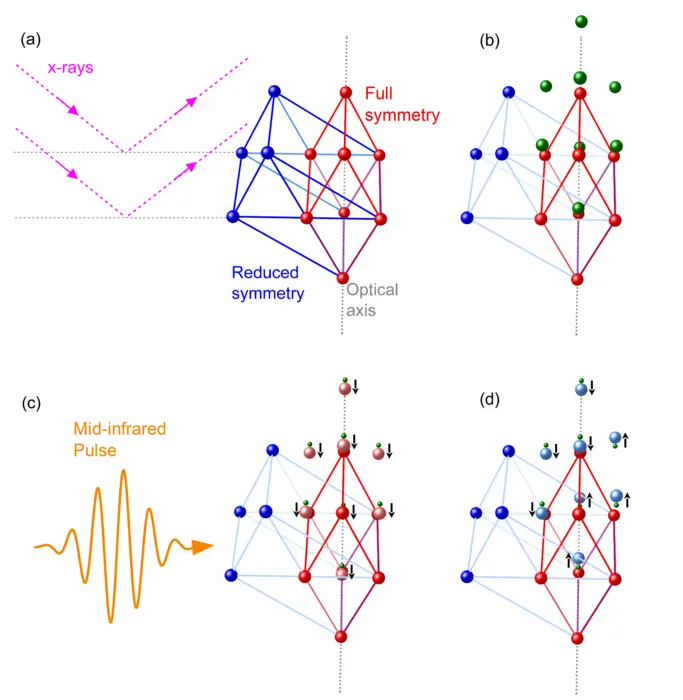
The physical properties of coherent phonons are determined by the symmetry of the crystal, which represents a periodic arrangement of identical unit cells. Weak optical excitation does not change the symmetry properties of the crystal. In this case, coherent phonons with identical atomic motions in all unit cells are excited (red unit cells in Fig. 1(c) with arrows indicating atomic displacements). In contrast, strong optical excitation can break the symmetry of the crystal and make atoms in adjacent unit cells oscillate differently [Fig. 1(d)]. While this mechanism holds potential for accessing other phonons, it has not been explored so far.
In the journal Physical Review B (https://link.aps.org/doi/10.1103/PhysRevB.107.L180303), researchers from the Max-Born-Institute in Berlin in collaboration with researchers from the University of Duisburg-Essen have demonstrated a novel concept for exciting and probing coherent phonons in crystals of a transiently broken symmetry. The key of this concept lies in reducing the symmetry of a crystal by appropriate optical excitation, as has been shown with the prototypical crystalline semimetal bismuth (Bi).
Ultrafast mid-infrared excitation of electrons in Bi modifies the spatial charge distribution and, thus, reduces the crystal symmetry transiently. In the reduced symmetry, new quantum pathways for the excitation of coherent phonons open up. As illustrated in Fig. 1, the symmetry reduction causes a doubling of the unit-cell size from the red framework with two Bi atoms to the blue framework with four Bi atoms. In addition to the unidirectional atomic motion shown in Fig. 1(c), the unit cell with 4 Bi atoms allows for coherent phonon wave packets with bidirectional atomic motions as sketched in Fig. 1(d).
Probing the transient crystal structure directly by femtosecond x-ray diffraction reveals oscillations of diffracted intensity (Fig. 2), which persist on a picosecond time scale. The oscillations arise from coherent wave packet motions along phonon coordinates in the crystal of reduced symmetry. Their frequency of 2.6 THz is different from that of phonon oscillations at low excitation level. Interestingly, this behavior occurs only above a threshold of the optical pump fluence and reflects the highly nonlinear, so-called non-perturbative character of the optical excitation process.
In summary, optically induced symmetry breaking allows for modifying the excitation spectrum of a crystal on ultrashort time scales. These results may pave the way for steering material properties transiently and, thus, implementing new functions in optoacoustics and optical switching.
Journal
Physical Review B
DOI
10.1103/PhysRevB.107.L180303
Method of Research
Experimental study
Subject of Research
Not applicable
Article Title
Quantum pathways of carrier and coherent phonon excitation in bismuth
Article Publication Date
23-May-2023
COI Statement
We declare that none of the authors have competing financial or non-financial interests.