Light is a very delicate and vulnerable property. Light can be absorbed or reflected at the surface of a material depending on the matter’s properties or change its form and be converted into thermal energy. Upon reaching a metallic material’s surface, light also tends to lose energy to the electrons inside the metal, a broad range of phenomena we call “optical loss.”
Credit: POSTECH
Light is a very delicate and vulnerable property. Light can be absorbed or reflected at the surface of a material depending on the matter’s properties or change its form and be converted into thermal energy. Upon reaching a metallic material’s surface, light also tends to lose energy to the electrons inside the metal, a broad range of phenomena we call “optical loss.”
Production of ultra-small optical elements that utilize light in various ways is very difficult since the smaller the size of an optical component results in a greater optical loss. However, in recent years, the non-Hermitian theory, which uses optical loss in an entirely different way, has been applied to optics research. New findings in physics are being made adopting non-Hermitian theory that embraces optical loss, exploring ways to make use of the phenomenon, unlike general physics where optical loss is perceived as an imperfect component of an optical system. A ‘blessing in disguise’ is that which initially seems to be a disaster but which ultimately results in good luck. This research story is a blessing in disguise in physics.
Prof. Junsuk Rho (Departments of Mechanical Engineering and Chemical Engineering) from POSTECH and PhD candidates Heonyeong Jeon and Seokwoo Kim (Mechanical Engineering) from POSTECH, and Prof. Yongmin Liu of Northeastern University (NEU) in Boston and their joint research team were able to control the direction of light beams using non-Hermitian meta-grating systems. The paper was featured in Science Advances, the international academic journal.
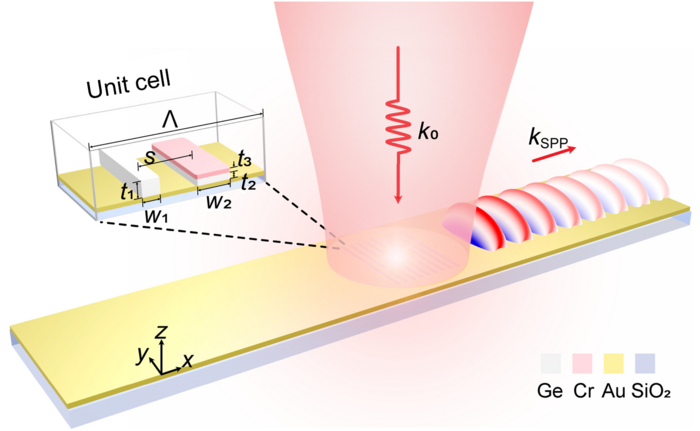
When light is incident on a metal surface, the electrons in the metal oscillate collectively as a single body with the light wave. The phenomenon is called surface plasmon polariton or SPP. A ‘grating coupler’ is widely used as an auxiliary device to control the directions of the SPPs. The efficiency of the device is limited in that it converts the right-angle incident light into SPPs in unintended directions.
The research team applied non-Hermitian theory to overcome the drawback. To start, the team calculated the theoretical exceptional point near which a certain optical loss occurs. Then, they validated its effectiveness through experiments using their specially designed non-Hermitian meta-grating coupler. The meta-grating coupler proved effective in providing unidirectional control of SSPs, which was nearly impossible with other grating couplers. They also could make light and SPP propagate in opposite directions by controlling the size and distance of meta-gratings. The research team was able to achieve the conversion of incident light into SSPs back to normal light using the same meta-grating device.
The research findings can be useful in quantum sensor research in various areas, such as detection of antigens for disease diagnosis or harmful gases in the atmosphere, which, combined with engineering, could open the door to a wide range of applications. Prof. Junsuk Rho, who led the team, said, “This research brought non-Hermitian optics to the nano-scale territory. It will contribute to the development of future plasmonic devices that have excellent direction controllability and performance.”
The research was funded by the US National Science Foundation, Samsung Science and Technology Foundation, and the National Research Foundation of Korea.
Journal
Science Advances
DOI
10.1126/sciadv.adf3510
Article Title
Subwavelength control of light transport at the exceptional point by non-Hermitian metagratings
Article Publication Date
12-May-2023