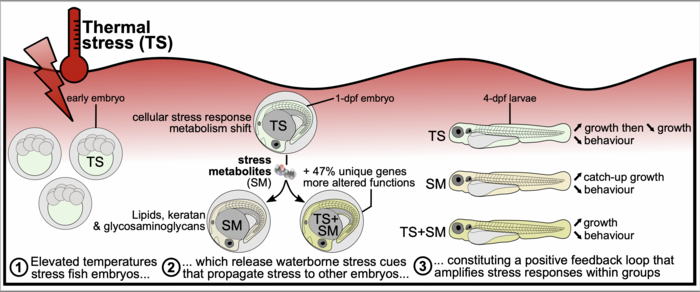
Heat-stressed fish embryos release chemical signals that change the appearance, behavior, and development of fish embryos that were not heat stressed, according to a study. Stress during development can change how an embryo grows and which genes are activated. Katharina Wollenberg Valero and colleagues explored how stress might be communicated to other animals and what the consequences are. Using zebrafish (Danio rerio), a classic model organism, the authors heated embryos to a stressful +5℃ over normal temperature, a temperature which is expected to occur more frequently during heat waves. The authors found that heat-stressed embryos tended to grow more quickly, show reduced response to new stimuli, and hatch early compared to controls. The authors then looked within the embryos’ growth medium for chemical cues that could act as messengers of heat stress and found that “stress metabolites” include both sulphur-containing compounds and fats. Next, the authors exposed other zebrafish embryos to these stress metabolites to see whether the embryos react in similar ways to the cues as to heat stress itself. The authors found that the stress metabolites influenced activity of genes associated with immune response, extracellular signaling, as well as with structural components of the cell membrane such as sugars and fats. These non-heat-stressed embryos showed a pattern of quick growth and reduced activity that was similar to that of the heat-stressed embryos, but achieved through a different molecular pathway. According to the authors, such propagation of heat stress across groups of individuals has implications for both ecology and animal welfare in a warming world.
Credit: Feugere et al.
Heat-stressed fish embryos release chemical signals that change the appearance, behavior, and development of fish embryos that were not heat stressed, according to a study. Stress during development can change how an embryo grows and which genes are activated. Katharina Wollenberg Valero and colleagues explored how stress might be communicated to other animals and what the consequences are. Using zebrafish (Danio rerio), a classic model organism, the authors heated embryos to a stressful +5℃ over normal temperature, a temperature which is expected to occur more frequently during heat waves. The authors found that heat-stressed embryos tended to grow more quickly, show reduced response to new stimuli, and hatch early compared to controls. The authors then looked within the embryos’ growth medium for chemical cues that could act as messengers of heat stress and found that “stress metabolites” include both sulphur-containing compounds and fats. Next, the authors exposed other zebrafish embryos to these stress metabolites to see whether the embryos react in similar ways to the cues as to heat stress itself. The authors found that the stress metabolites influenced activity of genes associated with immune response, extracellular signaling, as well as with structural components of the cell membrane such as sugars and fats. These non-heat-stressed embryos showed a pattern of quick growth and reduced activity that was similar to that of the heat-stressed embryos, but achieved through a different molecular pathway. According to the authors, such propagation of heat stress across groups of individuals has implications for both ecology and animal welfare in a warming world.
Journal
PNAS Nexus
DOI
10.1093/pnasnexus/pgad137
Article Title
Heat induces multi-omic and phenotypic stress propagation in zebrafish embryos
Article Publication Date
23-May-2023