Methane, a greenhouse gas known to do about 80 times more damage to the atmosphere than carbon dioxide over a 20-year period, is often overlooked by policymakers and governments. In a review publishing in the journal One Earth on May 19, researchers analyzed the coverage, stringency, and real-world impact of current global methane emissions policies for the first time. They found that only 13% of emissions are currently covered by direct mitigation policies.
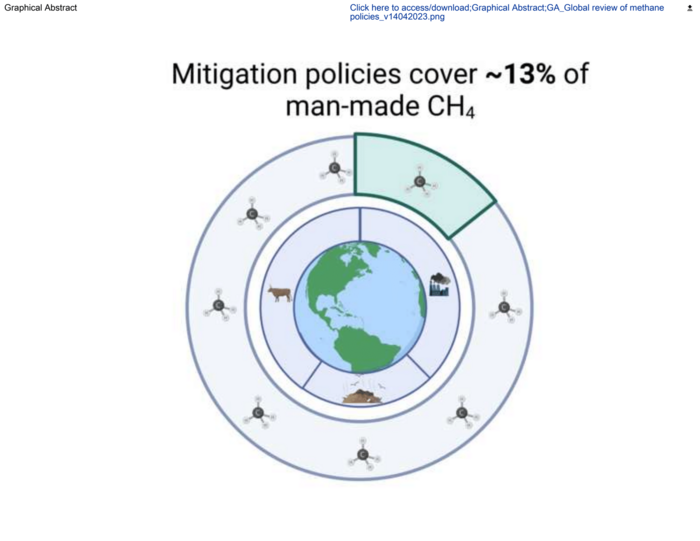
Credit: One Earth/Olczak et al.
Methane, a greenhouse gas known to do about 80 times more damage to the atmosphere than carbon dioxide over a 20-year period, is often overlooked by policymakers and governments. In a review publishing in the journal One Earth on May 19, researchers analyzed the coverage, stringency, and real-world impact of current global methane emissions policies for the first time. They found that only 13% of emissions are currently covered by direct mitigation policies.
In order to limit climate warming to 1.5 degrees Celsius in accordance with the Paris Agreement, global methane emissions need to be cut by at least 40%–45%, according to the 2021 Global Methane Assessment—a feat that the authors assert can be accomplished if governments adopt stricter methane policies and measure emissions more accurately.
“The need for comprehensive and targeted methane mitigation strategies is highlighted by a growing body of literature. But methane emissions are increasing faster than at any time since the 1980s,” write environmental policy experts Maria Olczak, Andris Piebalgs, and Paul Balcombe of the Queen Mary University of London/Environmental Defense Fund Europe, the European University Institute’s Florence School of Regulation, and the Queen Mary University of London, respectively.
To determine how effective current methane emissions restrictions are, the team reviewed 281 policies across the highest methane-producing sectors, including energy, waste, and agriculture. They found that the number of methane policies varies dramatically between regions and that the policies currently in place are not stringent enough, largely because they were created based on inaccurate data. Often, the methane emissions estimates used by policymakers come from underreported greenhouse gas estimates, datasets that are not open to the public, or figures that vary substantially depending on the method used to measure the amount of methane.
“A consistent approach for accurate identification, quantification, and verification of methane emissions sources alongside greater policy coverage and stringency must be put into place to realize the significant methane emissions reduction opportunities,” write the researchers.
Mitigating man-made methane emissions is one of the cheapest ways to slow down climate change and improve air quality, according to the Global Methane Assessment. However, the authors argue, progress will depend on a global, unified effort to limit methane emissions, and quick action needs to be taken on both a national and a regional level in order to meet climate goals.
“Effective methane mitigation requires stronger social support and political consensus. Yet, methane reduction is still perceived as a choice rather than a necessity complementing the ongoing decarbonization efforts focused largely on CO2,” the researchers write. “The upcoming climate conference COP28 in Dubai (United Arab Emirates), when collective progress towards the Paris Agreement objectives will be assessed for the first time, offers an enormous opportunity for change.”
###
One Earth, Olczak et al. “A global review of methane policies reveals only 13% of emissions are covered with unclear effectiveness” https://www.cell.com/one-earth/fulltext/S2590-3322(23)00195-1
One Earth (@OneEarth_CP), published by Cell Press, is a monthly journal that features papers from the fields of natural, social, and applied sciences. One Earth is the home for high-quality research that seeks to understand and address today’s environmental Grand Challenges, publishing across the spectrum of environmental change and sustainability science. A sister journal to Cell, Chem, and Joule, One Earth aspires to break down barriers between disciplines and stimulate the cross-pollination of ideas with a platform that unites communities, fosters dialogue, and encourages transformative research. Visit http://www.cell.com/one-earth. To receive Cell Press media alerts, contact [email protected].
Journal
One Earth
DOI
10.1016/j.oneear.2023.04.009
Method of Research
Literature review
Article Title
A global review of methane policies reveals only 13% of emissions are covered with unclear effectiveness
Article Publication Date
19-May-2023