Credit: Courtesy of IceCube Neutrino Observatory
EAST LANSING, Mich. – Trillions of neutrinos, or ghost particles, are passing through us every second. While scientists know this fact, they don't know what role neutrinos play in the universe because they are devilishly hard to measure.
New measurements of neutrino oscillations, observed at the IceCube Neutrino Observatory at the South Pole, have shed light on outstanding questions regarding fundamental properties of neutrinos. These new measurements of neutrinos as they change from one type to another while they travel were presented at the American Physical Society Meeting in Washington. They could help fill key gaps in the Standard Model, the theory that describes the behavior of fundamental particles at every energy scale scientists have been able to measure.
"While the Standard Model is an accurate theory, it leaves gaping holes, like the nature of dark matter and how a universe filled with matter, rather than anti-matter, arose from the Big Bang. We don't know how to fill them yet," said Tyce DeYoung, MSU associate professor of physics and astronomy. "We're hoping that by measuring the properties of neutrinos, such as their masses and how they morph or oscillate from one into another, we may get some clues into these open questions."
Neutrinos are weird particles. Unlike other elementary particles that make up ordinary matter, such as electrons and quarks, neutrinos have no electric charge. They're also at least a million times lighter than any other particle known to science. In fact, their masses are so small scientists have not yet been able to measure them accurately.
With this in mind, DeYoung compares his work to a fishing trip, one in which scientists aren't quite sure of the best bait to use. "Fishing" through the ice of Antarctica, though, is yielding promising results and narrowing the search.
"As physicists, we hoped the Higgs boson would point us to the physics that lies beyond the Standard Model; unfortunately, our measurements of the Higgs haven't turned up many clues," DeYoung said. "So we hope we may find something by studying neutrinos. IceCube detects neutrinos with a wider range of energies and distances than other experiments, so we cast a wide net."
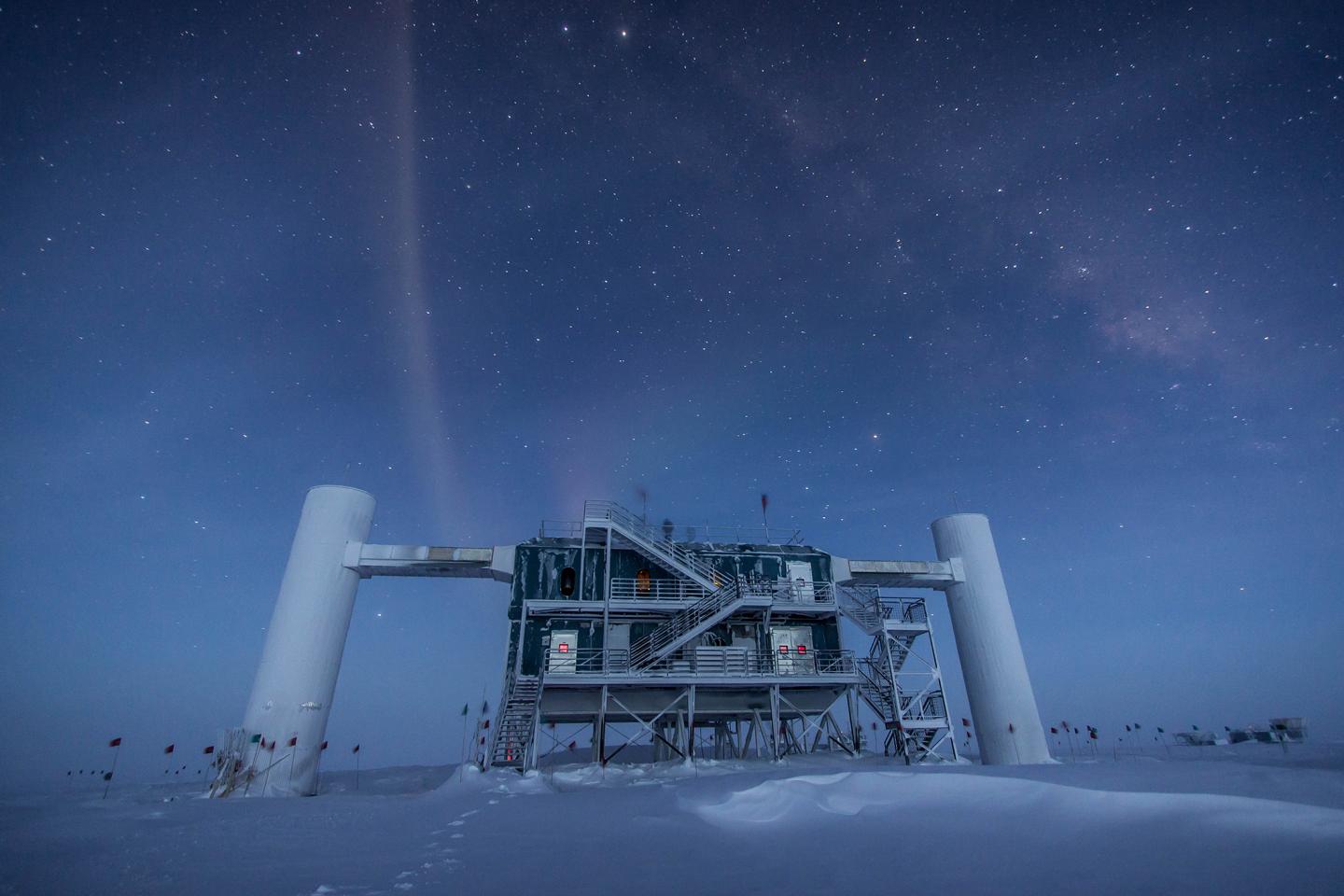
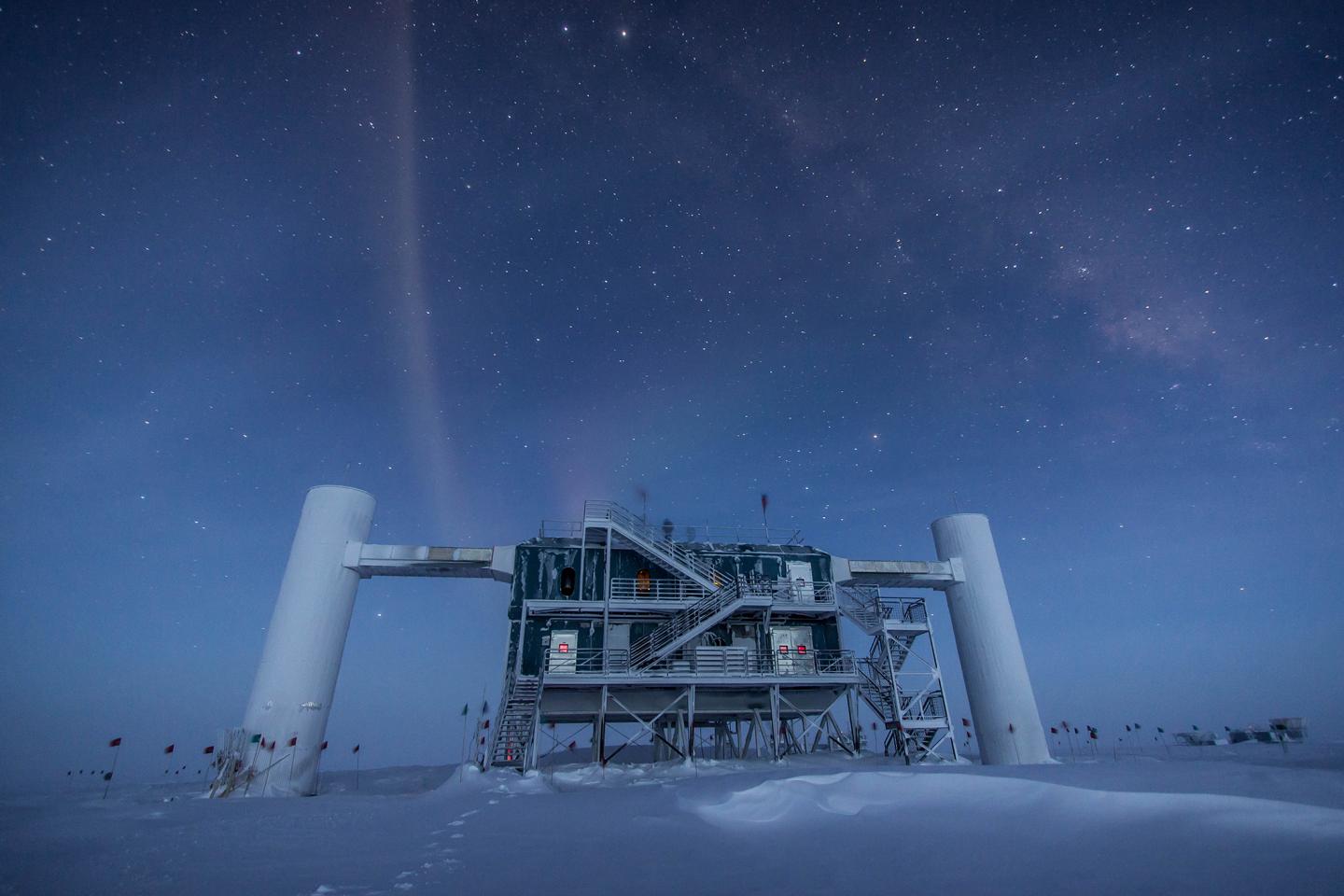
Energetic neutrinos produced by cosmic rays hitting the Earth's atmosphere can be detected at the South Pole, using the Antarctic ice as a particle detector like no other on the planet.
The IceCube data suggest that one species of neutrino may comprise exactly equal amounts of two neutrino "flavors."
"Neutrinos have a habit of changing, or oscillating, between three types, we call them 'flavors,'" said Joshua Hignight, the MSU research associate who presented the new results at the meeting. "So, if one neutrino is a precisely equal mix of two flavors, it could be a surprising coincidence or there might be a deeper reason for it coming from the physics beyond the Standard Model."
These measurements are consistent from results from other experiments using neutrinos with lower energies, but whether this flavor mixture is exactly balanced remains under debate. The IceCube physicists will continue to refine their analysis and collect more data. Future data will enable these measurements to be made more precisely, DeYoung said.
IceCube is the world's largest neutrino detector, using a billion tons of the Antarctic ice cap beneath the U.S. Amundsen-Scott South Pole Station to observe neutrinos. It's operated by a collaboration of 300 physicists from 48 universities and national laboratories in 12 countries. Construction was made possible by support from the National Science Foundation and other international funding agencies.
###
Michigan State University has been working to advance the common good in uncommon ways for more than 150 years. One of the top research universities in the world, MSU focuses its vast resources on creating solutions to some of the world's most pressing challenges, while providing life-changing opportunities to a diverse and inclusive academic community through more than 200 programs of study in 17 degree-granting colleges.
For MSU news on the Web, go to MSUToday. Follow MSU News on Twitter at twitter.com/MSUnews.
Media Contact
Layne Cameron
[email protected]
517-353-8819
@MSUnews
http://msutoday.msu.edu/journalists/
############
Story Source: Materials provided by Scienmag