Hydrogen, seen as the “ultimate energy” for the 21st century, boasts benefits such as being clean and renewable, and is storable and versatile. The International Energy Agency predicts that 115 million tons of hydrogen will be required in 2030 to make global carbon dioxide net emissions zero by 2050. This makes green hydrogen a promising avenue to a carbon-free society.
Credit: THE AUTHORS
Hydrogen, seen as the “ultimate energy” for the 21st century, boasts benefits such as being clean and renewable, and is storable and versatile. The International Energy Agency predicts that 115 million tons of hydrogen will be required in 2030 to make global carbon dioxide net emissions zero by 2050. This makes green hydrogen a promising avenue to a carbon-free society.
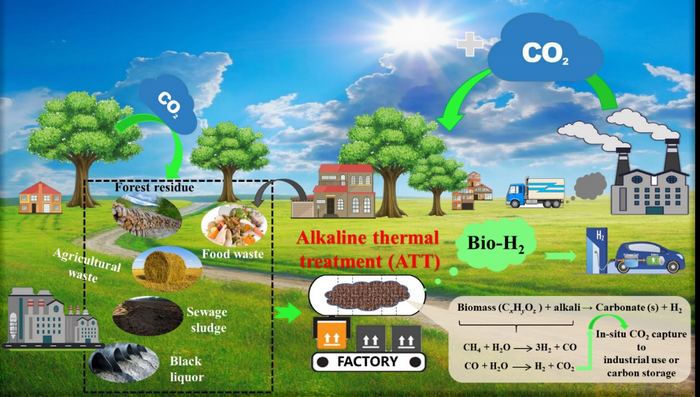
By making use of biomass for hydrogen production we can reduce carbon emissions created by fossil fuels, thus helping to address the worsening energy crisis. The novel alkaline thermal treatment (ATT) technology for hydrogen production involves pyrolysis at atmospheric pressure and low temperature. From the viewpoint of the complete biomass life cycle, ATT has significant potential for “negative carbon emissions” and could substitute some fossil fuels.
In a review published in the KeAi journal Carbon Resources Conversion, a team of researchers comprehensively examined the latest progress in ATT of biomass for hydrogen production. “There are many factors that affect the hydrogen production efficiency from ATT of biomass, ” explains the study’s first author, Guojie Liu, a PhD student at the School of Chemical Engineering, Sichuan University. “They include alkali, feedstock, catalysts, process parameters, and reactors, among others.”
“However, we must first clarify the fundamental role and synergy of alkali and catalysts in the ATT reaction and the conversion mechanism of biomass, and then use that knowledge to guide the development of more effective upgrading strategies and even breakthroughs in larger-scale applications,” Liu added.
To address that, the team believes that to maximize hydrogen production efficiency from the ATT reaction, the alkali used should promote the conversion of biomass into small gasifiable intermediates and in-situ carbon storage.
“Furthermore, by overcoming the kinetic limitation of the reformation reaction under low pressure and temperature in the ATT process, hydrogen production efficiency can be enhanced, and the synergy between alkali and metal catalysts can be fully demonstrated,” explained Houfang Lu, professor at the same school.
Following the review, four major conclusions were drawn. In order to better understand the transformation of model substances through different alkalis and identify more suitable biomass, further study is needed. To establish a suitable catalyst system based on the intermediate products of the ATT reaction, an analysis must be conducted into the deactivation mechanism of the catalyst, the interaction between the active site and carrier, and the catalytic structure-activity relationship. Additionally, when weighing the advantages and disadvantages of in-situ and ex-situ reactions, designing reasonable reactors and developing efficient inlet/outlet methods are key to overcoming problems such as coking, limited mass transfer and catalyst regeneration caused by solid-solid reactions. Finally, economic assessment and energy consumption analysis should be conducted.
“We hope that these points will guide forthcoming experiments on hydrogen production via biomass ATT processes to realize the industrialization of this technology,” expressed Lu.
###
Contact the author: Houfang Lu, [email protected], [email protected]
The publisher KeAi was established by Elsevier and China Science Publishing & Media Ltd to unfold quality research globally. In 2013, our focus shifted to open access publishing. We now proudly publish more than 100 world-class, open access, English language journals, spanning all scientific disciplines. Many of these are titles we publish in partnership with prestigious societies and academic institutions, such as the National Natural Science Foundation of China (NSFC).
Journal
Carbon Resources Conversion
DOI
10.1016/j.crcon.2023.04.001
Method of Research
Systematic review
Subject of Research
Not applicable
Article Title
A green route for hydrogen production from alkaline thermal treatment (ATT) of biomass with carbon storage
COI Statement
The authors declare that they have no known competing financial interests or personal relationships that could have appeared to influence the work reported in this paper.