

• HOME
  • NEWS
  • EXPLORE
    • CAREER
      • Companies
      • Jobs
    • EVENTS
    • iGEM
      • News
      • Team
    • PHOTOS
    • VIDEO
    • WIKI
  • BLOG
  • COMMUNITY
    • FACEBOOK
    • INSTAGRAM
    • TWITTER
Saturday, February 7, 2026
BIOENGINEER.ORG
No Result
View All Result
  • Login
  • HOME
  • NEWS
  • EXPLORE
    • CAREER
      • Companies
      • Jobs
        • Lecturer
        • PhD Studentship
        • Postdoc
        • Research Assistant
    • EVENTS
    • iGEM
      • News
      • Team
    • PHOTOS
    • VIDEO
    • WIKI
  • BLOG
  • COMMUNITY
    • FACEBOOK
    • INSTAGRAM
    • TWITTER
  • HOME
  • NEWS
  • EXPLORE
    • CAREER
      • Companies
      • Jobs
        • Lecturer
        • PhD Studentship
        • Postdoc
        • Research Assistant
    • EVENTS
    • iGEM
      • News
      • Team
    • PHOTOS
    • VIDEO
    • WIKI
  • BLOG
  • COMMUNITY
    • FACEBOOK
    • INSTAGRAM
    • TWITTER
No Result
View All Result
Bioengineer.org
No Result
View All Result
Home NEWS Science News Biology

The bat’s ability to convert energy into muscle power is affected by flight speed

Bioengineer by Bioengineer
May 9, 2023
in Biology
Reading Time: 3 mins read
0
Bat in flight
Share on FacebookShare on TwitterShare on LinkedinShare on RedditShare on Telegram

Small bats are bad at converting energy into muscle power. Surprisingly, a new study led by Lund University reveals that this ability increases the faster they fly.
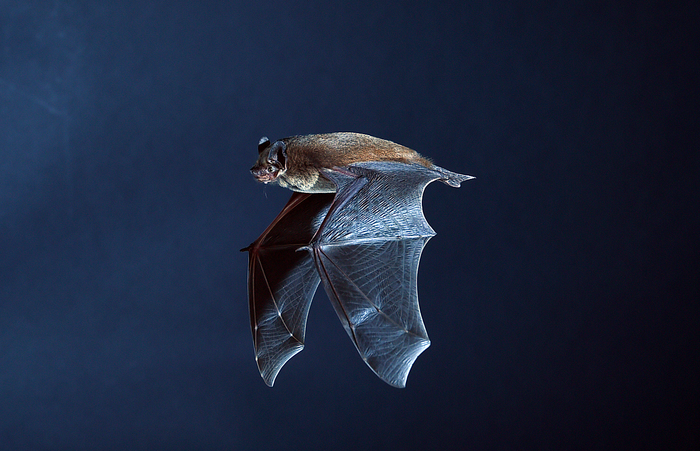
Bat in flight

Credit: Anders Hedenström

Small bats are bad at converting energy into muscle power. Surprisingly, a new study led by Lund University reveals that this ability increases the faster they fly.

The researchers have studied the efficiency of migratory bats – a species that weighs about eight grams and is found in almost all of Europe. Efficiency, in this case, is the ability to convert supplied energy into something we need. For bats and birds, it’s the energy required to fly. In a new study published in the journal Proceedings of the Royal Society B, a research team in Lund states that the efficiency varies with the bats’ flight speed. The faster the bats flew, the more energy they managed to convert into muscle power.

“Previously, we have believed that efficiency is a constant. So this is a bit of a breakthrough”, says Anders Hedenström, biology researcher at Lund University.

Using high-speed cameras, laser and smoke in a wind tunnel, the researchers have measured the bat’s kinetic energy. They have then compared these results with the animals’ metabolism – a methodological breakthrough with technically advanced measurements. In the past, researchers have only measured either kinetic energy or metabolic rate and compared this to theories.

“Our study reveals that the efficiency is lower than expected in this small migratory bat, but that it increases with flight speed”, says Anders Hedenström.

The bat’s ability to convert food into energy in flight controls the ability to produce a forward and upward force to overcome air resistance and gravity. This is what is known as metabolic energy. How efficiently animals use metabolic energy during flight has previously been assumed to be the same at all speeds.

“Until now, the calculations have greatly underestimated the “flight costs” of the migratory bat, which has made it difficult to predict their migratory behaviour. Our results provide a new basis for studying their behaviour”, says Anders Hedenström.

The researchers’ new discovery helps us to better understand the migratory behaviour of these mysterious bats. Compared to bird migrations, bat migrations are not as well mapped.

“We have previously analysed the blackcap, a bird which also migrates. The bird’s efficiency was 20 percent compared to the bat’s ten percent. This means that of all the energy the bat consumes, only ten percent is useful, while it’s 20 percent for the blackcap. The bat thus uses the energy less efficiently. The difference may be because birds only have two flight muscles, while bats have about 15 muscles for the same job”, says Anders Hedenström.


Journal

Proceedings of the Royal Society B Biological Sciences

DOI

10.1098/rspb.2023.0045

Article Title

Conversion efficiency of flight power is low, but increases with flight speed in the migratory bat Pipistrellus nathusii


Share12Tweet8Share2ShareShareShare2

Related Posts

Florida Cane Toad: Complex Spread and Selective Evolution

Florida Cane Toad: Complex Spread and Selective Evolution

February 7, 2026
New Study Uncovers Mechanism Behind Burn Pit Particulate Matter–Induced Lung Inflammation

New Study Uncovers Mechanism Behind Burn Pit Particulate Matter–Induced Lung Inflammation

February 6, 2026

DeepBlastoid: Advancing Automated and Efficient Evaluation of Human Blastoids with Deep Learning

February 6, 2026

Navigating the Gut: The Role of Formic Acid in the Microbiome

February 6, 2026

POPULAR NEWS

  • Robotic Ureteral Reconstruction: A Novel Approach

    Robotic Ureteral Reconstruction: A Novel Approach

    82 shares
    Share 33 Tweet 21
  • Digital Privacy: Health Data Control in Incarceration

    63 shares
    Share 25 Tweet 16
  • Study Reveals Lipid Accumulation in ME/CFS Cells

    57 shares
    Share 23 Tweet 14
  • Breakthrough in RNA Research Accelerates Medical Innovations Timeline

    53 shares
    Share 21 Tweet 13

About

We bring you the latest biotechnology news from best research centers and universities around the world. Check our website.

Follow us

Recent News

Digital Health Perspectives from Baltic Sea Experts

Florida Cane Toad: Complex Spread and Selective Evolution

Exploring Decision-Making in Dementia Caregivers’ Mobility

Subscribe to Blog via Email

Enter your email address to subscribe to this blog and receive notifications of new posts by email.

Join 73 other subscribers
  • Contact Us

Bioengineer.org © Copyright 2023 All Rights Reserved.

Welcome Back!

Login to your account below

Forgotten Password?

Retrieve your password

Please enter your username or email address to reset your password.

Log In
No Result
View All Result
  • Homepages
    • Home Page 1
    • Home Page 2
  • News
  • National
  • Business
  • Health
  • Lifestyle
  • Science

Bioengineer.org © Copyright 2023 All Rights Reserved.