An optical spectrometer is an instrument used to measure properties of light over a specific portion of the light spectrum, which has found a wide range of practical applications. Dispersive optical elements (e.g., a diffraction grating or a prism) are the key components of the conventional spectrometer to achieve the desired dispersion. Dispersion originates from the variation of the material’s refractive index with the wavelength of the incident light beam. The combination of such free-space optical elements along with the free-space propagation volume result in bulky spectrometers, which are incompatible with on-chip integration technology. To meet the requirement of system integration, there is a pressing need for a compact, simple, and efficient approach to realize a high-resolution spectrometer.
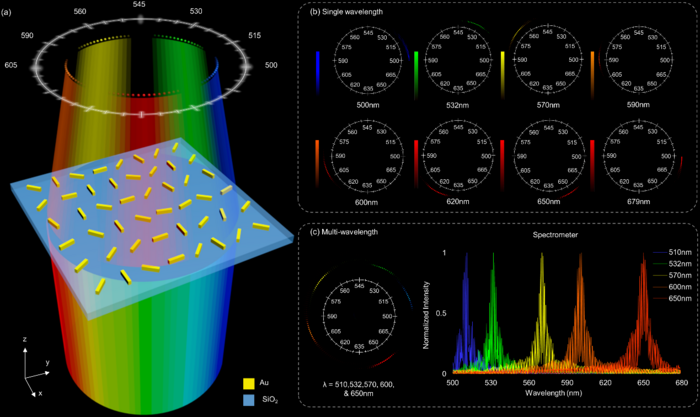
Credit: by Ruoxing Wang, Muhammad Afnan Ansari, Hammad Ahmed, Yan Li, Wenfeng Cai, Yanjun Liu, Songtao Li, Jianlong Liu, Li Li, and Xianzhong Chen
An optical spectrometer is an instrument used to measure properties of light over a specific portion of the light spectrum, which has found a wide range of practical applications. Dispersive optical elements (e.g., a diffraction grating or a prism) are the key components of the conventional spectrometer to achieve the desired dispersion. Dispersion originates from the variation of the material’s refractive index with the wavelength of the incident light beam. The combination of such free-space optical elements along with the free-space propagation volume result in bulky spectrometers, which are incompatible with on-chip integration technology. To meet the requirement of system integration, there is a pressing need for a compact, simple, and efficient approach to realize a high-resolution spectrometer.
In a paper published in Light Science & Application, a team of researchers, led by Prof. Xianzhong Chen from Institute of Photonics and Quantum Sciences, School of Engineering and Physical Sciences, Heriot-Watt University, UK, have proposed a new method for dispersion control. They have developed an ultra-thin spectrometer with a nanometer resolution by controlling the dispersion using a single metasurface device, which was designed based on a novel lens model. The uniqueness of this technique lies in the novel lens design that can simultaneously realize wavelength splitting and light focusing. The compactness and ultrathin nature of the spectrometer render this technology very attractive for potential applications in on-chip integrated photonics where spectral analysis and information processing can be performed in a compact platform.
The wavelengths of the incident light beam are accurately mapped to different positions on the focal plane using the proposed device. The device consists of gold nanorods with spatially variant orientations sitting on a glass substrate. Upon the illumination of left circularly polarized light, the right circularly polarized light (converted part) is converged at the desired positions, i.e., a predesigned ring. The ring is designed to incorporate multiple focal points, and each focal point corresponds to a different incident wavelength.
The design process of the proposed metasurface spectrometer includes a unique design technique of multi-foci metalens with wavelength information. The researchers explained:
“We initially consider the phase profile of a metalens that can generate a single focal point at the desired position governed by Fermat’s principle. Individual phase profiles of different metalenses with a single focal point can be integrated into one combined phase profile. Then, the wavelength of each focal point is considered a design variable and added to the phase profile of multi-foci metalens. A single-layer metasurface consisting of gold nanorods with spatially variant orientations is employed to realize the desired functionality.”
“The larger samples of metasurface will enable accurate linewidth detection and continuous spectrum recognition. The increase in the sample size will increase the number of wavelength dependent focal points, which will help boost the resolution and working bandwidth of the metasurface spectrometer.” they added.
“The proposed approach is very flexible and robust, providing a new scheme for controlling the desired dispersion under the illumination of both mono and polychromatic incident light beams. The design flexibility and ultrathin nature render the ultra-compact spectrometer very attractive for monolithic on-chip integration with sensor technology. This technology can be effectively utilized for many exciting applications in the areas of spectral analysis, information security, and information processing.” the scientists forecast.
DOI
10.1038/s41377-023-01148-9