Professor Nicolas Doucet and his team at Institut national de la recherche scientifique (INRS) made a major breakthrough earlier this year in the field of evolutionary conservation of molecular dynamics in enzymes. Their work, published in the journal Structure, points to potential applications in health, including the development of new drugs to treat serious diseases such as cancer or to counter antibiotic resistance.
Credit: Nicolas Doucet (INRS)
Professor Nicolas Doucet and his team at Institut national de la recherche scientifique (INRS) made a major breakthrough earlier this year in the field of evolutionary conservation of molecular dynamics in enzymes. Their work, published in the journal Structure, points to potential applications in health, including the development of new drugs to treat serious diseases such as cancer or to counter antibiotic resistance.
As a researcher specializing in protein dynamics, Professor Doucet is captivated by things that are invisible to the naked eye, yet full of mysteries and essential to all forms of life. He studies proteins and enzymes, and the poorly understood links between their structure, function, and motion at the atomic scale.
To better envision unexplored avenues of enquiry, the enzyme engineering specialist starts by examining problems from a conceptual standpoint.
“A bit of imagination may be all it takes to envision multiple paths of enquiry in this tiny world we still know relatively little about, but the scientific process is very meticulous,” said Professor Doucet, a researcher at the Armand-Frappier Santé Biotechnologie Research Centre and scientific co-head of the Nuclear Magnetic Resonance Spectroscopy Lab at INRS.
Towards a better understanding of macromolecular function
As part of this study, Professor Doucet’s team investigated an issue considered fundamental by experts in the field: if a particular protein or enzyme relies on the conformational change of its three-dimensional structure to perform its biological function in humans, do homologous enzymes in other vertebrates or other living organisms also depend on these same conformational changes? In other words, if certain motions are essential to the biological function of proteins and enzymes, are these conformation changes selected and conserved as a molecular evolutionary mechanism in all forms of life?
Despite our very limited understanding of how these macromolecules essential to life on Earth actually work, the team attempted to answer this question.
Developments in biochemical and biophysical technology in recent decades have made it easier to observe the molecular structures of proteins and enzymes.
“We studied different enzymes of the same family to analyze several proteins exhibiting the same biological function. We compared their atomic-scale motions to uncover whether they are preserved throughout evolution. Despite overall similarities between species, we were surprised to find that, on the contrary, movements are divergent,” explained the lead author of the study, David Bernard, an INRS graduate who was a PhD student in Professor Doucet’s lab at the time. He now works as a researcher at NMX.
Molecular motions of great importance
The molecular function of a protein or enzyme depends on its amino acid sequence, but also on its three-dimensional (3D) structure. In recent years, scientists have discovered that protein dynamics are closely linked to the biological activity of certain enzymes and proteins.
If this is the case for a given enzyme, what about the conservation of these motions from an evolutionary standpoint? In other words, are specific atomic motions in an enzyme family always present and similarly conserved to preserve biological function?
This would imply that the atomic-scale motions within proteins are an important determinant of the selective pressure experienced to preserve biological function, similar to the preservation of an amino acid sequence or a protein structure.
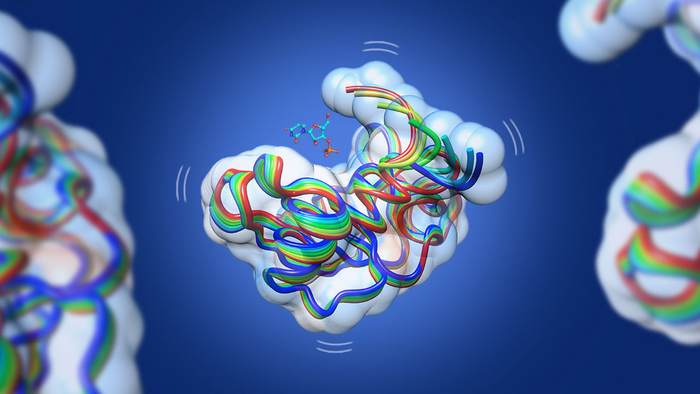
In the article, Professor Doucet’s team and their U.S. collaborators present a molecular and dynamic analysis of several ribonucleases, enzymes known as RNases that catalyze the degradation of RNA into smaller elements. RNases from a handful of vertebrate species, including primates and humans, were selected based on their structural and functional homology.
This study, which builds on *previously published research by the team, convincingly demonstrates that RNases that retain specific biological functions in various species also maintain a very similar dynamic profile among themselves. In contrast, structurally similar RNases with distinct biological function demonstrate a unique dynamic profile, strongly suggesting that the preservation of dynamics is related to biological function in these biocatalysts.
Elucidating the motions essential to the function of a protein or enzyme therefore holds promise for exploiting its therapeutic potential. This could provide a potential target for controlling protein and enzyme functions in the cell, a field known as allosteric modulation or inhibition.
For example, successfully inhibiting an enzyme by binding a drug to its active (or orthosteric) site while also targeting an allosteric site on the surface of a protein could kill two birds with one stone. The idea here is to inhibit the active site of the enzyme while at the same time disrupting its molecular dynamics by targeting an allosteric site. This inhibitory action would also significantly reduce the development of antibiotic resistance.
Drug resistance is a global health issue. In recent years, one of the most compelling and widely publicized examples of this has been antibiotic resistance in the fight against bacteria that infect humans and farm animals.
In conclusion, since specific molecular motions are uniquely observable in some enzyme families, this would allow researchers to achieve a remarkable degree of selectivity in developing unique allosteric inhibitors—all without affecting structurally or functionally homologous enzymes.
*Article published in Structure (2018)
Editorial
About the publication
The article “Conformational exchange divergence along the evolutionary pathway of eosinophil-associated ribonucleases” was published on March 2, 2023, in the Cell Press journal Structure, by David N. Bernard, Chitra Narayanan, Tim Hempel, Khushboo Bafna, Purva Prashant Bhojane, Myriam Létourneau, Elizabeth E. Howell, Pratul K. Agarwal, and Nicolas Doucet.
This research was primarily funded by the Natural Sciences and Engineering Research Council of Canada (NSERC), Fonds de Recherche Québec – Santé (FRQS), the National Institutes of Health (NIH) in the United States, and the Armand-Frappier Foundation.
Journal
Structure
DOI
10.1016/j.str.2022.12.011
Subject of Research
Cells
Article Title
Conformational exchange divergence along the evolutionary pathway of eosinophil-associated ribonucleases
Article Publication Date
2-Mar-2023