• HOME
  • NEWS
  • EXPLORE
    • CAREER
      • Companies
      • Jobs
    • EVENTS
    • iGEM
      • News
      • Team
    • PHOTOS
    • VIDEO
    • WIKI
  • BLOG
  • COMMUNITY
    • FACEBOOK
    • INSTAGRAM
    • TWITTER
Saturday, February 7, 2026
BIOENGINEER.ORG
No Result
View All Result
  • Login
  • HOME
  • NEWS
  • EXPLORE
    • CAREER
      • Companies
      • Jobs
        • Lecturer
        • PhD Studentship
        • Postdoc
        • Research Assistant
    • EVENTS
    • iGEM
      • News
      • Team
    • PHOTOS
    • VIDEO
    • WIKI
  • BLOG
  • COMMUNITY
    • FACEBOOK
    • INSTAGRAM
    • TWITTER
  • HOME
  • NEWS
  • EXPLORE
    • CAREER
      • Companies
      • Jobs
        • Lecturer
        • PhD Studentship
        • Postdoc
        • Research Assistant
    • EVENTS
    • iGEM
      • News
      • Team
    • PHOTOS
    • VIDEO
    • WIKI
  • BLOG
  • COMMUNITY
    • FACEBOOK
    • INSTAGRAM
    • TWITTER
No Result
View All Result
Bioengineer.org
No Result
View All Result
Home NEWS Science News Chemistry

Exciton fission – one photon in, two electrons out

Bioengineer by Bioengineer
May 5, 2023
in Chemistry
Reading Time: 2 mins read
0
Emergence of the bitriplet exciton in crystalline pentacene.
Share on FacebookShare on TwitterShare on LinkedinShare on RedditShare on Telegram

”When pentacene is excited by light, the electrons in the material rapidly react,” explains Prof. Ralph Ernstorfer, a senior author of the study. “It was an open and very disputed question whether a photon excites two electrons directly or initially one electron, which subsequently shares its energy with another electron.”
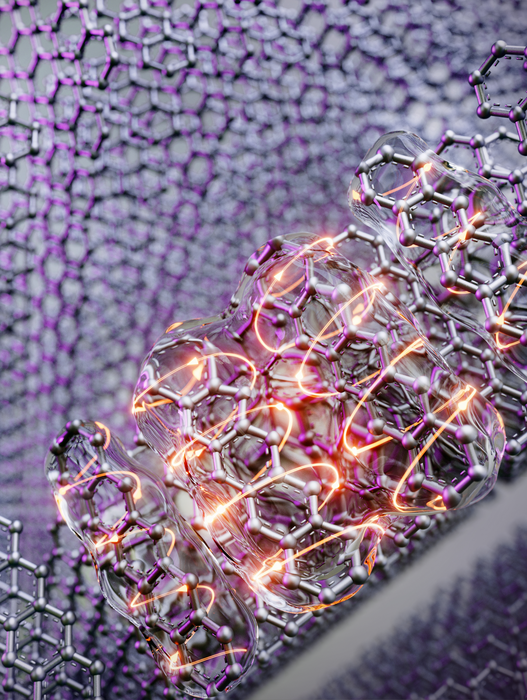
Emergence of the bitriplet exciton in crystalline pentacene.

Credit: © TU Berlin

”When pentacene is excited by light, the electrons in the material rapidly react,” explains Prof. Ralph Ernstorfer, a senior author of the study. “It was an open and very disputed question whether a photon excites two electrons directly or initially one electron, which subsequently shares its energy with another electron.”

To unravel this mystery the researchers used time- and angle-resolved photoemission spectroscopy, a cutting-edge technique to observe the dynamics of electrons on the femtosecond time scale, which is a billionth of a millionth of a second.  This ultrafast electron movie camera enabled them to capture images of the fleeting excited electrons for the first time.

“Seeing these electrons was crucial to decipher the process,” says Alexander Neef, from the Fritz Haber Institute and the first author of the study. “An excited electron not only has a specific energy but also moves in distinct patterns, which are called orbitals. It is much easier to tell the electron apart if we can see their orbital shapes and how these change over time.”

With the images from the ultrafast electron movie at hand, the researchers decomposed the dynamics of the excited electrons for the first time based on their orbital characteristics. “We can now say with certainty that only one electron is excited directly and identified the mechanism of the excitation-doubling process,” adds Alexander Neef.

Knowing the mechanism of exciton fission is essential to using it for photovoltaic applications. A silicon solar cell enhanced with an excitation-doubling material could boost the solar-to-electricity efficiency by one-third. Such an advance could have enormous impacts since solar energy will be the dominant power source of the future. Already today large investments are flowing into the construction of these third-generation solar cells.


Journal

Nature

DOI

10.1038/s41586-023-05814-1

Article Title

Orbital-resolved observation of singlet fission

Article Publication Date

12-Apr-2023

Share12Tweet8Share2ShareShareShare2

Related Posts

blank

Breakthrough in Environmental Cleanup: Scientists Develop Solar-Activated Biochar for Faster Remediation

February 7, 2026
blank

Cutting Costs: Making Hydrogen Fuel Cells More Affordable

February 6, 2026

Scientists Develop Hand-Held “Levitating” Time Crystals

February 6, 2026

Observing a Key Green-Energy Catalyst Dissolve Atom by Atom

February 6, 2026

POPULAR NEWS

  • Robotic Ureteral Reconstruction: A Novel Approach

    Robotic Ureteral Reconstruction: A Novel Approach

    82 shares
    Share 33 Tweet 21
  • Digital Privacy: Health Data Control in Incarceration

    63 shares
    Share 25 Tweet 16
  • Study Reveals Lipid Accumulation in ME/CFS Cells

    57 shares
    Share 23 Tweet 14
  • Breakthrough in RNA Research Accelerates Medical Innovations Timeline

    53 shares
    Share 21 Tweet 13

About

We bring you the latest biotechnology news from best research centers and universities around the world. Check our website.

Follow us

Recent News

Personalized Guide to Understanding and Reducing Chemicals

Inflammasome Protein ASC Drives Pancreatic Cancer Metabolism

Phage-Antibiotic Combo Beats Resistant Peritoneal Infection

Subscribe to Blog via Email

Enter your email address to subscribe to this blog and receive notifications of new posts by email.

Join 73 other subscribers
  • Contact Us

Bioengineer.org © Copyright 2023 All Rights Reserved.

Welcome Back!

Login to your account below

Forgotten Password?

Retrieve your password

Please enter your username or email address to reset your password.

Log In
No Result
View All Result
  • Homepages
    • Home Page 1
    • Home Page 2
  • News
  • National
  • Business
  • Health
  • Lifestyle
  • Science

Bioengineer.org © Copyright 2023 All Rights Reserved.