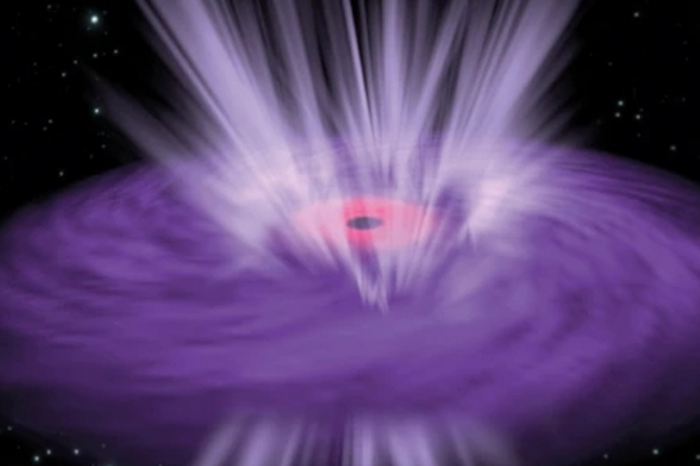
They are called UFOs, but aliens have nothing to do with them. They are the ultra-fast outflows: space winds that emerge from the surroundings of supermassive black holes and blow at speeds close to that of light. An international research team has explored this still little-understood phenomenon, hunting for these gas emissions, which are crucial to understanding the mechanisms regulating the behaviour of supermassive black holes in their active phase.
The research project is called SUBWAYS (SUper massive Black hole Winds in the x-rAYS) and the first results have been published, in two papers, in Astronomy & Astrophysics. The first of these, led by scholars from the University of Bologna and INAF, is mainly based on data obtained from ESA’s XMM-Newton space telescope.
The scholars analysed 22 active galactic nuclei (AGN), i.e. the regions surrounding supermassive black holes at the centre of galaxies and emitting enormous amounts of radiations across the entire electromagnetic spectrum when black holes are in the active phase. The investigation showed that in about 30% of the active galactic nuclei analysed, there are space winds travelling at speeds between 10% and 30% of the speed of light.
“These results allow us to establish with greater certainty that a significant proportion of active galactic nuclei hosts ultra-fast winds called UFOs, ultra-fast outflows,” explains Marcella Brusa, professor at the University of Bologna and INAF associate, as well as coordinator of the entire SUBWAYS project. “And we were able to confirm that the intensity of these gas flows is sufficient to significantly change the ecosystem of their galaxies.”
Between a supermassive black hole and the galaxy that surrounds it, there is in fact a close relationship that reciprocally influences their formation and evolution. The mechanisms driving this reciprocal relationship are still poorly understood, but among the key ingredients may be the ultra-fast winds emitted by active galactic nuclei. These powerful emissions arise when part of the gas in the accretion disk is ejected outwards, thus transferring some of the matter and energy produced to interstellar space, a mechanism that has important implications for regulating the process of star formation.
In order to detect UFOs, spectra emitted in the X-ray band are analysed, looking for absorptions produced by the presence of highly ionised materials such as iron. This phenomenon is due to the extreme temperatures – up to tens of millions of degrees – generated in the vicinity of supermassive black holes. With this in mind, SUBWAYS scientists managed to obtain 1.6 million seconds of observation time (more than eighteen days) with the ESA XMM-Newton X-ray Space Telescope. They thus explored 17 active galactic nuclei in the relatively nearby universe (between about 1.5 and 5 billion light years away), to which they added data from another 5 AGN already collected in previous observations.
“These observations have allowed us to obtain new independent evidence of the existence of highly ionised matter that is ejected from the innermost regions of active galactic nuclei at speeds close to that of light,” says Gabriele Matzeu, researcher at the University of Bologna, INAF associate and first author of the paper presenting the results on UFOs statistics. “These outcomes have allowed us to learn more about these ultrafast winds and to better understand their role in shaping the evolution process of galaxies.”
The result of the research work was published in Astronomy & Astrophysics in the article ‘Supermassive Black Hole Winds in X-rays: SUBWAYS. I. Ultra-fast outflows in quasars beyond the local Universe’. For the University of Bologna (Department of Physics and Astronomy ‘Augusto Righi’), the following participated: G. A. Matzeu, M. Brusa, C. Vignali, and P. Baldini. For INAF – National Institute for Astrophysics the authors are: G. Lanzuisi, M. Dadina, A. Comastri, P. Grandi, E. Torresi, M. Cappi, and R. Gilli (INAF – Observatory of Astrophysics and Space Science of Bologna), E. Nardini and G. Cresci (INAF – Astrophysical Observatory of Arcetri), E. Piconcelli and L. Zappacosta (INAF – Astronomical Observatory of Rome), A. Luminari, G. Bruni, A. De Rosa and F. Panessa (INAF – Institute of Space Astrophysics and Planetology), M. Bischetti and F. Fiore (INAF – Astronomical Observatory of Trieste), G. Ponti (INAF – Astronomical Observatory of Brera). They were joined by another 30 authors from 20 different universities and international institutions.
In Astronomy & Astrophysics was also published the companion paper ‘Supermassive Black Hole Winds in X-rays: SUBWAYS. II. HST UV spectroscopy of winds at intermediate redshifts’, led by Missagh Mehdipour (Space Telescope Science Institute, Baltimore, USA), which presents a study of lower-velocity and lower-ionisation gas flows visible in the ultraviolet band thanks to the HST satellite.
Credit: University of Bologna
They are called UFOs, but aliens have nothing to do with them. They are the ultra-fast outflows: space winds that emerge from the surroundings of supermassive black holes and blow at speeds close to that of light. An international research team has explored this still little-understood phenomenon, hunting for these gas emissions, which are crucial to understanding the mechanisms regulating the behaviour of supermassive black holes in their active phase.
The research project is called SUBWAYS (SUper massive Black hole Winds in the x-rAYS) and the first results have been published, in two papers, in Astronomy & Astrophysics. The first of these, led by scholars from the University of Bologna and INAF, is mainly based on data obtained from ESA’s XMM-Newton space telescope.
The scholars analysed 22 active galactic nuclei (AGN), i.e. the regions surrounding supermassive black holes at the centre of galaxies and emitting enormous amounts of radiations across the entire electromagnetic spectrum when black holes are in the active phase. The investigation showed that in about 30% of the active galactic nuclei analysed, there are space winds travelling at speeds between 10% and 30% of the speed of light.
“These results allow us to establish with greater certainty that a significant proportion of active galactic nuclei hosts ultra-fast winds called UFOs, ultra-fast outflows,” explains Marcella Brusa, professor at the University of Bologna and INAF associate, as well as coordinator of the entire SUBWAYS project. “And we were able to confirm that the intensity of these gas flows is sufficient to significantly change the ecosystem of their galaxies.”
Between a supermassive black hole and the galaxy that surrounds it, there is in fact a close relationship that reciprocally influences their formation and evolution. The mechanisms driving this reciprocal relationship are still poorly understood, but among the key ingredients may be the ultra-fast winds emitted by active galactic nuclei. These powerful emissions arise when part of the gas in the accretion disk is ejected outwards, thus transferring some of the matter and energy produced to interstellar space, a mechanism that has important implications for regulating the process of star formation.
In order to detect UFOs, spectra emitted in the X-ray band are analysed, looking for absorptions produced by the presence of highly ionised materials such as iron. This phenomenon is due to the extreme temperatures – up to tens of millions of degrees – generated in the vicinity of supermassive black holes. With this in mind, SUBWAYS scientists managed to obtain 1.6 million seconds of observation time (more than eighteen days) with the ESA XMM-Newton X-ray Space Telescope. They thus explored 17 active galactic nuclei in the relatively nearby universe (between about 1.5 and 5 billion light years away), to which they added data from another 5 AGN already collected in previous observations.
“These observations have allowed us to obtain new independent evidence of the existence of highly ionised matter that is ejected from the innermost regions of active galactic nuclei at speeds close to that of light,” says Gabriele Matzeu, researcher at the University of Bologna, INAF associate and first author of the paper presenting the results on UFOs statistics. “These outcomes have allowed us to learn more about these ultrafast winds and to better understand their role in shaping the evolution process of galaxies.”
The result of the research work was published in Astronomy & Astrophysics in the article ‘Supermassive Black Hole Winds in X-rays: SUBWAYS. I. Ultra-fast outflows in quasars beyond the local Universe’. For the University of Bologna (Department of Physics and Astronomy ‘Augusto Righi’), the following participated: G. A. Matzeu, M. Brusa, C. Vignali, and P. Baldini. For INAF – National Institute for Astrophysics the authors are: G. Lanzuisi, M. Dadina, A. Comastri, P. Grandi, E. Torresi, M. Cappi, and R. Gilli (INAF – Observatory of Astrophysics and Space Science of Bologna), E. Nardini and G. Cresci (INAF – Astrophysical Observatory of Arcetri), E. Piconcelli and L. Zappacosta (INAF – Astronomical Observatory of Rome), A. Luminari, G. Bruni, A. De Rosa and F. Panessa (INAF – Institute of Space Astrophysics and Planetology), M. Bischetti and F. Fiore (INAF – Astronomical Observatory of Trieste), G. Ponti (INAF – Astronomical Observatory of Brera). They were joined by another 30 authors from 20 different universities and international institutions.
In Astronomy & Astrophysics was also published the companion paper ‘Supermassive Black Hole Winds in X-rays: SUBWAYS. II. HST UV spectroscopy of winds at intermediate redshifts’, led by Missagh Mehdipour (Space Telescope Science Institute, Baltimore, USA), which presents a study of lower-velocity and lower-ionisation gas flows visible in the ultraviolet band thanks to the HST satellite.
Journal
Astronomy and Astrophysics
DOI
10.1051/0004-6361/202245036
Article Title
Supermassive Black Hole Winds in X-rays: SUBWAYS. I. Ultra-fast outflows in quasars beyond the local Universe