Philadelphia, May 2, 2023 – Vascular diseases, including myocardial infarction, stroke, renal failure, and peripheral vascular disease, continue to account for one third of all mortality in the United States, Europe, and the developing world (World Health Organization, 2021). Vascular smooth muscle cell (VSMC) activation plays a crucial role in the development of multiple vascular diseases. In a novel study in The American Journal of Pathology, published by Elsevier, researchers found that when fragile-X related protein-1 (FXR1) is absent, VSMC proliferate more slowly, become senescent, and scar tissue (neointima) development is reduced. Therefore, drugs targeting FXR1 may treat vascular proliferative diseases.
Credit: The American Journal of Pathology
Philadelphia, May 2, 2023 – Vascular diseases, including myocardial infarction, stroke, renal failure, and peripheral vascular disease, continue to account for one third of all mortality in the United States, Europe, and the developing world (World Health Organization, 2021). Vascular smooth muscle cell (VSMC) activation plays a crucial role in the development of multiple vascular diseases. In a novel study in The American Journal of Pathology, published by Elsevier, researchers found that when fragile-X related protein-1 (FXR1) is absent, VSMC proliferate more slowly, become senescent, and scar tissue (neointima) development is reduced. Therefore, drugs targeting FXR1 may treat vascular proliferative diseases.
“Our lab previously reported that expression of FXR1, a muscle-enhanced RNA binding protein that appears to decrease inflammatory transcripts, is increased in injured arteries and in plaque VSMC in human aortas,” explained lead investigator Michael V. Autieri, PhD, Department of Cardiovascular Sciences, Lewis Katz School of Medicine at Temple University, Philadelphia, PA, USA. “However, the role of FXR1 expression in the vascular response to injury had not yet been studied in a relevant animal model of vascular disease, and so we designed our study to explore this further.”
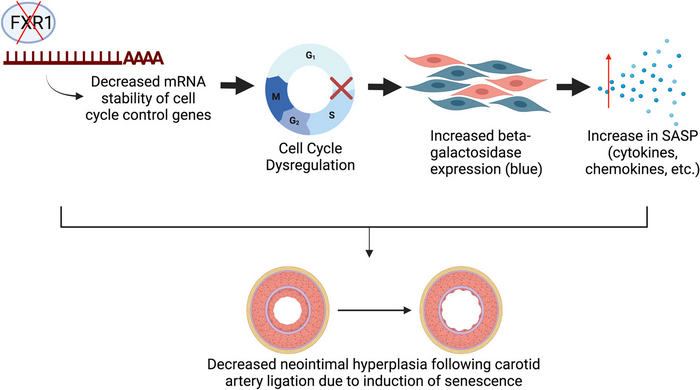
To extend their understanding of the impact of the absence of FXR1, investigators performed RNA-sequencing on FXR1-depleted human VSMCs. Their results suggest that FXR1 appears to stabilize a group of transcripts involved in control of the cell cycle, most of which are associated with proliferation and cell division. In addition, they noted an increase in beta galactosidase and gamma H2AX, molecules indicative of cell senescence.
Next, to understand how the absence of FXR1 would affect vascular occlusive disease, they developed a mouse model to specifically deplete FXR1 in the smooth muscles upon drug induction. The mice were subjected to carotid ligation, which is a model of vascular stenosis. Drug-induced depletion of FXR1 in smooth muscle cells protected the mice against neointima formation following injury. Injured arteries had a gene expression profile similar to human VSMC following FXR1 knockdown.
“These results are the first to suggest that in addition to destabilization of inflammatory transcripts, FXR1 may stabilize cell cycle related genes in VSMC, and absence of FXR1 leads to induction of a senescent phenotype. This supports the hypothesis that FXR1 may mediate vascular disease by regulating stability of proliferative mRNA in VSMC,” commented Dr. Autieri.
The fact that FXR1 stabilized this group of transcripts, while it normally is regarded as an RNA-binding protein that destabilizes transcripts, was surprising to investigators. Additionally, while they expected to see a difference in the knockout mouse phenotype compared to controls, they did not expect such a dramatic result.
“Because we have seen that in the absence of FXR1, VSMC have significantly reduced proliferation and become senescent, drugs that target FXR1 may have implications for modalities to combat vascular proliferative diseases such as atherosclerosis, restenosis, hypertension, and abdominal aortic aneurysm. Given the global increase in cardiovascular diseases in an aging and increasingly sedentary population, it is critical to do everything we can to investigate potential genes and targets that may be exploited to influence disease pathology,” Dr. Autieri concluded.
Journal
American Journal Of Pathology
DOI
10.1016/j.ajpath.2023.01.006
Method of Research
Experimental study
Subject of Research
Animals
Article Title
Genetic Deletion of FXR1 Reduces Intimal Hyperplasia and Induces Senescence in Vascular Smooth Muscle Cells