• HOME
  • NEWS
  • EXPLORE
    • CAREER
      • Companies
      • Jobs
    • EVENTS
    • iGEM
      • News
      • Team
    • PHOTOS
    • VIDEO
    • WIKI
  • BLOG
  • COMMUNITY
    • FACEBOOK
    • INSTAGRAM
    • TWITTER
Monday, October 5, 2026
BIOENGINEER.ORG
No Result
View All Result
  • Login
  • HOME
  • NEWS
  • EXPLORE
    • CAREER
      • Companies
      • Jobs
        • Lecturer
        • PhD Studentship
        • Postdoc
        • Research Assistant
    • EVENTS
    • iGEM
      • News
      • Team
    • PHOTOS
    • VIDEO
    • WIKI
  • BLOG
  • COMMUNITY
    • FACEBOOK
    • INSTAGRAM
    • TWITTER
  • HOME
  • NEWS
  • EXPLORE
    • CAREER
      • Companies
      • Jobs
        • Lecturer
        • PhD Studentship
        • Postdoc
        • Research Assistant
    • EVENTS
    • iGEM
      • News
      • Team
    • PHOTOS
    • VIDEO
    • WIKI
  • BLOG
  • COMMUNITY
    • FACEBOOK
    • INSTAGRAM
    • TWITTER
No Result
View All Result
Bioengineer.org
No Result
View All Result
Home NEWS Science News Chemistry

Review article on asymmetric synthesis using arynes

Bioengineer by Bioengineer
April 28, 2023
in Chemistry
Reading Time: 2 mins read
0
Example of asymmetric synthesis using arynes
Share on FacebookShare on TwitterShare on LinkedinShare on RedditShare on Telegram

Arynes, synthetic intermediates in which a portion of the benzene ring is a triple bond, have been applied in various organic molecular transformations and have long been of interest to chemists as extremely useful compounds. Furthermore, with the advancement in aryne chemistry, the development of “asymmetric synthesis” reactions of arynes, which are expected to increase the efficiency of the synthesis of compounds with complex steric structures and facilitate the creation of new compounds, has attracted increasing attention.
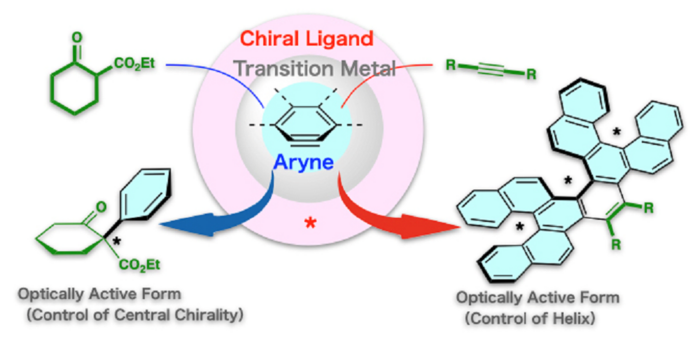
Example of asymmetric synthesis using arynes

Credit: Ken Kamikawa, OMU

Arynes, synthetic intermediates in which a portion of the benzene ring is a triple bond, have been applied in various organic molecular transformations and have long been of interest to chemists as extremely useful compounds. Furthermore, with the advancement in aryne chemistry, the development of “asymmetric synthesis” reactions of arynes, which are expected to increase the efficiency of the synthesis of compounds with complex steric structures and facilitate the creation of new compounds, has attracted increasing attention.

However, asymmetric synthesis based on arynes, which are extremely reactive and unstable, presents several challenges. Therefore, asymmetric reactions that can realize high stereoselectivity of arynes need to be developed.

Ken Kamikawa, Professor at the Graduate School of Science, Osaka Metropolitan University, published a review article on numerous asymmetric reactions based on arynes, organized by style, and detailed their outline and characteristics. Unresolved issues and prospects in this field are also described.

 “Asymmetric synthesis using arynes is an unexplored field with many possibilities,” stated Professor Kamikawa. “In the future, many researchers will enter this field, and their expertise and creativity will greatly expand the potential of asymmetric synthesis for developing pharmaceuticals and materials.”

###

About OMU 

Osaka Metropolitan University is a new public university established by a merger between Osaka City University and Osaka Prefecture University in April 2022. For more science news, see https://www.omu.ac.jp/en/, and follow @OsakaMetUniv_en, or search #OMUScience. 


Journal

Nature Reviews Chemistry

DOI

10.1016/j.eti.2023.103093

Method of Research

Experimental study

Subject of Research

Not applicable

Article Title

Asymmetric reactions involving aryne intermediates

Article Publication Date

31-Mar-2023

Share12Tweet8Share2ShareShareShare2

Related Posts

Linseed Oil and Cardanol Yield Isocyanate-Free Polyurethane Coatings

Linseed Oil and Cardanol Yield Isocyanate-Free Polyurethane Coatings

October 5, 2026
One-Pot Tetrazole Chemistry Yields New Antibacterial Candidates Against MRSA

One-Pot Tetrazole Chemistry Yields New Antibacterial Candidates Against MRSA

October 5, 2026

Non-Alcoholic Beer Can Hide as Much Purine as Regular Beer, Study Finds

October 5, 2026

Sugarcane Waste Gets a Second Life: Silane-Treated Fibers Supercharge Tough Polymer Networks

October 5, 2026

POPULAR NEWS

  • Alloys That Shrink Their Own Grains: New PIX Mechanism Refines Metals With Heat Alone

    Alloys That Shrink Their Own Grains: New PIX Mechanism Refines Metals With Heat Alone

    29 shares
    Share 12 Tweet 7
  • Endurance Exercise Reshapes the Liver in Males and Females Through Distinct Molecular Routes

    29 shares
    Share 12 Tweet 7
  • Single Transcription Factor PU.1 Rapidly Converts Fibroblasts into Macrophage-Lineage Cells

    29 shares
    Share 12 Tweet 7
  • New Scale Measures How Ready Nurse Educators Really Are for the AI Era

    29 shares
    Share 12 Tweet 7

About

We bring you the latest biotechnology news from best research centers and universities around the world. Check our website.

Follow us

Recent News

Alloys That Shrink Their Own Grains: New PIX Mechanism Refines Metals With Heat Alone

Endurance Exercise Reshapes the Liver in Males and Females Through Distinct Molecular Routes

Single Transcription Factor PU.1 Rapidly Converts Fibroblasts into Macrophage-Lineage Cells

Subscribe to Blog via Email

Success! An email was just sent to confirm your subscription. Please find the email now and click 'Confirm' to start subscribing.

Join 85 other subscribers
  • Contact Us

Bioengineer.org © Copyright 2023 All Rights Reserved.

Welcome Back!

Login to your account below

Forgotten Password?

Retrieve your password

Please enter your username or email address to reset your password.

Log In
No Result
View All Result
  • Homepages
    • Home Page 1
    • Home Page 2
  • News
  • National
  • Business
  • Health
  • Lifestyle
  • Science

Bioengineer.org © Copyright 2023 All Rights Reserved.