• HOME
  • NEWS
  • EXPLORE
    • CAREER
      • Companies
      • Jobs
    • EVENTS
    • iGEM
      • News
      • Team
    • PHOTOS
    • VIDEO
    • WIKI
  • BLOG
  • COMMUNITY
    • FACEBOOK
    • INSTAGRAM
    • TWITTER
Saturday, February 7, 2026
BIOENGINEER.ORG
No Result
View All Result
  • Login
  • HOME
  • NEWS
  • EXPLORE
    • CAREER
      • Companies
      • Jobs
        • Lecturer
        • PhD Studentship
        • Postdoc
        • Research Assistant
    • EVENTS
    • iGEM
      • News
      • Team
    • PHOTOS
    • VIDEO
    • WIKI
  • BLOG
  • COMMUNITY
    • FACEBOOK
    • INSTAGRAM
    • TWITTER
  • HOME
  • NEWS
  • EXPLORE
    • CAREER
      • Companies
      • Jobs
        • Lecturer
        • PhD Studentship
        • Postdoc
        • Research Assistant
    • EVENTS
    • iGEM
      • News
      • Team
    • PHOTOS
    • VIDEO
    • WIKI
  • BLOG
  • COMMUNITY
    • FACEBOOK
    • INSTAGRAM
    • TWITTER
No Result
View All Result
Bioengineer.org
No Result
View All Result
Home NEWS Science News Chemistry

New programmable smart fabric responds to temperature and electricity

Bioengineer by Bioengineer
April 24, 2023
in Chemistry
Reading Time: 2 mins read
0
New programmable smart fabric
Share on FacebookShare on TwitterShare on LinkedinShare on RedditShare on Telegram

A new smart material developed by researchers at the University of Waterloo is activated by both heat and electricity, making it the first ever to respond to two different stimuli.
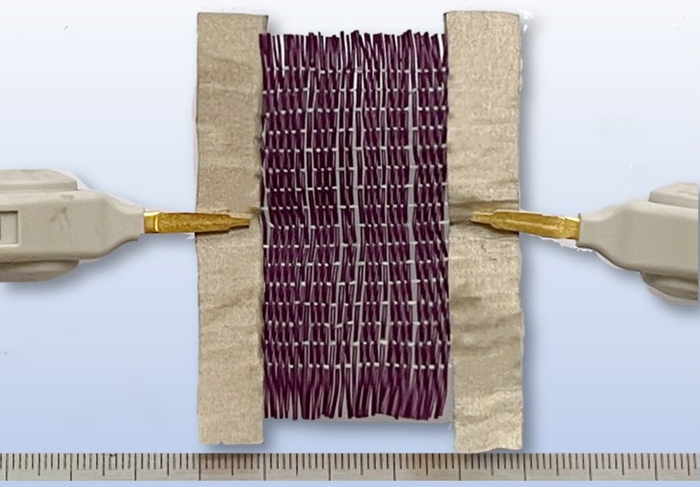
New programmable smart fabric

Credit: University of Waterloo

A new smart material developed by researchers at the University of Waterloo is activated by both heat and electricity, making it the first ever to respond to two different stimuli.

The unique design paves the way for a wide variety of potential applications, including clothing that warms up while you walk from the car to the office in winter and vehicle bumpers that return to their original shape after a collision.

Inexpensively made with polymer nano-composite fibres from recycled plastic, the programmable fabric can change its colour and shape when stimuli are applied.

“As a wearable material alone, it has almost infinite potential in AI, robotics and virtual reality games and experiences,” said Dr. Milad Kamkar, a chemical engineering professor at Waterloo. “Imagine feeling warmth or a physical trigger eliciting a more in-depth adventure in the virtual world.”

The novel fabric design is a product of the happy union of soft and hard materials, featuring a combination of highly engineered polymer composites and stainless steel in a woven structure. 

Researchers created a device similar to a traditional loom to weave the smart fabric. The resulting process is extremely versatile, enabling design freedom and macro-scale control of the fabric’s properties.

The fabric can also be activated by a lower voltage of electricity than previous systems, making it more energy-efficient and cost-effective. In addition, lower voltage allows integration into smaller, more portable devices, making it suitable for use in biomedical devices and environment sensors.

“The idea of these intelligent materials was first bred and born from biomimicry science,” said Kamkar, director of the Multi-scale Materials Design (MMD) Centre at Waterloo.

“Through the ability to sense and react to environmental stimuli such as temperature, this is proof of concept that our new material can interact with the environment to monitor ecosystems without damaging them.”

The next step for researchers is to improve the fabric’s shape-memory performance for applications in the field of robotics. The aim is to construct a robot that can effectively carry and transfer weight to complete tasks.

A paper on the research, Multi-Stimuli Dually-Responsive Intelligent Woven Structures with Local Programmability for Biomimetic Applications, appears in the journal Nano-Micro Small.


DOI

10.1002/smll.202207900

Share12Tweet8Share2ShareShareShare2

Related Posts

blank

Breakthrough in Environmental Cleanup: Scientists Develop Solar-Activated Biochar for Faster Remediation

February 7, 2026
blank

Cutting Costs: Making Hydrogen Fuel Cells More Affordable

February 6, 2026

Scientists Develop Hand-Held “Levitating” Time Crystals

February 6, 2026

Observing a Key Green-Energy Catalyst Dissolve Atom by Atom

February 6, 2026

POPULAR NEWS

  • Robotic Ureteral Reconstruction: A Novel Approach

    Robotic Ureteral Reconstruction: A Novel Approach

    82 shares
    Share 33 Tweet 21
  • Digital Privacy: Health Data Control in Incarceration

    63 shares
    Share 25 Tweet 16
  • Study Reveals Lipid Accumulation in ME/CFS Cells

    57 shares
    Share 23 Tweet 14
  • Breakthrough in RNA Research Accelerates Medical Innovations Timeline

    53 shares
    Share 21 Tweet 13

About

We bring you the latest biotechnology news from best research centers and universities around the world. Check our website.

Follow us

Recent News

TPMT Expression Predictions Linked to Azathioprine Side Effects

Improving Dementia Care with Enhanced Activity Kits

Decoding Prostate Cancer Origins via snFLARE-seq, mxFRIZNGRND

Subscribe to Blog via Email

Enter your email address to subscribe to this blog and receive notifications of new posts by email.

Join 73 other subscribers
  • Contact Us

Bioengineer.org © Copyright 2023 All Rights Reserved.

Welcome Back!

Login to your account below

Forgotten Password?

Retrieve your password

Please enter your username or email address to reset your password.

Log In
No Result
View All Result
  • Homepages
    • Home Page 1
    • Home Page 2
  • News
  • National
  • Business
  • Health
  • Lifestyle
  • Science

Bioengineer.org © Copyright 2023 All Rights Reserved.