This study is led by Dr. Wenxia Liu (State Key Laboratory of Biobased Materials and Green Papermaking, Qilu University of Technology, Shandong Academy of Science). To uniformly disperse LM into hydrogel, she conceived and designed using CCNFs rich in quaternary ammonium groups to encapsulate LM droplets through an approach of Pickering emulsion. “The strong electrostatic attraction and ion-dipole interaction between the quaternary ammonium groups of CCNFs and the hydroxyl groups on LM droplet surfaces were expected to prevent the LM droplets from aggregation and coalescence. The incorporation of CCNFs into hydrogel with the LM droplets was also expected to improve the mechanical properties of hydrogel by forming a reversible hard polymer network. “Using CCNFs to prevent LM droplets from coalescence is a strategy of more with less” Liu says.
Credit: ©Science China Press
This study is led by Dr. Wenxia Liu (State Key Laboratory of Biobased Materials and Green Papermaking, Qilu University of Technology, Shandong Academy of Science). To uniformly disperse LM into hydrogel, she conceived and designed using CCNFs rich in quaternary ammonium groups to encapsulate LM droplets through an approach of Pickering emulsion. “The strong electrostatic attraction and ion-dipole interaction between the quaternary ammonium groups of CCNFs and the hydroxyl groups on LM droplet surfaces were expected to prevent the LM droplets from aggregation and coalescence. The incorporation of CCNFs into hydrogel with the LM droplets was also expected to improve the mechanical properties of hydrogel by forming a reversible hard polymer network. “Using CCNFs to prevent LM droplets from coalescence is a strategy of more with less” Liu says.
Master degree candidate Mr. Shihao Wu further designed the polymer matrix for the conductive hydrogel. “By inducing acrylic acid (AA) polymerization and crosslinking of poly(acrylic acid) (PAA) in the presence of a CCNF-stabilized LM emulsion, a conductive hydrogel was expected to be prepared with the formation of reversible hydrogen bonds, ionic coordination, electrostatic attraction and ion-dipole interaction among CCNFs, LM droplets, and PAA” Wu says.
Wu and another master degree candidate Miss Bingyan Wang performed the experiments in Liu’s Laboratory of Qilu University of Technology. The team collected and figured the related data. Liu and Wu analyzed the morphology and properties of the as-prepared LM emulsion and hydrogel.
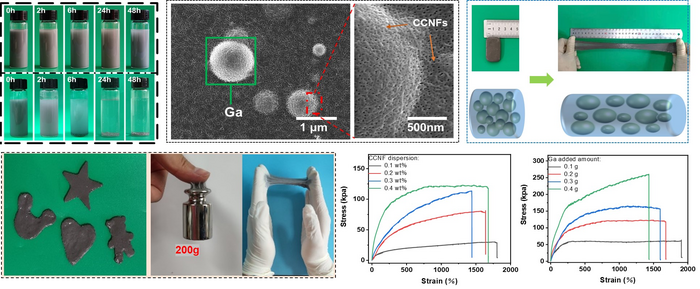
The team found that bulk Ga could be broken into droplets in the presence of CCNFs under sonification. The formed Ga droplets possess a regular spherical shape with CCNFs covering their surfaces, where the CCNFs form mechanical barriers to prevent the Ga droplets from coalesce and aggregation, confirming the excellent stabilization effect of CCNFs on Ga droplets. In the presence of CCNF-encapsulated Ga droplets, a hydrogel could be formed at room temperature owing to the in situ polymerization of AA and ionic crosslinking of PAA promoted by Ga droplets and Ga3+ formed by reaction of Ga with AA, respectively. The ionically crosslinked PAA contributes a soft network while the reversibly crosslinked CCNFs by hydrogen, electrostatic attraction and ion-dipole interaction contribute a hard polymeric network for the hydrogel. The occurrence of double network and Ga/Ga3+ as well as the reversible crosslinking enables the hydrogel to possess good conductivity, excellent stretchability and tensile strength, good adhesiveness, quick self-healing capacity (see below).
The researchers also explored the sensing performance and application of the hydrogels as a strain sensing material. They found that the hydrogel exhibited a very high sensing sensitivity (GF = 16.2), a low strain detection limit (less than 1%), a short response/recovery time (107/91 ms), and good repeatability and durability. When directly attached to human body via its adhesiveness, the hydrogel-based strain sensor could repeatedly monitor various human activities (see below). “The excellent sensing performance, self-adhesiveness and self-healing capacity enable the hydrogel-based strain sensor to be a good candidate for wearable electronics.” Wu and Liu say.
The good stability of LM emulsion and the compatibility of LM droplets with polymeric matrix are critical for uniformly dispersing LM droplets in hydrogel and fabrication of conductive hydrogels with high sensing preformation. The CCNFs provide good mechanical barriers for Ga droplets and improve the compatibility of Ga with PAA, enabling Ga droplets uniformly dispersing in PAA hydrogel. The combination of Ga, CCNFs and PAA allows the hydrogel to possess multifunctional properties and high sensing performance.
See the article:
Highly sensitive and self-healing conductive hydrogels fabricated from cationic cellulose nanofiber-dispersed liquid metal for strain sensors
https://doi.org/10.1007/s40843-022-2328-8
Journal
Science China Materials
DOI
10.1007/s40843-022-2328-8